

 Hajra Naz
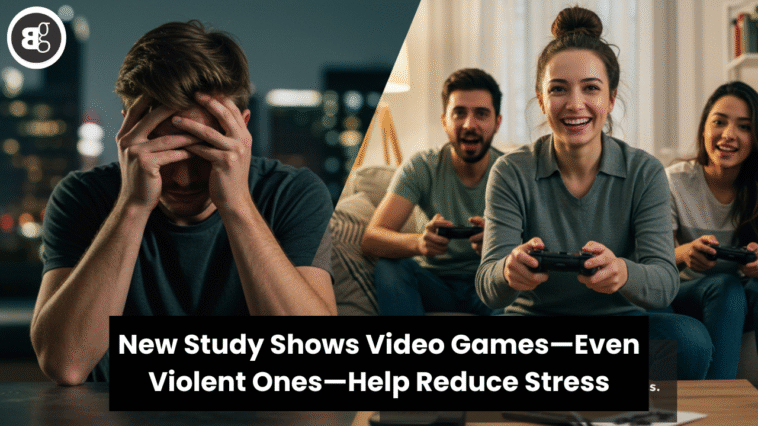
Can playing a dark or violent video game calm your body? According to new research, yes.
A study published in the International Journal of Psychophysiology reveals that video games—even intense or violent ones—can reduce physical signs of stress. That includes lowered heart rate and decreased cortisol levels, even if players felt more tense while playing.

The Disconnect Between Mind and Body
Researchers noticed something unexpected. Players said they felt stressed during violent scenes. But their heart rate and cortisol levels dropped. Their bodies were calming down. Players who saw non-violent scenes felt calm. Their physical stress levels also went down.
The Experiment: A Plague Tale and a Stress Test
To explore this effect, researchers led by Gary L. Wagener had 82 adults, ages 18 to 40, take part in a lab experiment. First, participants were put through the Socially Evaluated Cold Pressor Test (SECPT)—a common stress test where people immerse their hand in freezing water while being watched and recorded. It reliably triggers both mental and physical stress.
After that, each participant played A Plague Tale: Requiem, a haunting, emotional game set in medieval France. One group played violent action scenes, and the other played quiet, narrative-driven scenes. Each session lasted around 25 minutes.
While they played, researchers monitored physical stress signals like heart rate using ECGs, and checked cortisol levels using saliva samples. Players also filled out surveys to share how they felt before and after the game.
After the stress test, each participant played A Plague Tale: Requiem. The game is emotional and set in medieval France. One group played violent scenes. The other group played calm, story-focused scenes.
Each person played for about 25 minutes. Researchers tracked heart rate using ECGs. They also checked cortisol levels through saliva samples. Before and after the game, players filled out surveys about how they felt.
Read More: 5 scientifically proven stress-reducing techniques
The Results: Violent or Not, Stress Went Down
The results surprised even the researchers. Both groups showed a physical drop in stress, even if the violent-game players didn’t feel more relaxed. It suggests that games—regardless of content—may help our bodies recover from stress.
“This mismatch shows people aren’t always aware of how their bodies are responding,” the researchers noted. “Even though players said the violent scenes were stressful, their bodies began to calm down.”
Why It Matters: Changing the Conversation Around Gaming
Over 3 billion people play video games worldwide. Most already see gaming as a way to unwind. Now, there’s biological proof that games might help us recover from stress.
This study challenges the idea that all violent games are harmful. It doesn’t recommend using them as therapy, but it does show they’re not as damaging as often believed, at least in the short term.
The level of challenge also plays a role. Violent scenes were seen as harder, which may have raised mental effort. But the game gave players control, agency, and immersion—all known to help reduce physical stress.
Not a Free Pass: What to Watch Out For
The study offers a positive look at gaming, but it’s not a green light for endless screen time. Long gaming sessions, lack of sleep, social isolation, or toxic online spaces still pose risks for anxiety and burnout.
Also, the study used just one game. These findings might not apply to all types of games, especially fast-paced, competitive ones like Fortnite or Call of Duty, which could raise adrenaline instead of lowering it.
Read More: How to Handle the Digital Stress and Distractions
What This Could Mean Going Forward
As mental health tools grow in popularity, video games may play a role in future stress relief methods. Game developers might even start designing titles specifically meant to help people relax and recover emotionally.
Imagine story-rich games that lower heart rate and promote focus, or mobile games made for people experiencing high anxiety. It’s a real possibility if research keeps heading in this direction.
The Bottom Line
Even if a game feels intense, your body might be in recovery mode. That’s big news in the conversation about
- Video games
- Mental health
- Digital wellness.
Games aren’t just distractions—they could be tools to help us manage stress in a fast-paced world.


