

 Hajra Naz
TikTok, in other words, has become one of the world’s primary news sources for young people around the globe around the world who have access to mobile devices, including at least 65 million Americans; roughly two-thirds are under 30 years old.
With Americans aged 18 to 29 now far less likely than other adults to get news through traditional platforms and more likely instead to opt for a social platform, it’s no wonder these new numbers have emerged from the Pew Research Center: the short-form video app has become the most popular destination for news among this segment of the population, surpassing long-dominant leaders like YouTube and Instagram.

It’s part of a larger change in the way young news consumers find and interact with current events, and it cements TikTok’s evolution from entertainment app to central destination for news, commentary, and real-time reporting.
TikTok Surpasses YouTube and Instagram in Pew’s Latest Survey
According to a 2025 Pew survey, 43 percent of adults between the ages of 18 and 29 report that they receive news from TikTok often. That’s just a hair ahead of YouTube and Facebook, which landed at 41%, as well as Instagram at 40%.
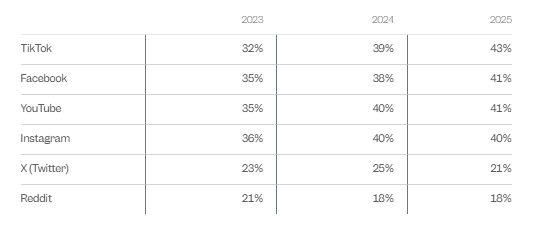
Other platforms trail further behind. Roughly 21 percent said they regularly get news from X (once known as Twitter), and 18 percent turned to Reddit for the news.
The year before, the leading platforms were YouTube and Instagram. The jump on TikTok highlights how quickly viewing habits are shifting for young Americans.
Read More: Pew Study Reveals How Teens Use Social Media and AI Chatbots
Young Adults Get Their News From Social Media
The poll also underscores a larger trend: social media has solidified its place as the most common way that young people come across news, surpassing almost every other way.
And 76 percent of those aged 18 to 29 said they get news often or sometimes from social platforms. By contrast, 60 percent said they turned to news websites; just 28 percent said they depend on email newsletters.
In short, scrolling feeds now matter more than home pages or inboxes to staying informed.
Trust in Social Media News Is Rising—Cautiously
Trust and Reliability. Trust in social media as a news source remains relatively high, despite persistent concerns about misinformation. About half of the young adults who were polled told the researchers that they trust “some” or “a lot” of the news they see on those platforms.
That degree of confidence is just about in line with how much trust the same age group invests in national news organizations, and it means that social media is no longer presumed to be a less credible alternative, especially when content comes from familiar creators.
TikTok’s Fast Rise as a News Source
TikTok’s rise has been swift. Only 32 percent of young adults, in 2023, reported regularly getting news from the app. That figure has increased by more than 10 percentage points in just two years.
But watching news on TikTok doesn’t necessarily mean tuning into videos from established outlets like NBC News or The Washington Post. For many users, “news” consists of commentary from independent creators and firsthand videos from protests or war zones as much as it does explainers tied to trending events.
News Influencers and Creator-Led Reporting Take Center Stage
A new generation of independent news creators has emerged to fill this space. Influencers like Philip DeFranco and Vitus “V” Spehar of @underthedesknews have built large followings by breaking down complex issues in a conversational, accessible way.
Some established media organizations are adapting, too. NPR’s “Planet Money,” for example, has leaned into creator-led storytelling, centering individual voices to build trust and relatability with Gen Z audiences.
Young social media users have consistently told outlets like Business Insider that they prefer news delivered by creators who feel authentic, transparent, and human rather than distant or overly polished.
Creators Are Becoming Part of the Political Press Ecosystem
Beyond commentary, social media creators and podcasters are increasingly involved in news gathering itself. Politicians and government institutions are now turning to podcasts, YouTube shows, and TikTok creators to reach younger voters.
Creators had a visible presence at both Democratic and Republican national conventions last year, and in 2025, many independent journalists and influencers applied for access to White House press briefings, a sign that the boundaries of traditional political media are continuing to blur.
Read More: Social Media Trends That Took Over the Internet in 2025
TikTok’s Efforts to Support News and Fact-Checking
TikTok has introduced tools to support publishers and elevate the quality of information as its impact on news expands.
These can be things like tools that let publishers link directly to full articles from inside a video, as well as a community-powered fact-checking system known as “footnotes”—something akin to Community Notes on X.
TikTok also says it collaborates with independent fact-checkers in over 130 markets around the world to evaluate content veracity as part of its wider efforts to combat misinformation on the platform.
A New Era of News Consumption
Collectively, the Pew data and TikTok’s expanding place in journalism point to an unmistakable reality: As far as young Americans are concerned, news no longer comes from newspapers, TV broadcasts, or even traditional websites. It’s happening in feeds, through creators, in short videos, and more often now on TikTok first.


