Hajra Naz
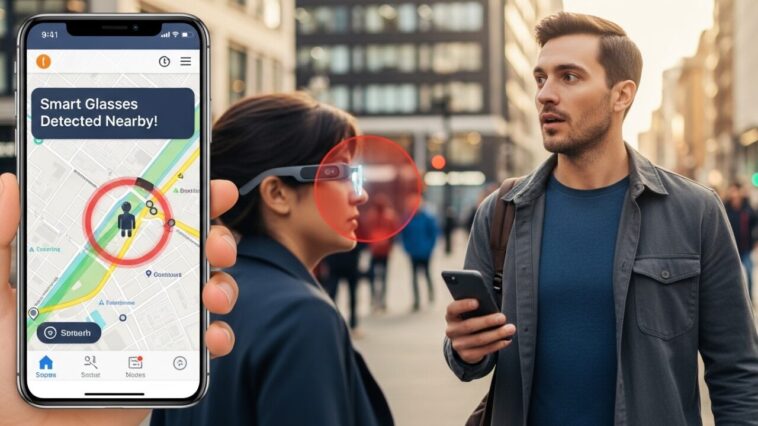
One of the most frequently cited problems with so-called “luxury surveillance” devices—particularly smart glasses with integrated cameras—is just how normal they look. Compared to conventional body cams or handheld phones, these devices can appear identical to everyday eyewear. That means you might be recorded without your knowledge.
Now, a new Android app hopes to change that.

Named Nearby Glasses, the app scans for Bluetooth signals from nearby wearable devices and notifies users when it detects smart glasses or other always-on recording technologies. It primarily targets hardware from major manufacturers like Meta (including Ray-Ban Meta smart glasses and Oakley models) and Snap Inc., both of which produce connected eyewear.
Rising pushback against “always-on” tech
The app launches at a time of growing backlash against devices that continuously record audio or video. Privacy advocates argue that these tools capture information about bystanders who never gave consent. As wearable cameras become more discreet and socially normalized, critics warn that the gap between convenience and consent is widening.
Developer Yves Jeanrenaud said he was partly inspired by investigative reporting into wearable surveillance, including coverage of how Ray-Ban Meta smart glasses have allegedly been used in immigration raids and to film or harass sex workers. On the project page, he describes smart glasses as an “intolerable intrusion” that disregards consent.
In an email interview, Jeanrenaud said his concerns intensified after Meta enabled facial recognition–related capabilities in its smart glasses ecosystem, calling it a “floodgate for privacy-invasive behavior.” His broader worry centers on the normalization of discreet recording devices operating quietly in public spaces.
Read More: Apple Watch’s Future: Cameras & AI Upgrades Could Redefine Wearable Tech
How the app works
Nearby Glasses monitors for Bluetooth signals that contain publicly assigned manufacturer identifiers—unique codes that reveal which company made the device. If it detects identifiers linked to Meta or Snap, the app immediately sends an alert.
Importantly, users can manually add additional Bluetooth identifiers, allowing detection of a wider range of wearable surveillance technology. This creates a more customizable privacy shield.
However, the system is not flawless. Jeanrenaud acknowledges the possibility of false positives. For instance, the app could flag a Meta virtual reality headset instead of smart glasses since both share the same manufacturer code. That said, VR headsets are typically more visible and less likely to be confused with discreet eyewear.

Read More: Meta Lost $19B on VR Last Year, and It’s Getting Worse
Real-world testing
In informal neighborhood testing, the app did not detect any nearby smart glasses users. But when a broader Bluetooth identifier (0x004C) associated with Apple Inc. devices was added, the phone was quickly flooded with alerts—likely picking up nearby iPhones, AirPods, and other Apple hardware.
The experiment demonstrated the app’s core capability: accurately identifying devices based on Bluetooth manufacturer codes. The main challenge lies in refining detection to reduce unnecessary alerts.
Read More: Apple Is Working on Three New AI-Powered Wearables
What’s next?
Jeanrenaud says he is continuing to refine the app and develop new features. There is a growing demand for an iOS version, though development depends on time and platform limitations.
Still, he sees the project as more than a technical experiment. “It’s a technical solution to a social problem,” he said, acknowledging that wearable surveillance is unlikely to disappear soon. He describes Nearby Glasses as a “desperate act of resistance,” aimed at restoring at least some awareness and agency in increasingly sensor-filled public spaces.
Representatives for Meta and Snap did not respond to requests for comment about the app or the broader privacy concerns it raises.