Hajra Naz
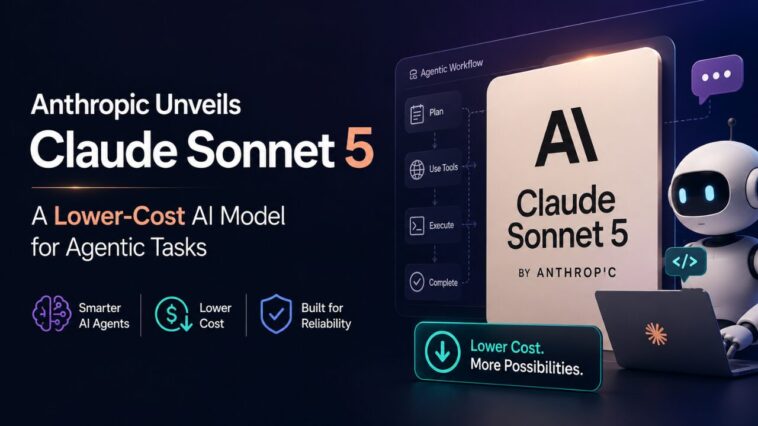
The race to build capable AI agents is heating up, and Anthropic is making its next move with the launch of Claude Sonnet 5, an upgraded version of its mid-tier AI model. The company says the new release brings much stronger autonomous capabilities while remaining significantly more affordable than its flagship models.
According to Anthropic, Claude Sonnet 5 is designed to independently plan tasks, use external tools such as web browsers and terminals, and complete complex workflows with minimal human guidance. The company says these abilities previously required much larger and more expensive AI models.

In a blog post announcing the launch, Anthropic explained that Sonnet 5 can “make plans, use tools like browsers and terminals, and run autonomously” at a level that only top-tier models could achieve just a few months ago.
The announcement reflects a growing trend across the AI industry. Leading model developers are no longer treating agentic AI as a premium feature. Instead, autonomous task execution is quickly becoming a standard capability across different model sizes and pricing tiers.
OpenAI recently introduced GPT-5.6 Sol in preview, highlighting its ability to divide complex work among multiple AI subagents for longer-running tasks. Earlier this year, Google launched Gemini 3.5 Flash with a similar focus, positioning it as an AI system capable of planning projects, building solutions, and refining work with very little user intervention.
With Claude Sonnet 5, Anthropic is reinforcing the idea that the competition is shifting. Rather than simply offering agentic features, AI companies are now competing on how efficiently and affordably those capabilities can be delivered while maintaining reliable performance without constant human oversight.
Read More: Anthropic Says Claude Could Soon Ask Users for ID Verification
Near-Flagship Performance at a Lower Price
Anthropic says Claude Sonnet 5 delivers performance approaching that of its flagship Opus 4.8 model while costing considerably less.
Beginning Tuesday, Sonnet 5 becomes the default model for both free and pro Claude users. It is also available across all subscription tiers.
For a limited launch period through August 31, the model costs $2 per million input tokens and $10 per million output tokens. After that promotional period ends, pricing will increase to $3 per million input tokens and $15 per million output tokens.
Even after the planned price increase, Anthropic says Sonnet 5 remains less expensive than Opus 4.8, OpenAI’s GPT-5.5, and Google’s Gemini 3.1 Pro. However, it still costs more than Google’s Gemini 3.5 Flash.
Better Coding, Reasoning, and Knowledge Work
Anthropic also reports notable improvements over Claude Sonnet 4.6, which debuted in February.
The company says Sonnet 5 performs better across several important areas, including logical reasoning, software development, tool usage, and knowledge-intensive tasks.
On Anthropic’s agentic coding benchmark, Claude Sonnet 5 achieved a score of 63.2%. That compares with 58.1% for Sonnet 4.6, while Opus 4.8 remains ahead at 69.2%.
Interestingly, Anthropic says Sonnet 5 slightly surpasses Opus 4.8 on one benchmark measuring knowledge work. Opus has generally been regarded as the stronger model for solving highly complex problems, making nuanced judgments, and conducting deep research.
Despite that improvement, Anthropic says Opus 4.8 remains the preferred option for developers who require the highest possible accuracy.
The company noted that Sonnet 5 gives developers a far more affordable alternative while still delivering quality that was previously available only through premium models. Users can choose between Sonnet 5 and Opus 4.8, depending on whether they want to prioritize lower costs or maximum performance.
Read More: Anthropic Suspends Access to New AI Models After US Security Concerns
Improved Task Completion and Self-Checking
Anthropic says internal testing shows Claude Sonnet 5 is much better at completing lengthy, multi-step tasks than earlier Sonnet versions.
According to the company, the model can successfully finish workflows that previously stalled before completion. It also reviews its own responses during execution, even when users do not explicitly ask it to verify its work.
Daniel Shepard, Senior Engineer at Zapier, shared one example from early testing.
He said his team assigned Claude Sonnet 5 a two-part workflow involving Salesforce account updates and sending a launch announcement to enterprise customers. Previous versions often stopped midway through the process, but Sonnet 5 completed the entire workflow from start to finish.
Shepard described the upgrade as a significant improvement for everyday automation tasks.
Stronger Safety Protections
Alongside performance upgrades, Anthropic says it has also improved the model’s safety.
According to the company, Claude Sonnet 5 shows fewer undesirable behaviors than Sonnet 4.6. It is less likely to cooperate with harmful requests, engage in deceptive behavior, or fall victim to prompt injection attacks.
Anthropic also says the model refuses malicious requests more effectively while showing lower rates of hallucinations and sycophantic behavior compared with its predecessor.
However, the company notes that Sonnet 5 does not yet match the safety performance of Opus 4.8 or Claude Mythos Preview when it comes to preventing misaligned behavior.
Anthropic added that evaluations indicate Sonnet 5 has a significantly lower ability to carry out dangerous cybersecurity-related tasks than its current Opus models, reducing certain security risks.
Fabian Hedin, co-founder of Lovable, also praised the model’s safety improvements.
According to Hedin, Claude Sonnet 5 consistently refuses unsafe requests while remaining reliable for builders using the platform.
“As we’re putting powerful AI tools into the hands of millions of people,” Hedin said, “it’s just as important for a model to know when to refuse a request as it is to know how to complete one.”