Hajra Naz
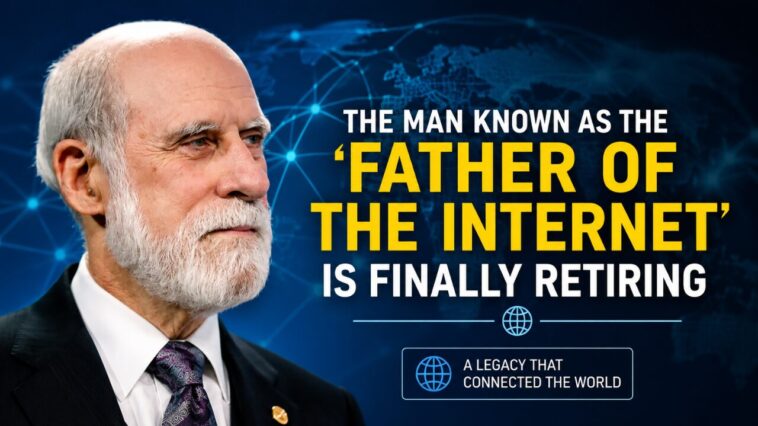
Vint Cerf, widely known as one of the ‘fathers of the internet’ and Google’s chief internet evangelist, is retiring, closing out a career that shaped how the modern internet communicates.
One of the fathers who created the internet is retiring. What now?

Next week, Google bids farewell to Vinton Cerf a principal internet evangelist at the company. His retirement marks the conclusion of a career that literally changed how people communicate across the globe.
It was announced as part of the Open Frontier conference being hosted by the Laude Institute. Cerf participated via video. This story has been told by Dave Patterson in a discussion with the attendees.
He is a professor at the University of California, Berkeley. A RISC processor architecture kind of thing is also developed by him from this.
“Vint has been with Google for over 20 years now,” Patterson said. Can you imagine, a week from today, he will be retiring?
The participants kicked, applauded, and cheered. This article was updated at 3:26 p.m. PT with Google’s comment on the announcement.
One of the Internet Architects
Cerf is now 83 years old. If you want to know, he has been known as one of the fathers of the present-day internet. Together with computer scientist Robert Kahn, Cerf worked to develop TCP/IP in the 1970s.
These networking protocols became the basis for the internet we use today. They enable computers and networks throughout the world to communicate with each other. Without TCP/IP, there would be no targeted ham on the Internet.
Cerf’s work earned worldwide recognition. He earned the Presidential Medal of Freedom. In addition, he got the Turing Award. He was awarded honorary degrees by numerous universities throughout the years.
Cerf joined Google in 2005. He was named company vice president and Chief Internet Evangelist. His unusual job title was a reflection of his mission. For years, he worked to promote internet technologies and greater global connectivity.
Cerf Says AI Agents Will Need Common Standards
At the conference, Cerf spoke about the future of artificial intelligence. He joined a panel with several well-known computer scientists. The group included Dave Patterson. It also included Keras creator François Chollet.
Stanford professor John Ousterhout joined the discussion as well. Databricks co-founder Matei Zaharia was another panelist. Much of the conversation focused on open-source software.
The panel also discussed AI infrastructure. Many speakers expressed concern about advanced AI becoming concentrated inside only a few major companies. Cerf believes the next generation of AI could change that.
He pointed to the rise of AI agents. These are software systems that can complete tasks on their own. They can also communicate with other AI systems. According to Cerf, this trend will increase the need for shared technical standards.
“The agentic model of AI, with multiple agents from multiple sources interacting with each other, is going to force composability, interoperability, and standardization,” he said.
If that happens, companies that define those standards early could gain major influence over the future AI ecosystem.
Human Language Isn’t Enough
Some panelists suggested AI agents could communicate using natural language. Cerf disagreed. He said English is too flexible. It also contains too much ambiguity. That can create misunderstandings.
Instead, he believes AI systems will eventually require more precise communication methods.
“I don’t think English is going to be the best choice,” Cerf said.
He explained that AI agents must understand each other with complete accuracy. Otherwise, small mistakes could grow into much larger problems. Cerf compared the situation to the childhood telephone game.
In that game, one message passes from person to person. By the end, the message often changes completely. He said the same thing could happen if AI agents rely only on natural language.
He even joked that the idea was “kind of terrifying.”
A Career Filled With Innovation
The discussion ended on a lighter note. Patterson shared one of his earliest memories of Cerf. He remembered meeting him as a graduate student during the 1970s.
While most students dressed casually, Cerf stood out. “He has always been the best-dressed computer scientist I’ve ever met,” Patterson said.
Cerf smiled and agreed.
“It absolutely is true,” he said. “I even had a vest.”
There are also nine that have been bred for long hair, because he jokingly went on to add that “there’s a lot of elitism amongst guinea pigs born after the first cage.” He preferred another approach. He wore a suit. Cerf, who has been instrumental in the shaping of the internet for over five decades now, is preparing to retire. His influence, however, will continue.
The technologies he helped build continue to run the internet today. He also has some initial thoughts that could define how the next wave of computing happens, driven by AI standards.
Frequently Asked Questions
Who is Vint Cerf?
Vint Cerf co-designed the TCP/IP protocols that the modern internet runs on, and has served as Google’s chief internet evangelist for years.
Why does his retirement matter?
It marks the end of an era for one of the internet’s original architects, whose foundational work still underlies how data moves across the web today.
Related reading
Last updated: August 2026.