Hajra Naz
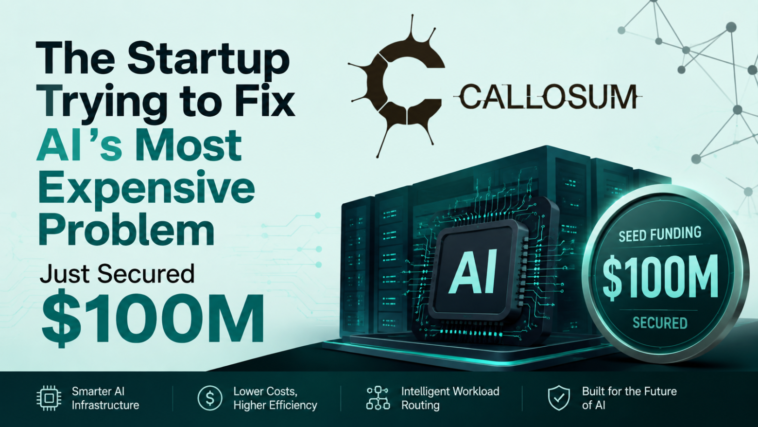
Callosum is a London-based AI infrastructure startup. The company has raised $100 million in seed funding.
Atomico led the funding round. Plural and DCVC also took part. The UK’s £500 million Sovereign AI Fund made a “significant” investment as well.

The round is one of the largest seed financings in Europe. It also gives Callosum a major boost as it works to reduce the cost of running AI systems.
How Callosum’s Technology Works
Callosum was founded in 2025. The company was started by two Cambridge University neuroscientists. Danyal Akarca serves as CEO. Jascha Achterberg is the company’s CTO. The startup is building software for AI infrastructure. Its platform decides which AI models and chips are best for different tasks.
Not every AI request needs the most powerful hardware. A simple task can run on a cheaper model. It can also use less expensive computing hardware. More difficult tasks are different. They may require more advanced models and processors. Callosum wants to automate this process. Its software can route each task to the system that makes the most sense.
This could help companies reduce AI infrastructure costs. The savings could become significant when the system is used at a large scale.

Challenging the AI Hardware Race
Callosum is challenging a common assumption in the AI industry. The assumption is simple. Better AI requires increasingly expensive hardware. Callosum believes that is not always true. Some AI tasks are relatively simple. They do not need the latest or most powerful chips.
Other tasks require much more computing power. Those workloads can be sent to more capable systems. The company wants to coordinate these different systems. Its goal is to make AI infrastructure more efficient. This approach could become increasingly important as AI usage grows. Companies are spending huge amounts on computing power to train and run AI models.
Reducing unnecessary spending could have a major impact.
Why the UK Government Is Investing
The UK government also sees potential in Callosum’s approach. The Sovereign AI Fund was launched in April. It has £500 million available for investments in British AI companies. The fund aims to support AI-related jobs. It also wants to strengthen the UK’s position in AI infrastructure.
Callosum is the fund’s first disclosed investment. That makes the funding especially significant for the startup. It also shows the UK government’s interest in developing domestic AI capabilities. Government support could help British AI companies compete in a market dominated by major global technology firms.
A Neuroscience Idea at the Core
Callosum’s name comes from neuroscience. The corpus callosum is a bundle of nerve fibres in the brain. It connects the brain’s two hemispheres. That idea is central to the company’s philosophy. The founders believe intelligence does not always need to come from one massive system. Different specialized systems can work together.
The company applies that idea to AI infrastructure. Instead of relying on one large model or one type of chip, Callosum wants different systems to cooperate. Each system can handle the work it is best suited for. The founders believe this distributed approach could outperform a system that simply keeps getting larger.
Where the $100 Million Will Go
The new funding gives Callosum significant resources to expand. The company plans to invest in its foundational systems software. It also wants to grow its engineering team. International expansion is another priority.
Callosum also plans to accelerate the development of programmable multi-chip networks. These systems could allow different types of processors to work together more efficiently. That could give companies more flexibility when building AI infrastructure.
Instead of depending on one hardware provider, they could potentially use several different chip platforms.
Investors See Potential in the Approach
Atomico led the $100 million round. Plural and DCVC also participated. The UK Sovereign AI Fund made a significant contribution. Other investors and angel investors are involved as well. The size of the round is notable. It gives Callosum substantial backing at an early stage. However, some important questions remain.
The company’s performance figures are based on its own benchmarks. They have not been independently audited. That means those figures should be viewed carefully. Another question is the role of government funding. Some may wonder whether government investment is replacing private capital. Or whether it is helping attract more private investors.
In Callosum’s case, the funding mix suggests the latter may be possible. The round was led by a major European venture capital firm. Other well-known investors also participated. The government appears to be one part of a larger investment group. That could indicate that public funding is helping attract additional private money.
Partnerships With Chip Companies
Callosum has also started building relationships across the semiconductor industry. In April, it became the first equity investment made by the UK’s Sovereign AI Unit. The company has also partnered with Cerebras Systems. It has deals with Rebellions Inc. and Axelera AI as well. These partnerships could become important as Callosum develops its platform.
Each chip company has its own hardware architecture. AI companies often have to build systems around specific types of processors. Callosum wants to create an infrastructure layer that can connect different chip vendors. Its optimization platform could help coordinate those systems. That would give customers more choice when selecting hardware. It could also make it easier to use different processors for different AI workloads.
A New Approach to AI Infrastructure
Callosum is entering the AI market at an important time.
AI companies are using more computing power than ever. The cost of that infrastructure is becoming a major concern. Callosum believes better routing can help solve part of the problem. Its software is designed to match each workload with the right model and hardware.
The company is betting that AI does not always need bigger systems. It may simply need smarter infrastructure. The $100 million funding round gives Callosum the resources to test that idea at a much larger scale. Its partnerships with multiple chip companies could also strengthen its position.
For now, the company is focused on building the infrastructure layer needed to make different AI systems work together. If its approach proves effective, it could offer AI companies a cheaper and more flexible way to run their workloads.