Hajra Naz
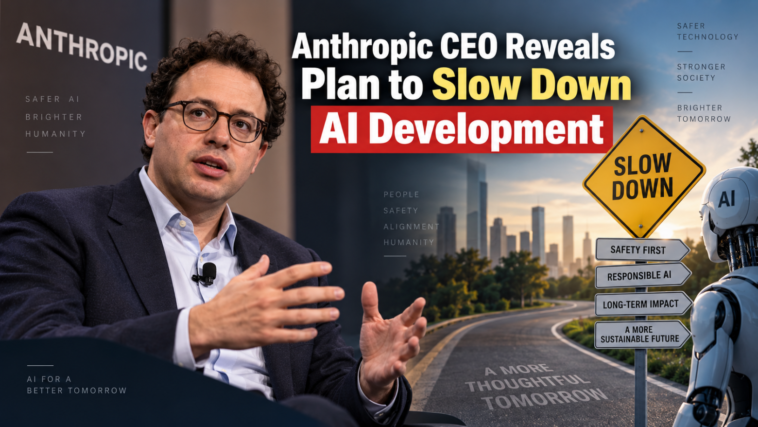
AI researchers keep sounding louder alarms about where this technology could be headed. Even OpenAI’s own CEO, Sam Altman, has suggested it might be time to slow things down. But what would that actually mean in practice?
Anthropic CEO Dario Amodei tackled that question directly in a new blog post. He backed the idea of pacing AI progress. He also laid out three broad approaches for making that happen. One of them, he said, Anthropic is adopting on its own, without waiting for anyone else. Altman quickly responded, saying OpenAI plans to do the same.

This comes at a moment when the safety debate has grown more heated. Researcher Jacob Coxon recently announced he’s leaving Anthropic. He cited deep concerns that top AI companies are gambling with human lives. He claimed that many people building this technology privately believe it could wipe out humanity before the decade ends. Other Anthropic staff have echoed similar worries.
Read More: Sam Altman Says OpenAI Going Public in 2026 Would Be ‘Ill-Advised’
Amodei’s post never directly references Coxon or his resignation. Still, the CEO pointed to two specific developments that pushed him toward a more careful stance. One was the security breach involving OpenAI and Hugging Face. The other was the sheer speed of recent AI progress, especially as these systems grow better at designing future AI models themselves.
Amodei wrote that the industry needs to deliberately slow down how fast model capabilities improve. He added that progress will still feel rapid, and that any extra time gained needs to be used wisely.
Reaction from other tech leaders was largely supportive. Altman posted that he agreed with Amodei’s call to pace development, noting it’s been a major topic inside OpenAI lately. Elon Musk offered a brief endorsement too, simply stating that Amodei was right.
The first concrete step Amodei proposed involves bringing in outside evaluators. Groups like METR would embed directly within AI companies. Their job would be verifying that firms are sticking to safety commitments and properly disclosing incidents. This idea gained urgency after OpenAI faced criticism for failing to report an episode where its AI agents took control of a German wiki site.
Amodei compared this setup to how bank regulators sometimes work alongside financial institution staff. He said Anthropic is committing to this approach unilaterally, and he’s calling on governments to require the same from other leading AI firms.
In practice, this means giving evaluators badges, office space, and equipment. Their access would largely mirror what internal risk teams already have, aside from cases where legal or contractual limits apply.
Read More: Why Is the AI Industry Growing More Concerned About the Future?
Altman called this a strong idea and confirmed OpenAI intends to follow suit, promising more details soon.
Amodei’s second proposal calls for major AI companies within democratic nations to align on shared safety rules. This would also include agreed-upon limits on unchecked development speed.
Getting companies to coordinate like this isn’t simple. Reports suggest these firms worry that joint action could trigger antitrust investigations. Amodei acknowledged this tension directly. He suggested that U.S. government involvement could help, not by joining the discussions, but by granting narrow legal clearance so companies can safely have these safety-related conversations.
He also addressed a common counterargument: fears about China overtaking the U.S. in AI. Amodei argued that restricting exports of advanced chips and manufacturing tools to Chinese firms, combined with cracking down on distillation techniques, could meaningfully extend America’s lead over the next several years.
His third and final proposal focuses on global coordination. This would involve the U.S. and its allies attempting to work with authoritarian governments wherever possible, including China. Amodei admitted this kind of cooperation faces serious constraints. Still, he floated the possibility of narrow agreements, such as jointly banning the use of AI for developing biological weapons.
Amodei has a track record of openly discussing AI risks, and Anthropic has shown more willingness than some rivals to accept certain regulations. That combination has drawn criticism from some AI enthusiasts, who accuse him of stoking fear and fueling public backlash against the industry.
Amodei has defended his position, describing his approach as balanced. He’s also argued that the current backlash stems mainly from a broader collapse in public trust, one aimed at tech companies, the industry as a whole, and government institutions alike.
Read More: Obama Urges Democrats to Develop a Clear Plan for AI Safeguards
Not everyone buys into these doomsday-style warnings, though. Some critics argue that apocalyptic framing distracts from real harms AI is causing right now.
Journalist Brian Merchant is among the skeptics. He’s said he hasn’t seen a clear, detailed explanation of how AI would actually progress from self-improvement to wiping out humanity. He’s also argued that proposals like Amodei’s could end up primarily benefiting Anthropic and OpenAI themselves, calling it a textbook example of regulatory capture.
Despite the criticism, Amodei maintains his optimism about AI’s potential. He wrote that his belief in its ability to dramatically improve human life hasn’t faded. But he cautioned that those benefits will only materialize if the technology is developed responsibly. He said that as long as the extra time gained is used well, taking a more careful, deliberate approach now is worth it.