

 Hassan Khan
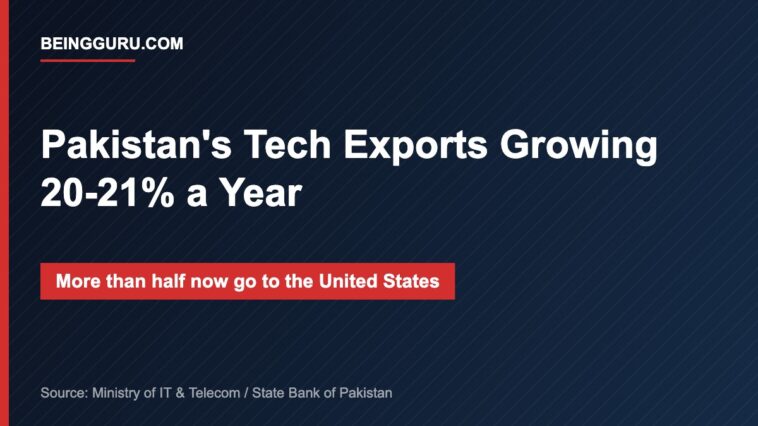
Pakistan’s IT and telecom exports are growing 20 to 21 percent a year, and more than half of the country’s technology exports now go to the United States, Federal Minister for Information Technology and Telecommunication Shaza Fatima Khawaja said in Islamabad on Monday. She was speaking at the ribbon cutting for Innovation Hive, a startup workspace and mentorship programme run by the United States Educational Foundation in Pakistan. In the same remarks she said the second round of the Pakistan Startup Fund will open with a government seed grant of at least $10 million, with the fund itself to be managed by outside professionals rather than by the government.
The numbers behind the 20 percent claim
State Bank of Pakistan data puts IT and telecom export remittances at $4.6 billion in FY2025-26, up from $3.814 billion the year before, growth of about 20.6 percent. That was a record for the sector, and it was also a miss, because the government had set a $5 billion target for the year.

The monthly path was choppy rather than smooth. Remittances reached a record $423 million in April 2026, fell to $373 million in May, then closed the fiscal year at $416 million in June. So the minister’s 20 to 21 percent figure lines up with the official data, and the more useful point is that this rate has held across several years instead of appearing once.
Why the American share matters more than the growth rate
The detail worth sitting with is not the growth number but the destination. If more than half of Pakistan’s technology exports are going to one country, then the sector’s earnings are tied to one economy’s hiring appetite, one country’s visa and procurement rules, and one currency corridor. Growth of 20 percent a year is comfortable while that single market is buying. It is a different exposure when the market cools.
For anyone in Pakistan earning in dollars from software, design, marketing or support work, that concentration is a practical planning question rather than an abstract one. Diversifying client bases toward the Gulf, the UK and Europe is the standard hedge, and it is part of why Pakistan has pushed delegations into regional technology events, including its largest ever delegation to LEAP 2026 in Riyadh.
American companies are putting staff on the ground
Shaza Fatima framed the physical arrival of US technology firms as the clearest evidence of confidence in the market. Google, she said, welcomed a Chromebook assembly line in Pakistan last year and opened a country office this year. Apple has appointed its first head of government affairs for Pakistan, based in the country. The US accelerator Plug and Play has also entered the local startup ecosystem.
“Physical presence of all these big tech companies coming in is a testament to the kind of market, people and the strength that our youth holds,” she said, adding that she expected more American firms to follow.
An office and a government affairs hire are worth more than a partnership announcement, because they create local hiring, local vendor spending and a local point of contact. They are still a long way from manufacturing or engineering investment at scale.
Startup Fund round two, with the government stepping back
The Pakistan Startup Fund launched roughly two years ago and has begun disbursing to companies. Round two, the minister said, is meant to be more ambitious: the government will put in a minimum $10 million seed grant, and the World Bank along with other development partners will support the creation of a larger anchor fund, with the long-term goal of a fund of funds that draws international capital.
She was direct about who will not be running it. “I am quite adamant that the government of Pakistan will not be managing the fund,” she said, adding that leading global fund managers would be brought in to manage the money, on the reasoning that international venture investors trust professional managers more than they trust a ministry.
She put the fund in context by noting that global venture funding dropped sharply in 2022 and 2023, and that Pakistan was among the countries hit hardest by that pullback. The ministry also runs around eight National Incubation Centres, including a new one set up specifically for women founders.
Fewer founders, taken further
The most quotable thing the minister said was about programme design rather than money. She argued that support organisations too often mentor young people at one stage and then leave them to find markets and partners on their own. “Sometimes we work in silos and that is where the connections break,” she said.
Her preference: “I am of the opinion that we should do lesser number of people but make sure that we take them to the full end rather than doing a lot of people but then leaving most of them in the middle.” For a country that has spent a decade running large-volume digital skills drives, choosing depth over headcount would be a meaningful shift, if the budgets follow the sentiment.
Open questions from here
Three things will show whether Monday’s announcements amount to more than a good speech. Whether the World Bank anchor fund actually closes, and at what size. Whether FY2026-27 exports clear the $5 billion mark that last year missed. And whether the American share of exports keeps climbing or starts to level off as Pakistani firms chase other markets. The growth rate is the headline. The concentration is the thing to watch.
Sources
- Associated Press of Pakistan, the original wire report of the minister’s remarks at the USEFP Innovation Hive ceremony
- Daily Independent, September 21, 2026
- TechJuice, on State Bank of Pakistan FY2025-26 export data


