

 Hajra Naz
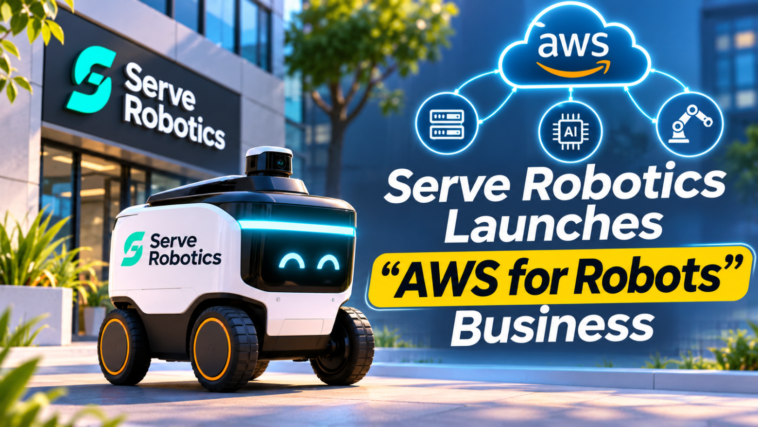
Autonomous sidewalk delivery maker Serve Robotics is expanding its core operations. The company is launching a new software division to supply technology to third-party hardware developers. Leadership envisions this model as a cloud infrastructure framework similar to Amazon Web Services.
The company spun out of Uber’s Postmates unit in 2021 and went public in 2024. On Thursday, management announced the official release of its new business line, named Physical AI Services.

Modular Cloud Infrastructure for Autonomous Fleets
Serve Robotics is opening up its proprietary navigation and data tools to external hardware makers. Self-driving construction equipment startup Bedrock Robotics has already signed on as an initial client. Serve also announced a partnership with T-Mobile to bring edge computing capabilities closer to autonomous fleets in the field.
Co-founder and CEO Ali Kashani emphasized that their core hardware operations will continue as usual. The company will maintain both its flagship sidewalk delivery units and its specialized hospital robots, which were acquired through Diligent Robotics. However, management sees immense commercial value in licensing its internal stack to builders working across agriculture, logistics, and industrial environments.
Kashani compared this strategic shift to Amazon’s early cloud decisions. He noted that building an end-to-end proprietary product was necessary during the market’s early days. Now that autonomous systems are maturing, licensing underlying tools allows other developers to build directly on Serve’s platform.
Read More: Robotics Startup Unveils First Industrial Humanoid in UK
Enterprise Product Architecture
The Physical AI Services division focuses on three main software products:
Serve Link: A high-performance networking framework that connects remote hardware directly to data centers. It allows small robots to leverage large AI models without installing expensive onboard processors. It maintains stable connections across spotty mobile networks.
Data Curator: An automated data filter that flags rare edge cases from real-world telemetry logs. Developers can feed these specific scenarios back into their machine-learning pipelines.
Foundation Model Data Catalog: A massive dataset compiled over years of sidewalk operations. It gives third-party AI models direct visual data on how humans move through complex public spaces.
Market Transition and Fleet Growth
This technology expansion coincides with changes across Serve’s core delivery operations. While the company continues to scale its physical presence, it is diversifying its commercial partnerships. Serve is shifting reliance away from Uber Eats while expanding operational deployments with DoorDash and food hall platform Wonder.