

 Hajra Naz
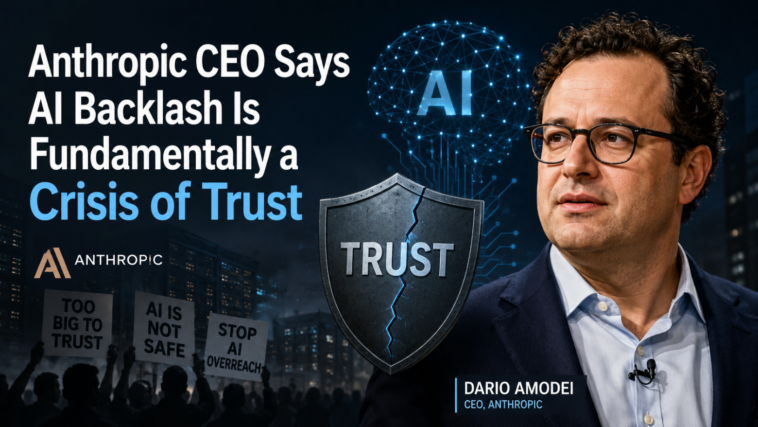
Anthropic CEO Dario Amodei has rejected claims that he has presented an overly negative view of artificial intelligence and its potential impact on the future.
Amodei’s comments followed criticism from investor Gavin Baker, who argued on the All-In podcast and on X that Amodei’s warnings about AI risks have contributed to growing skepticism toward the technology in the United States. Baker pointed in particular to rising opposition to AI data centers and infrastructure.

Baker also argued that Amodei had “lost the argument” on AI regulation. Anthropic has supported certain regulatory measures, including a California law that introduced transparency requirements for large AI companies. With Amodei expected to lead one of the world’s most important technology companies, Baker said he believed Amodei should take a more positive position when speaking about the industry.
Read More – WhatsApp Begins Testing On-Device AI Scam Alerts in Limited Beta
Baker is not the only person who has linked growing AI skepticism and government intervention to warnings from technology executives about the risks posed by the technology. Amodei, however, rejected the suggestion that his own messaging has been disproportionately negative.
In a series of posts, Amodei said his public writing has been “about equally balanced between risks and benefits.” He also pointed to his essay Machines of Loving Grace, which he wrote because he felt the AI industry was not offering an inspiring enough vision of how the technology could transform the world for the better.
Amodei did acknowledge that the public has a negative view of AI and said that this is a serious problem. He disagreed, however, with the argument that this negativity was primarily created by him or other AI executives who have warned about AI’s potential risks.
“I think it is fundamentally a crisis of trust,” Amodei said. “I think that ordinary people don’t trust companies, governments, or the tech industry and always suspect that we are cooking up some new way to screw them over.”
Trust has also become a recurring issue in discussions about other AI leaders, including OpenAI CEO Sam Altman. Amodei’s view is that the problem did not begin with AI. Instead, he sees the current backlash as the latest stage of a much older breakdown in public trust that has developed over several decades.
Amodei said the strongest criticism of AI companies, including Anthropic, is that they have not yet delivered on many of their promises to improve people’s lives.
Read More – Samsung Unveils First 400-Layer V10 BV-NAND and zHBM Concept at FMS 2026
“I think by far the most accurate criticism of AI companies, including Anthropic, is that we haven’t yet delivered on our big promises to benefit the world,” he said. “That is totally on us, and I think it’s the criticism you should be making, instead of all this stuff about messaging and marketing.”
He used claims about AI curing cancer as an example. Promising that AI will cure cancer, Amodei argued, has become more of a cliché than an inspiring vision. In his view, actually helping cure cancer would do far more to change public attitudes toward AI.
Amodei Pushes Back on the Regulation Argument
Amodei also challenged Baker’s argument that AI regulation creates a choice between making the technology widely available without restrictions and concentrating it in the hands of a small number of companies.
He described that as “a false choice.”
Amodei said there is a common view in Silicon Valley that regulation leads to regulatory capture and greater concentration of power. He believes that view oversimplifies how regulation works.
“I know that there’s a sort of Silicon Valley shorthand where regulation = regulatory capture = concentration of power, but I’ve always found this to be an overly simplified picture of the world,” Amodei said.
He added that many people outside the technology industry see regulation differently. For them, regulation can place limits on corporate power while providing greater protection for ordinary people.
Amodei said he does not necessarily agree with that view in every case, which is why Anthropic has tried to approach its policy proposals carefully.
“We try very hard to make proposals that disadvantage (slow down) frontier AI companies while advantaging smaller competitors,” he said.
Read More – Microsoft Patches 421 Vulnerabilities in August 2026, Including an Exploited Zero-Day
Why Anthropic Supports AI Regulation
Amodei said one reason for supporting certain regulations is his belief that AI has a structural tendency to concentrate power.
“AI is structurally a technology that tends to concentrate power,” he said.
He acknowledged that open-weight AI models can help reduce that concentration, but argued that they do not solve the problem on their own. According to Amodei, open weights can still shift some of that power toward companies and organizations with access to the largest amounts of computing capacity and advanced chips.
He argued that carefully designed rules could address several issues at once. Those rules could address AI-related cybersecurity, biological and alignment risks, place institutional limits on the power of frontier AI companies, and still leave room for open-weight models while accounting for the risks associated with them.
Amodei’s comments offer a different explanation for the growing backlash against AI. Rather than seeing public skepticism as a direct response to warnings from AI executives, he believes it reflects a much deeper problem of trust between ordinary people and powerful companies, governments, and technology institutions.
For Amodei, the strongest way for AI companies to rebuild that trust is not through more optimistic messaging. It is through delivering tangible benefits that match the promises they have made.
This article was updated to include additional comments from Amodei’s posts, including his remarks about open-weight AI models.