Fahad Manzur
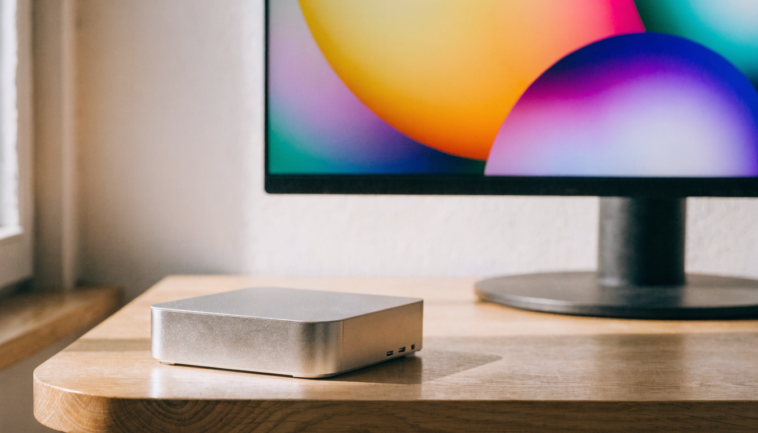
Apple announced a new Mac mini on August 25, 2026, built around the all-new M6 chip with a higher-end M5 Pro configuration alongside it, and opened pre-orders the same day. Apple says the M6 model delivers up to 4x faster AI performance, 2x faster graphics and storage, and 40 percent faster CPU performance than the M4 Mac mini it replaces. Machines start reaching customers on September 22.
What Apple actually shipped
The M6 configuration carries a 12-core CPU and a 12-core GPU, two more cores each than the previous generation. For the first time on a Mac mini, every GPU core includes a Neural Accelerator. Apple pairs that with an all-new Dual 16-core Neural Engine it rates at up to 2x the previous generation, 16GB of standard unified memory configurable to 32GB, and memory bandwidth up to 170GB/s.

Apple’s own testing, conducted in July 2026, claims the M6 Mac mini handles LLM prompt processing in LM Studio up to 13.5x faster than the M1 model and up to 4.8x faster than the M4. The M5 Pro configuration goes further: up to an 18-core CPU, up to a 20-core GPU with third-generation ray tracing, and up to 64GB of unified memory at 307GB/s. Its three Thunderbolt 5 ports also let users cluster multiple Mac mini systems together to run large AI models entirely on device.
Both models add Wi-Fi 7, Bluetooth 6, and 2.5Gb Ethernet as standard, with a 10Gb option. Johny Srouji, Apple’s chief hardware officer, described it in the press release as “the little Mac that can do it all.” Apple published a separate announcement covering the M6 and M5 Ultra silicon on the same day.
Prices, dates, and the landed-cost problem
Mac mini with M6 starts at $899 in the US, or $799 for education. Mac mini with M5 Pro starts at $1,699, or $1,599 for education. Pre-orders opened on August 25 across 30 countries and regions, with general availability from September 22.
Those numbers are the floor rather than the price most readers will pay. Pakistan is not in Apple’s first-wave launch list, so buyers there typically go through importers and grey-market channels, where duties, freight, and dealer margin sit on top of the US sticker. Anyone budgeting for one should treat $899 as a starting reference point and price the actual local configuration before committing.
Is owning AI compute cheaper than renting it?
Apple is not being subtle about the pitch. The press release repeatedly frames the Mac mini as an always-on machine for deskside agentic computing, which puts a one-time hardware purchase directly against a recurring cloud AI subscription.
The honest comparison is narrower than the marketing suggests. A local M6 will not match a frontier hosted model on raw capability, and for reasoning-heavy work the cloud still wins. What on-device compute removes is per-use metering on a specific class of jobs: transcription, image and video upscaling, batch photo processing, background removal, and running smaller open-weight models for drafting, tagging, and classification. A small design or video studio running those tasks all day is paying for them somewhere, either in subscription tiers or in credits.
That matters more than it used to, because creative and media services now make up a growing share of the country’s export mix, with non-IT work accounting for 39 percent of Pakistan’s freelance exports. Those are precisely the workloads that move on-device most cleanly.
The constraint to watch is memory, not benchmark numbers. The base M6 ships with 16GB of unified memory, and that figure, more than core counts, decides which models actually fit. Stepping up to 32GB, or to the M5 Pro’s 64GB, is where the price climbs quickly. Size the machine around the largest model you intend to run rather than around the headline performance claim, because the second number is easy to hit and the first one is what stops the job from running at all.