Hajra Naz
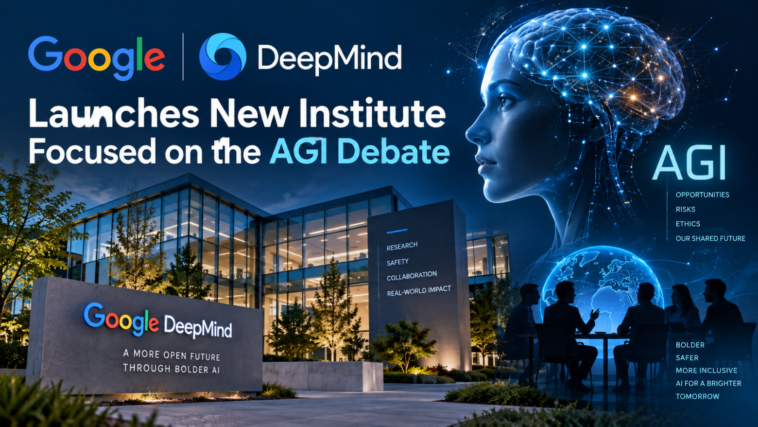
Google and Google DeepMind researchers launched something new on Wednesday. It’s called the DeepMind Institute. This new body aims to advance the conversation around artificial general intelligence (AGI). The institute lists several directors.
That includes DeepMind co-founder Shane Legg. It includes Google executive James Manyika. Demis Hassabis, Google DeepMind’s chair, serves as a director too. Legg will serve as managing editor for the institute.

This new institute has a specific goal. It aims to surface differing views on AGI. Those views span Google, Google DeepMind, and the broader global research community. “They will not always agree, and they will likely change their minds, as more data and information come to light at the fast-moving frontier,” the announcement read.
The institute launched with an inaugural collection of four essays. These essays cover a range of important topics. That includes economic policies for managing potential AGI disruption. It includes preserving human-readable model reasoning. Principles for human flourishing are addressed too. So is a framework for evaluating frontier AI models.
One essay comes from DeepMind safety researchers Rohin Shah and Anca Dragan. They argue something important about AI transparency. The shrinking window of transparency isn’t inevitable, they say. This refers to the ability to see and check a model’s step-by-step reasoning. New architectures are making the most powerful models harder to monitor. Given this, the authors argue developers and regulators need to confront safety trade-offs directly.
That could mean limiting something specific. They call it “opaque serial depth.” This refers to the amount of sequential computation a model can perform without producing readable reasoning. Alternatively, it could mean requiring developers to prove something. They’d need to demonstrate that less transparent systems remain just as monitorable.
In another essay, Hassabis proposes something significant. He suggests a U.S.-led frontier AI standards body. This body would evaluate the most advanced AI models available. Under his proposed framework, developers would initially submit models voluntarily. This review would happen up to 30 days before a model’s release. Once this evaluation system proves effective, something could change. Passing its tests could eventually become mandatory. This would apply to deploying frontier models within the United States.
This body would initially design assessments through consultation with AI companies directly. Over time, though, it would develop something more independent. That includes undisclosed evaluations, which the essay calls “held-out” tests. The goal is preventing labs from tailoring their models to known evaluation criteria. Hassabis said this framework could be “ratcheted up if the seriousness of the situation demands.” This could potentially include a coordinated slowdown among frontier AI developers.
These essays arrive at a notable moment for the industry. The broader safety debate is shifting right now. It’s moving away from broad statements of concern. Instead, it’s heading toward concrete proposals. That includes disclosure requirements. It includes outside scrutiny mechanisms.
It also includes coordinated slowdowns, if safeguards fall behind capability growth. This shift accelerated significantly this week. Industry leaders endorsed key elements of a recent call. That call came from Anthropic CEO Dario Amodei. He urged the industry to “pace” frontier AI development more carefully.