

 Hajra Naz
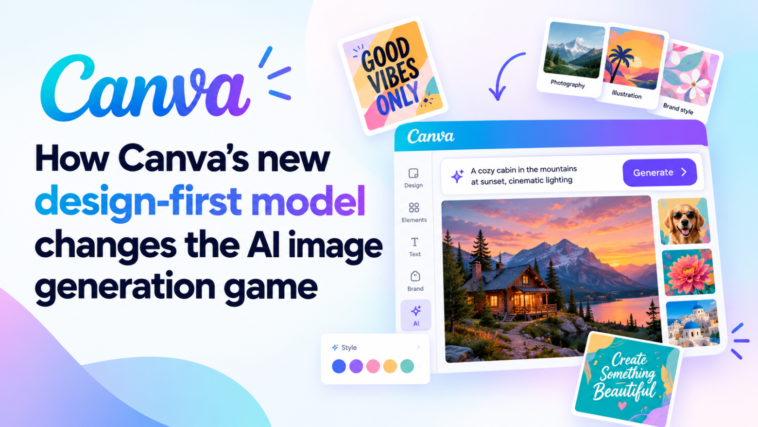
An Australian design software giant called Canva has released its first in-house image generation model. The software is named Canva Craft. The company built the model completely from scratch through its internal research lab. The primary goals were to improve creative control and reduce operating costs.
Standard image generators learn primarily from raw photographs scraped from the web. In contrast, Craft was trained on millions of human-made templates. The training dataset includes professional presentations, infographics, posters, and menus drawn from Canva’s vast content library. Because of this specialized training, the model learns fundamental design principles. These principles include visual hierarchy, proper margins, and accurate type sizing.

Robert Kawalsky serves as Canva’s global head of product. He spoke to media representatives about the design philosophy behind the software. He explained that development began with traditional flat images produced by diffusion models. Newer omni models advanced that technology. They allow users to edit flat images with sophistication using text prompts.
Read More: Canva introduces its first foundation model for AI image generation
However, Kawalsky noted that forcing users to prompt their way to a final result remains challenging for a visual medium. He stated that people want to start with a prompt and get far. At the same time, users want the ability to iterate and make direct edits themselves.
The software utilizes a unique two-stage technical architecture. First, an internal planning model interprets the user prompt. It maps out spatial relationships, element placement, and required text. Next, a rendering engine turns that structural blueprint into a finished picture. Because of this structured workflow, the model produces highly legible typography. It also generates much cleaner layouts compared to traditional single-pass tools.
The system supports high-definition outputs up to 2K resolution. It accommodates more than thirty different aspect ratios for various platforms. Generated assets integrate smoothly with Canva’s wider editing suite. This seamless connection allows creators to modify individual text boxes or graphic layers easily.
Platform executives noted that relying on external AI tools became increasingly expensive as user demand surged. Building proprietary infrastructure helps the company lower API expenses. It also secures long-term profit margins. Furthermore, researchers from Leonardo.ai contributed directly to the development process. Canva acquired that specialized media-generation platform earlier.
Read More: Canva CEO Shares Her Secret to Work-Life Balance: No Email or Slack on Her Phone
Initial benchmarking results place Craft strongly among industry competitors on evaluation leaderboards. Meanwhile, internal development teams are already working on lighter variants. These upcoming models are named Craft-fast and Craft-ultrafast. They aim to speed up generation times even further.
Ultimately, this major launch provides millions of global users with a specialized tool. The software was designed specifically for professional marketing and everyday design workflows.