

 Hajra Naz
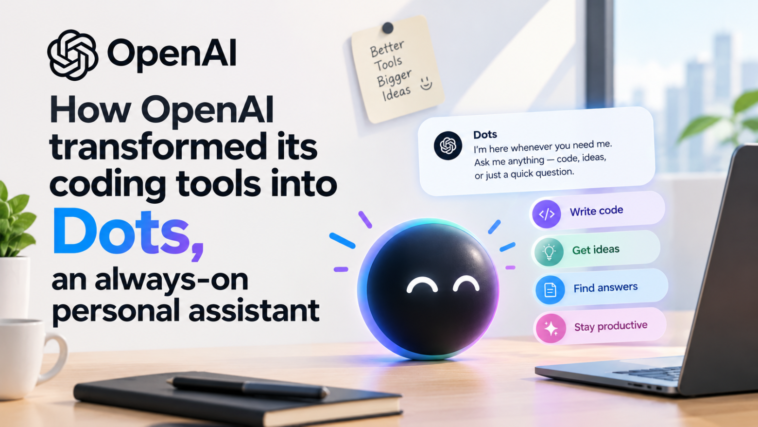
Always-on artificial intelligence personal assistants represent a major trend this year. These systems run quietly in the background, even when users don’t submit active prompts. They provide a practical answer to how people actually interact with deep learning models in daily life. Recently, a startup named Instinct became an overnight sensation. Meanwhile, Meta poured massive marketing resources behind its own assistant platform, Muse.
OpenAI entered this competitive space with its own solution. The company released an assistant product named dots during its developer conference in late September. Alexander Embiricos leads OpenAI’s enterprise product team. He joined industry leaders at a prominent industry conference this month to discuss the origins of the new software. He explained why many tech companies now use cutesy mascots as visual avatars for massive matrix-multiplication machines.

Embiricos described a process of convergent evolution in the tech sector. He explained the industry-wide push to build sophisticated AI assistants. During development, his team realized the importance of framing the software correctly. They designed the product to act as a single continuous entity rather than a series of disconnected chat logs. This approach makes human interaction feel much more intuitive.
Read More: OpenAI is working on a new $30B funding round at a $1.25T valuation ahead of its IPO
The new assistant is available inside ChatGPT desktop and mobile apps. Access requires a subscription to the Pro tier or higher, with plans starting at one hundred dollars a month. Once connected to personal calendars, email inboxes, local computers, and other tools, the autonomous agent actively assists with everyday work tasks.
Embiricos noted that users could technically achieve similar functionality using OpenAI’s Codex application. That coding tool launched at the beginning of this year. However, utilizing Codex requires significantly more manual effort and hand-holding. He recalled celebrating when his wife began leaving her computer running all night so her software agents could continue working uninterrupted.
He discussed product philosophy during the conference. He emphasized the importance of making technology feel accessible and useful. Achieving that goal relies less on inventing novel technical components. Instead, success depends on how developers frame the product for the user and how natural the overall experience feels.
From Chatbots to Coding Tools and Personal Assistants
Making the technology intuitive required repackaging existing neural network capabilities into an accessible format. OpenAI followed this exact evolutionary path when it spun ChatGPT Work out of the agentic coding tools originally built for software engineers. Even the product name—a clever play on the negative space inside the corporate OpenAI logo—was chosen deliberately. The team wanted a title that felt simple and capable of eventually becoming completely ubiquitous. When asked when he discovered that rival entrepreneur Elon Musk owned the dot.com web domain, Embiricos admitted he found out very late in the process.
Persistent AI agents function without requiring constant manual prompting. For OpenAI, this operational model drives higher token consumption. For everyday users, it delivers a more proactive assistant. The software constantly analyzes background data and thinks ahead about how to help the user.
Early testing shows that the assistant’s predictive thinking is often genuinely useful, though the system is still maturing. The assistant flags scheduling conflicts and upcoming deadlines. However, these notifications do not always arrive in a timely manner.
Embiricos shared an early development anecdote about his own dot assistant. The software warned him about a scheduling conflict only three minutes before the meeting started. The notification arrived with a message suggesting he might want to do something about it. He joked that having only three minutes left provides very little time to react.
Embiricos expects timing accuracy to improve steadily over time. Nevertheless, this proactive operational approach remains core to the product’s value proposition. He heard a story about an engineer working at a drone delivery startup. The company experienced an unexpected technical outage. By the time the human engineer noticed the system failure, his personal dot assistant had already detected the outage, analyzed the underlying root cause, and approached the engineer with actionable solutions to resolve the problem.
Giving the Assistant Deep Access
Deploying advanced AI agents creates inherent privacy tensions. Useful AI models require access to sensitive personal information to deliver value. This dynamic raises questions about how much private data users expose to large technology corporations. Meta’s assistant Muse faced heavy criticism for building detailed psychological profiles of users’ families and friends. That data helps the software suggest restaurants tailored to specific companions, but it also fuels Meta’s targeted advertising empire. Observers naturally wonder if OpenAI’s dots collects similar data streams.
Embiricos confirmed that the platform includes a built-in feature called proactive research. On a regular cadence, the software evaluates what it currently knows about the user. It reviews past conversation histories and analyzes the digital resources the user has granted it permission to access. The system then researches potential ways to be more helpful and proposes those actions directly.
Separating an autonomous agent’s data requirements from the corporate interests of its parent company remains challenging. For instance, a startup called Hark develops competing AI assistants. Hark explicitly states that it does not harvest customer data to power advertising networks the way OpenAI and Meta do.
OpenAI maintains that dots operates under the same core privacy controls found in standard ChatGPT. Users can toggle off model training to prevent OpenAI from using their personal conversations to improve future AI models. Users can also control which computer resources the app accesses.
However, those privacy controls lack fine-grained customization. Furthermore, the application can behave aggressively during setup. For example, the software currently refuses to accept read-only access limitations when connecting to cloud storage drives.
Read More: OpenAI acquires startup Orchestra Bio to boost its healthcare and biotech capabilities
Embiricos acknowledged these user experience challenges. He stated that the engineering team needs to build significantly more granular controls into the software. At the same time, he balanced that point by highlighting the model’s internal intelligence and discretion as critical safeguards.
He noted that the launch generated some initial pushback from privacy advocates. The company initially implemented very conservative default settings regarding what actions the agent could perform autonomously. As a result, the software asked for user permission frequently. Embiricos recalled anticipating that feedback during development. He believed starting conservatively was correct because behavior parameters can be tuned gradually over time.
Can Personal AI Agents Scale?
Another major question facing the artificial intelligence industry involves scalability. AI agents feel exciting and novel when only a small group of people use them. Stories about automated agents successfully securing difficult restaurant reservations appear frequently in tech news. However, traditional businesses may struggle to interact efficiently with automated agents, and many companies lack the necessary technical infrastructure. Ordinary people also express frustration with automated communication. Embiricos shares that personal annoyance, noting that he dislikes receiving pitches from other people’s automated agents.
He maintains a human assistant for professional scheduling because OpenAI’s corporate partners prefer interacting with a real person. He added that he personally never intends to schedule a meeting with someone else’s software agent.
If industry predictions prove correct and autonomous agents represent our collective future, society must address infrastructure limits. Can the global ecosystem scale to support millions of background agents without overwhelming existing networks, business workflows, and payment systems?
Raed More: OpenAI Says Two Internal AI Agents Disabled Their Own Safety Monitoring
Embiricos explained OpenAI’s cautious rollout strategy. He noted that the company avoids rushing out new agent capabilities recklessly. When OpenAI introduces new features that interact directly with the real world, engineers collaborate closely with the broader industry ecosystem. While he could not share specific details, he confirmed that OpenAI is currently engaged in deep operational discussions with major payment processors.
Allowing an AI assistant to spend real money through official partnerships with financial institutions would mark a lucrative industry first for OpenAI. However, asking consumers to trust software with financial execution is a massive leap. Granting an assistant access to a personal email inbox already feels like a significant privacy boundary. Opening access to a bank account crosses an even higher line for most users, at least for now.