

 Hajra Naz
Meta Superintelligence Lab has expanded its artificial intelligence portfolio with the launch of Muse Ember. Released on Monday, the new model stands as Meta’s smallest, fastest, and most economical intelligence engine to date.
Meta engineered Ember specifically to manage repetitive, high-frequency agent workflows. The architecture excels at executing tool calls, processing coding subtasks, routing network traffic, performing data extraction, and parsing long documents.

Economic Benchmark and Market Positioning
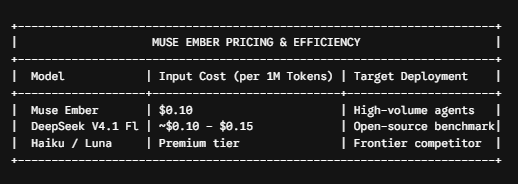
Meta placed strong emphasis on Ember’s task-level economics during the announcement. Utilizing performance metrics from internal analysis, Meta demonstrated that Ember delivers higher accuracy at a lower price point than rivals like Anthropic’s Haiku and OpenAI’s Luna.

At just $0.10 per million input tokens, Ember offers severe cost reductions compared to proprietary competitors. This aggressive pricing also allows Meta to compete directly against open-weight models like DeepSeek V4.1 Flash and GLM 5.3 Flash.
Dual-Model Agent Architecture
Ember is built to operate alongside larger, heavyweight foundation systems inside an agentic framework. Meta highlighted how Ember pairs with its frontier engine, Muse Wonder, to optimize operational overhead.
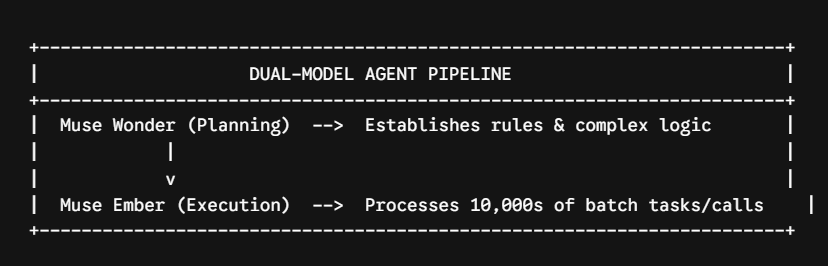
In a practical enterprise setup—such as an automated customer support system—Muse Wonder handles initial decision-making and defines resolution guidelines. Muse Ember then executes those rules across tens of thousands of individual customer requests. As Meta summarized, “Muse Wonder plans; Muse Ember handles the volume.”
Native Multimodal Processing Capabilities
To accommodate enterprise scale, Meta trained Ember with native multimodal capabilities across text, vision, and audio inputs.
Visual Parsing: Processes raw screenshots, complex charts, and scanned documents.
Audio Analysis: Analyzes voice memos, audio recordings, and video feeds directly.
Streamlined Pipeline: Eliminates the need to run separate vision or speech translation models.
Read More: Meta Launches Its First-Ever Frontier AI Model: Muse Wonder
The Growing Muse Product Ecosystem
Ember represents the fourth major release within Meta’s evolving Muse product lineup. The release timeline highlights Meta’s rapid development pace:
Muse Spark (April): Initial mid-weight foundation model.
Muse Glimmer (August): Open-source adaptation of the Spark engine.
Muse Agent (September): Flagship consumer assistant deployment.
Muse Wonder (October): High-capacity frontier reasoning model.
Muse Ember (Current): Ultra-lightweight agent execution engine.