Hajra Naz
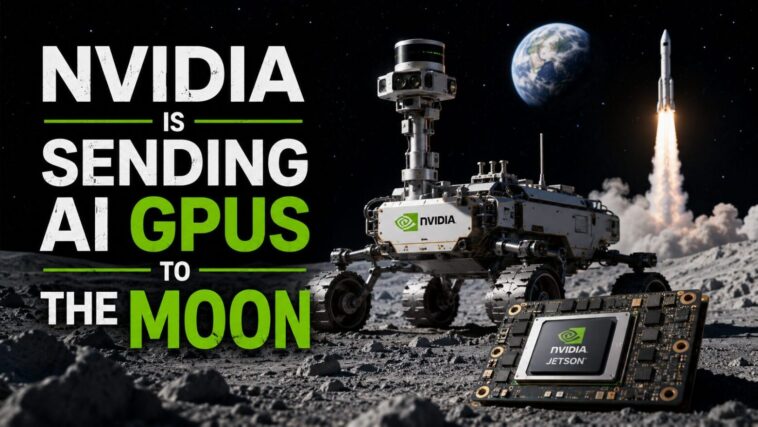
Nvidia is taking its GPU technology beyond Earth. The company’s next destination is the moon.
Space robotics startup Lunar Outpost announced on Thursday that its upcoming lunar rover will use Nvidia Jetson chips. The chips will control the rover’s lidar system. If the mission succeeds, it could place the first GPU on the moon’s surface.

Lunar Outpost CEO Justin Cyrus said the company is testing the Jetson platform alongside its existing flight computer.
The goal is to compare their performance. Engineers are measuring the strengths and weaknesses of each system. They also want to see whether powerful GPU-based computers can operate in the harsh conditions of space.
NASA is working with private space companies. The goal is to explore the moon before astronauts return. The agency hopes to send humans back to the lunar surface as early as 2028.
Under the program, companies build spacecraft and lunar rovers. They carry scientific instruments to the moon. The missions study the lunar surface. They also search for resources like water. Those findings could support future missions. They may also help long-term lunar exploration.
Read More: Nvidia Launches NemoClaw: New AI Agent Tackling Security & Privacy Risks
Nvidia has also announced another space partnership. The company is working with Firefly Aerospace. Firefly became the first private company to successfully land a robotic spacecraft on the moon.
As part of that project, Nvidia’s Jetson platform will run on a satellite orbiting the moon. It will process images in space instead of sending all the data back to Earth. The satellite will help scientists map the moon. It will also track the growing number of robotic missions on the lunar surface.
Lunar Outpost’s next rover will travel aboard a lander built by Intuitive Machines. The rover is designed to explore places that orbiting spacecraft cannot easily reach. That includes deep craters and other difficult terrain.
The mission after that will explore Reiner Gamma. It is a mysterious region on the moon known for its unusual magnetic properties. Scientists have been trying to explain the anomaly for decades.
Both missions are expected to launch on a Falcon 9 rocket before the end of the year.
Nvidia’s Jetson platform is less famous than its AI chips like Blackwell and Vera Rubin. Even so, it plays an important role in robotics and physical AI.
Jetson is built to be small and energy efficient. It allows robots to process sensor data directly on the device. That helps them react more quickly without relying on constant communication with remote computers.
Cyrus said the company’s software has changed significantly over the past few years.
Read More: Nvidia Launches Rubin, Its Most Advanced Chip Architecture Yet
He explained that earlier systems relied mostly on fixed programming. Today, they combine traditional software with physical AI. The company is now looking for new ways to use AI to perform tasks that were previously impossible.
Operating GPUs on the moon is far more difficult than using them in Earth orbit.
Most space-based GPUs work on satellites close to Earth. Those satellites receive some protection from radiation and extreme temperatures. The moon offers no such protection. It faces intense cosmic radiation and dramatic temperature swings between lunar day and night.