Hajra Naz
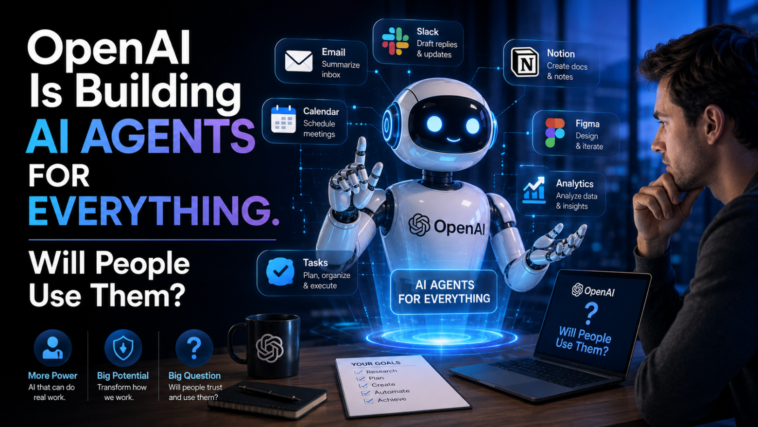
OpenAI is building AI agents that go beyond answering questions: software that can read your inbox, open your apps and finish multi-step work on its own. Whether people actually adopt them comes down to trust, permissions, pricing and how easy the tools are to set up, far more than raw model quality. That is the picture from inside OpenAI’s desktop app team, and it lands at the same moment the standards that let AI agents hand work to each other are settling under one foundation.
How much access would you give an AI model? That question is becoming more important as AI agents become more capable. These systems can now do more than answer questions. They can interact with apps, read information, and complete tasks.

Getting the most value from an AI model often means giving it access to more of your digital life. That can feel uncomfortable for people who are cautious about AI. Andrew Ambrosino, the lead engineer for OpenAI’s desktop app, has taken the opposite approach. He has given the app access to his inbox, Slack account, phone, and tools such as Notion and Figma.
Ambrosino knows there are risks. An AI writing a document could potentially pull information from a private conversation and accidentally include something it should not. He still believes using the tools himself is important. It gives him a better understanding of what AI agents can actually do.
OpenAI Wants AI Agents to Handle More Work
Ambrosino works on ChatGPT Work, one of OpenAI’s biggest product bets. The product is designed to let workers use AI agents across their daily jobs. These agents can connect to the software people already use.
The idea is different from traditional chatbots. Instead of asking an AI a question and receiving an answer, users can give it a larger assignment. The agent can then work through several steps and complete much of the task on its own.
OpenAI wants to bring this experience beyond software engineering. Accountants, investors, doctors, managers, marketers, and other professionals could eventually use AI agents as part of their regular workflows.
For developers, this shift is already happening. Coding agents can write code, inspect files, run commands, and fix problems. OpenAI now wants to give non-engineers similar capabilities.
The Challenge of Reaching More Workers
Coding is only a small part of professional work. AI companies need to expand into other industries if they want to justify the huge cost of training and running advanced models.
OpenAI has already seen a major difference between internal and external adoption. An OpenAI-backed study found that 98% of employees were using Codex in June. However, only 17% of organizational subscribers and less than 1% of individual subscribers were using the coding agent.
That gap highlights a major problem. Building a powerful AI tool is one thing. Getting ordinary workers to understand and trust it is another.
OpenAI’s non-engineering employees also had to adjust to Codex. The product was initially built around software development and used technical language that was difficult for people outside engineering.
The company gradually made it more general-purpose. That work helped shape the broader ChatGPT work experience.
Making AI Easier to Use
Every large language model needs what engineers call a “harness.” It is the software layer around the model. It controls what information the AI can access and which tools it can use.
An agent needs more than a chatbot interface. It needs instructions and tools that allow it to complete longer tasks.
For developers, command-line tools can provide that experience. But most people do not want to work through a command line. They want a simple interface that shows them what is possible.
That is why OpenAI is focusing heavily on usability.
The company wants people to interact with AI agents through natural language. Users should be able to explain what they need without understanding the technical system behind it.
AI Agents Have to Deal With the Real World
Building an agent for everyday work is harder than building one for coding. Software development is structured. Files have rules. Commands can be tested. The real world is much messier.
People use countless websites and workplace applications. Some are modern. Others were built years ago and were never designed to work with AI.
OpenAI wants its agents to work across email, calendars, documents, browsers, messaging platforms, and business software.
That requires more than intelligence. The agent must understand context. It must also know what it is allowed to do.
The Promise of an AI Personal Assistant
The potential becomes clearer when agents connect to existing work tools.
Office workers already have access to huge amounts of information. That information is spread across email, Slack, Salesforce, spreadsheets, calendars, and other systems.
Humans cannot process all of it. An AI agent can search through those systems, find relevant information, and take action.
That is the basic idea behind the AI personal assistant.
For example, an agent can take information from an email and add it to a calendar. It can analyze public companies and create a dashboard. It can build databases or monitor new research.
These tasks may not replace an employee. They can simply remove repetitive work and save time.
Trust and Permissions Remain Problems
The biggest challenge may be trust.
Asking an AI agent to perform a task is simple. Permitting it to access the information required to complete that task can be much harder.
Connecting an agent to a cloud drive may require several steps. Users may want read-only access, but the setup process may not always make that option clear.
Some settings are available on the web while others appear on mobile. That can make the experience confusing.
There are also surprising limitations. Connecting ChatGPT to Google Calendar can allow it to create events, but it may not be able to create an entirely new calendar.
These limitations can be frustrating. Users expect an AI that can handle complex tasks to also handle simple ones.
Read More: Top 11 AI Agent Courses to Boost Your Skills Fast
Measuring AI Work Is Difficult
OpenAI faces another major challenge when it moves beyond coding.
Software can be tested. It either works or it does not. Other forms of professional work are much harder to evaluate.
A presentation can be technically correct but still ineffective. A business strategy can sound impressive but fail months later. A sales pitch can work for one customer and fail with another.
This makes it difficult to determine whether an AI agent is genuinely doing a good job.
OpenAI says it uses its GDPval benchmark to evaluate these capabilities. The benchmark covers 44 occupations and hundreds of knowledge-work tasks. The company also uses feedback from real users and its own employees.
That feedback is important because OpenAI workers use AI tools more heavily than most people. The company has to make sure it is building for normal users, not just for its own unusually AI-focused workforce.
OpenAI and Anthropic Are Competing
OpenAI is not alone in building AI agents. Anthropic has also invested heavily in this area, particularly through Claude Code.
Claude Code became highly popular among software developers. Its approach also influenced how AI coding agents are designed.
OpenAI initially expected Codex to handle tasks with very little human input. Claude Code took a more interactive approach.
Users could give the system a problem. The agent would explore possible solutions and present options. The user could then choose how to proceed.
This created more checkpoints and gave users greater control.
OpenAI eventually moved toward a similar approach. Codex became more interactive and was later expanded to desktop and mobile platforms.
The competition between the two companies is now extending beyond coding.
What Makes a Good AI Agent?
OpenAI believes the underlying model remains extremely important. Its engineers argue that a powerful model can eventually reduce the need for complicated layers around it.
That idea is connected to the “bitter lesson” in AI research. Better general-purpose models can eventually outperform systems built around large numbers of specialized rules.
But there is still debate about how much structure an agent needs.
Research from companies such as Composio and Databricks suggests that different combinations of models and harnesses can produce different results.
Databricks found that an open-source harness called Pi outperformed Codex on one coding benchmark while using the same GPT-5.5 model.
That suggests the model alone may not determine performance.
The Problem With Non-Technical Work
Coding is easier for AI systems to learn because the results are measurable.
A developer asks an agent to change something. The result can be tested.
Management and strategy are different.
A manager may make a decision today, but the outcome may not become clear for months. There may be no simple record showing whether that decision was correct.
The same problem exists with hiring, leadership, business strategy, and other forms of professional work.
These activities are difficult to capture in simple user-agent interactions. That creates a challenge for AI companies trying to train agents for everyday work.
The Cost of AI Agents
AI agents can also become expensive.
Longer tasks use more tokens. More tool calls can increase computing costs.
A $20 subscription may look inexpensive to users, but heavy agent use can cost much more to operate.
In one experiment, more than 80 million tokens were used over four days. The model estimated the usage at around $65.
That raises questions about the economics of AI agents.
If millions of people begin using agents heavily, AI companies will need to keep reducing costs.
OpenAI says it is working on efficiency improvements. The company has also introduced major price cuts for some model usage.
Lower costs will be important if AI agents are going to become part of everyday work.
Will AI Agents Create Lock-In?
There is another potential issue.
Once an AI agent has access to a person’s email, calendar, documents, and workplace applications, switching to another service may become difficult.
Users may need to reconnect every service. They may have to configure permissions again. They could also need to rebuild workflows.
That creates a form of practical lock-in.
The deeper AI agents become embedded in people’s digital lives, the harder it may be to move between providers.
The Bigger Question for OpenAI
OpenAI is betting that AI agents will become a normal part of professional life.
The company wants people to move beyond simple questions and answers. It wants AI to handle entire tasks.
That could include preparing reports, analyzing information, managing schedules, building dashboards, researching companies, and organizing data.
The opportunity is enormous.
But trust remains the biggest barrier.
People may be comfortable asking AI to summarize a document. They may be much less comfortable giving it access to their inbox or allowing it to make decisions on their behalf.
OpenAI is betting that better models and simpler interfaces will change that.
The company wants AI agents to become a kind of digital personal assistant. But for that to happen, users must be willing to give those agents enough access to actually be useful.
The technology is moving quickly. The bigger question is whether people are ready to let AI become this deeply involved in their digital lives.