Hajra Naz
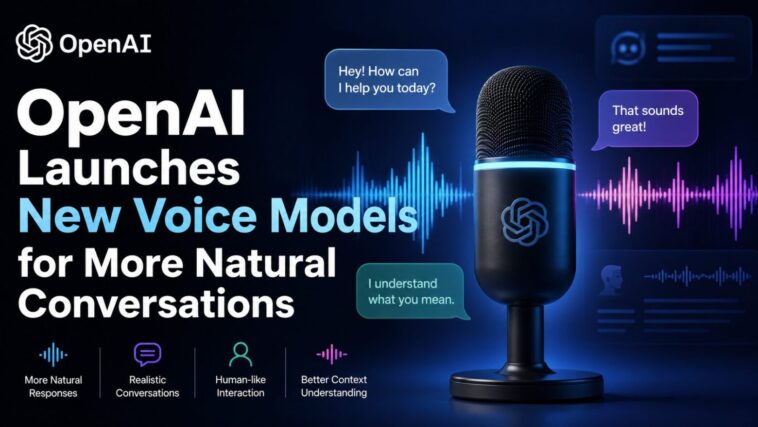
GPT-Live-1 and GPT-Live-1 small are two new speech models that OpenAI has released to improve the naturalness of ChatGPT discussions. According to the business, the new models can sustain longer voice conversations, reply more smoothly, and manage disruptions better.
Making ChatGPT sound more natural is not the primary objective. OpenAI aims to make talks feel more natural and human-like. You can naturally interrupt without ending the discussion because the new voice models are able to listen as you speak.

OpenAI is also replacing Advanced Voice Mode in ChatGPT with GPT-Live-1 mini as the default option. Users on paid plans will have access to the more powerful GPT-Live-1 model.
The biggest improvement is the move to full-duplex voice technology. This allows users to interrupt naturally without confusing the assistant. The models can also pause, stay silent while listening, and understand the conversation before responding.
Additionally, the models have the ability to halt, remain silent while listening, and comprehend what is being said before answering. According to the business, the new speech models can cooperate with its most recent models, such as GPT-5.5, to perform more difficult tasks like reasoning and search.
Read More: OpenAI Launches New Program to Find and Fix Open Source Software Bugs
Additionally, OpenAI exhibited features including visual information display during discussions and live translation. The company believes these improvements will make voice interactions more useful for both everyday tasks and complex work.
Over 150 million users have already used ChatGPT’s voice and dictation functions, according to OpenAI. The company’s voice product lead stated at a press conference that he frequently converses with the new speech mode while walking for 30 to 40 minutes.
The launch comes as companies race to improve voice assistants. Apple, Amazon, and startups like Sesame are also building assistants that better understand context and hold more natural conversations.
Based on OpenAI, it is not trying to create an AI companion. Actually, making voice a more practical way to communicate with technology is the top focus. Additionally, the new models feature protections to provide age-appropriate responses and help when talking about sensitive topics like self-harm.
The business acknowledges that it can yet do better. The live Hindi translation during a demonstration sounded strange and had a distinct American accent. While OpenAI says the new voice models are optimized for most widely spoken languages, it has not shared exactly which languages are currently supported.