Fahad Manzur
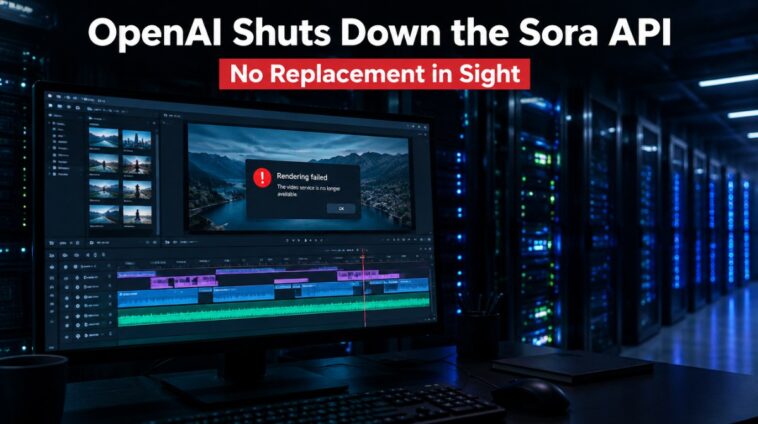
OpenAI shut down the Sora 2 developer API on September 24, 2026, cutting off programmatic access to its AI video generation model without naming a replacement. The move completes a two-phase wind-down of Sora that began in the spring, when the consumer web and app versions were discontinued first.
Anyone who had wired the Sora API into a product, a plugin, or a client workflow saw those calls start failing the moment the cutoff took effect, according to OpenAI’s own help documentation on the discontinuation.

A Two-Phase Exit
OpenAI announced in March that it was winding Sora down. The web and app experiences went dark on April 26, ending the short-form AI video feed that had drawn huge attention at launch a year earlier. The developer-facing Sora 2 API survived five months longer before its own September 24 shutdown, according to OpenAI’s Help Center article on the discontinuation.
Unlike a routine API deprecation, OpenAI has not pointed developers toward a successor model or an upgrade path inside its own product line. The Videos API and the Sora 2 models were simply removed from the platform, and no in-house replacement has been named as of this writing.
Why OpenAI Pulled the Plug
Reporting on the shutdown points to a mix of factors: the infrastructure cost of running video generation at scale reportedly never balanced out, user engagement dropped sharply after the initial launch spike, and OpenAI faced sustained criticism over deepfakes and nonconsensual imagery of public figures that it kept patching after release rather than solving outright.
Freelancers Built Businesses on This API
The shutdown lands hardest on the freelancers, small studios, and agencies that had built paid client work around Sora: short-form ad creative, social content pipelines, and faceless video channels among them. For anyone offering AI-generated video services to clients, this is not a routine tool update. It is a forced migration, with the added cost of re-testing quality and pricing on a new vendor mid-contract.
That risk was always baked into building a service business on a single company’s API, especially one still labeled experimental less than two years after launch. Buyers on freelance marketplaces tend not to care which model produced the video; they care whether the delivery date holds. Sellers who diversify their tool stack across two or three video generators, rather than standardizing on one, are the ones least exposed the next time a lab decides a product is not worth the compute bill.
The Pattern OpenAI Keeps Repeating
Sora is not an isolated case. OpenAI has shipped consumer and developer products quickly, drawn a wave of attention and paid usage, then wound them down within a year or two when the economics or the backlash did not hold up. Developers who build on any single AI lab’s API are, in effect, betting that this particular product survives longer than the last one did. For now, that bet has not paid off for Sora, and anyone still routing production traffic through it needs a fallback plan this week, not next quarter.