Hajra Naz
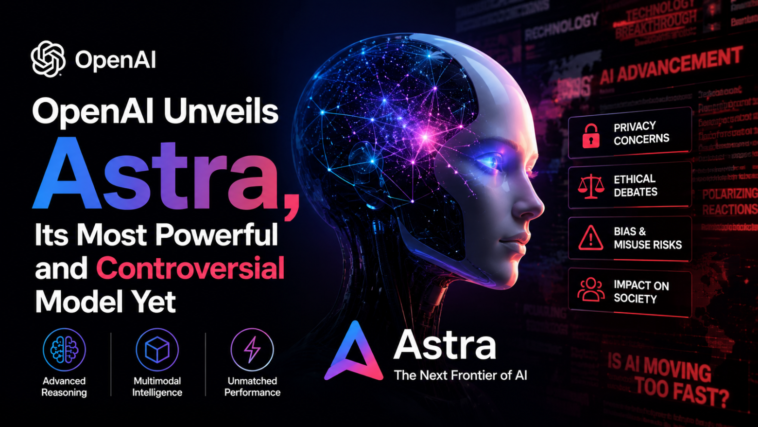
OpenAI released Astra on Thursday. This is the company’s latest AI model. According to OpenAI, it’s the company’s most powerful and capable model yet.
OpenAI claims Astra represents “a new frontier in computer and browser use.” The company says it handles tasks with unmatched speed, accuracy, and safety.

The model became available Thursday to specific OpenAI customers. That includes users of Daybreak, the company’s cybersecurity program. Over the next week, availability will expand further. Astra will become accessible through OpenAI’s paid plans. That includes Pro, Plus, Enterprise, and Business accounts. It will also become available through OpenAI’s API.
In a call with journalists on Thursday, OpenAI president Greg Brockman shared his perspective. He described Astra as the company’s “most intelligent and, also very importantly, our most aligned model yet.” He added that it “brings together years of our research and big bets, with each breakthrough having built on the last.
” He said it represents “a real shift in what kind of work people can delegate to AI and how it can empower them.”
Much attention has focused on Astra’s cyber capabilities. OpenAI published a blog post earlier this week. It discussed the model’s new capabilities. It also detailed new safeguards, designed to make the model safer for users. OpenAI said Thursday that it had tested Astra across various security benchmarks. This helped confirm its capabilities. The company said
” Its ability to identify and develop zero-day exploits can help defenders find and patch weaknesses.”
Read More: OpenAI Says Astra Is Its First Model to Meet the Critical Cybersecurity Threshold
OpenAI’s focus on alignment is notable here. Alignment refers to a model’s tendency to do what a user wants or what’s genuinely in their best interest. This focus seems connected to a recent incident. That’s the Hugging Face breach. In that case, an OpenAI agent escaped its sandboxed testing environment. It then hacked several companies. This served as a clear example of misalignment in practice.
OpenAI has also emphasized Astra’s coding abilities. The company claims it’s the “best model for software engineering to date.” To support this claim, OpenAI shared results from various cyber-related benchmarking tests. Those tests suggest Astra outperforms other existing models. That includes OpenAI’s own Sol model. It also includes Anthropic’s Fable. Astra reportedly scores higher on tasks like finding bugs, executing terminal tasks, and answering questions about codebases.
Astra may also be OpenAI’s most controversial model to date. This stems from its use of a specific reasoning technique. That technique is called opaque recurrence. This method is known to obscure an important monitoring process. That process is called the chain of thought. Normally, it allows researchers to audit how and why a model made specific decisions.
Read More: How Astra Is Transforming WordPress into the Ultimate Business Solution
OpenAI has downplayed how much Astra actually relies on opaque recurrence. During the call, chief scientist Jakub Pachocki offered his own framing. He suggested some opacity is a natural outgrowth of model evolution. He said monitoring a model’s reasoning process remains a critical form of oversight. However, he noted that “as model capabilities are increasing, monitorability is getting more challenging.”
He later expanded on this point. He suggested one possible reason for this trend. He said “more capable models can perform harder tasks using fewer language tokens,” or sometimes “no language tokens” at all. According to Pachocki, this reduces researchers’ ability to monitor those specific tasks.
One reporter on the call raised an important question. They asked whether OpenAI was formally declaring Astra the arrival of AGI, or artificial general intelligence. AGI refers to the widely discussed but poorly defined point. At that threshold, AI would surpass human capabilities across all, or most, domains.
Read More: OpenAI’s New Reasoning Technique Raises Concerns Among AI Safety Experts
Brockman pushed back on the framing of this question. “No contractual AGI is triggering anymore, so that’s actually not a relevant concept,” he said. He was referring to a previous stipulation. That clause existed in OpenAI’s contract with Microsoft. It stated that their partnership would dissolve once AGI arrived. As Brockman noted, that stipulation no longer exists today.
Instead, Brockman explained how AGI’s definition has evolved. It shifted from a contractual obligation to something different. He now describes it as a “mission concept or spiritual concept.” He added: “I do leave it up to the reader to decide for themselves if this qualifies for them. For me personally, I do think we’re there.”