Hajra Naz
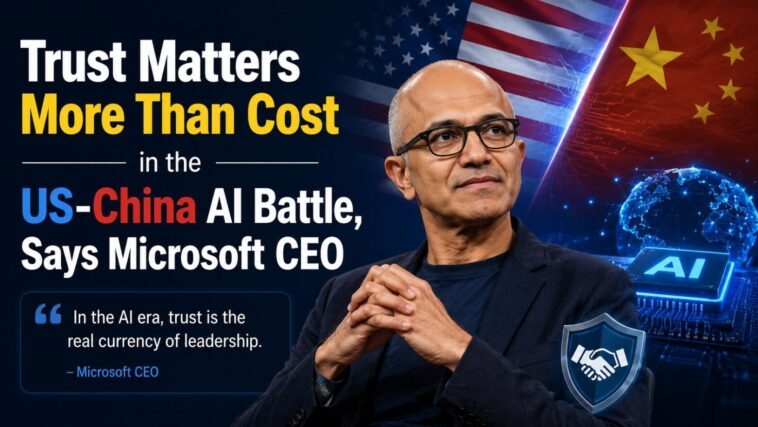
Chinese AI labs have rattled Silicon Valley more than once in the last couple of years. Every time one of these low-cost, high-performing models drops, the same question resurfaces: is America’s AI lead actually as solid as everyone assumed?
Satya Nadella’s answer is a pretty confident yes.

Speaking with Fareed Zakaria on CNN’s GPS, Nadella got asked directly about Kimi K3, the model from Moonshot AI that made waves after its July launch. It wasn’t just the performance that got people talking — it was the price tag, undercutting a lot of Western competitors and briefly spooking U.S. tech stocks along the way. Old worries about China closing the AI gap came right back to the surface.
But Nadella isn’t buying the idea that price wins this race.
What he leaned on instead was infrastructure — specifically, cloud infrastructure, which he framed as America’s real edge in all this.
His point: a lot of these Chinese AI models, even the open-weight ones, still end up running on American-owned hyperscale cloud platforms to actually operate. China can build the models, but it’s still leaning on U.S. cloud muscle to run them at scale.
Read More: What Is GLM-5.2? The Chinese AI Model Catching Silicon Valley’s Attention
That dependency, in Nadella’s view, isn’t a small detail — it’s a structural advantage the U.S. gets to hold onto for a while.
Then there’s trust, which he argued matters even more than infrastructure in the long run.
Governments and companies alike need to actually believe in the people building and operating their AI systems, not just be impressed by a benchmark score. And on that front, Nadella thinks the U.S. still has the upper hand, since so many organizations worldwide already have existing relationships with American tech providers.
“As long as that remains, we will absolutely be competitive, and we will win,” he said.
It’s worth noting Microsoft isn’t a neutral bystander here—the company holds a 27% stake in OpenAI’s for-profit arm, making it one of the most invested players in how this whole race plays out.
Kimi K3 wasn’t the first shock to the system either.
DeepSeek did something similar last year, catching investors off guard by matching top American models at a fraction of the cost. That moment wasn’t subtle — U.S. tech stocks took a sharp hit, and roughly $1 trillion in market value disappeared almost overnight.
Read More: Microsoft Launches New AI Deployment Company with $2.5 Billion Investment
Kimi K3 basically reopened that wound.
Analysts have pointed to its coding and reasoning abilities as genuinely competitive with what OpenAI and Anthropic are putting out, just at a noticeably lower price point.
Where this goes next is anyone’s guess, but both countries are clearly not slowing down their AI spending. Cheap models might win attention in the short term, but Nadella’s bet is that trust, dependable infrastructure, and a strong surrounding ecosystem end up mattering a lot more than who’s cheapest.