Hajra Naz
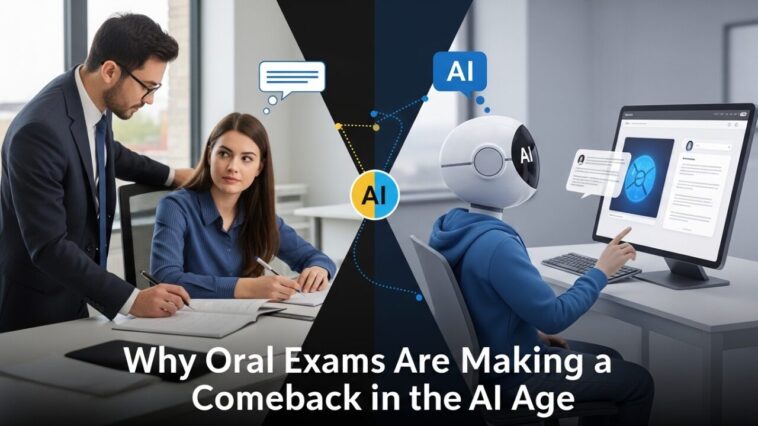
Walk into this class and the first thing you’ll notice is what’s missing.
No laptops. No notebooks. No quiet typing in the background. Not even a pen on the desk.

Instead, it’s just a student sitting across from a professor… talking.
That’s the test.
At Cornell University, professor Chris Schaffer decided to try something different with his biomedical engineering students. Rather than relying on written assignments, he asks them to explain their work out loud in what he calls an “oral defense.”
No copy-pasting. No AI assistance. No hiding behind polished paragraphs.
If you understand it, you can explain it. If you don’t… it shows pretty quickly.
And honestly, that’s the whole idea.
When “Perfect” Assignments Start Looking Suspicious
For a long time, a well-written assignment was a good sign. Clear structure, strong arguments, clean grammar—it usually meant the student had done the work.
That’s not always true anymore.
Tools like ChatGPT have changed the game. Now, it’s possible to generate an almost flawless essay in minutes. And professors are noticing something odd because of it.
Students are handing in near-perfect work… but when asked about it later, they hesitate. They struggle. Sometimes they can’t even walk through their own arguments.
That gap is what’s worrying educators.
It’s not really about cheating anymore. Most professors already assume AI is being used in some form. The bigger concern is this: are students actually thinking through the material—or just outsourcing it?
Because if the thinking part disappears, what’s left?
You may also like to read. ChatGPT is quietly testing a new feature called ‘Study Together.’
Going Back to Something Older (and Simpler)
So now, some instructors are going back to a method that’s been around for centuries—literally since Socrates was teaching through dialogue.
At University of Pennsylvania, professor Emily Hammer has started mixing written work with face-to-face discussions. Students still submit papers, but they also have to sit down and talk through them.
And that changes everything.
She’s upfront with her class. AI isn’t allowed—but she also admits there’s no perfect way to enforce that. What does reveal the truth is the conversation afterward.
If you didn’t really write it—or didn’t fully understand it—defending it in person gets uncomfortable fast.
According to Bruce Lenthall, this isn’t just one professor experimenting. There’s a broader shift happening, with more emphasis on in-person evaluation again.
Interestingly, this style isn’t new everywhere. Universities in places like Oxford and Cambridge have used discussion-based learning for years. In the U.S., though, it never really caught on at scale—until now.
Read more. ChatGPT Now Generates Interactive Visuals to help you understand math and science concepts
AI Didn’t Start This Shift—But It Definitely Accelerated It
Some of this change started during the pandemic, when online exams made cheating easier and harder to track.
But things really sped up after AI tools became widely available around 2022.
Now, universities are trying all sorts of approaches to adapt.
At University of California, San Diego, professor Huihui Qi has been working on how oral exams could work even in large classes. Because that’s the real challenge—this method works well in theory, but scaling it isn’t simple.
Still, the motivation is clear. If students skip the struggle of figuring things out themselves, they miss the part that actually builds understanding.
And that’s hard to fix later.
Using AI… to Catch AI
Not every professor is trying to move away from technology. Some are leaning into it.
At New York University, professor Panos Ipeirotis created an AI-based oral exam system.
It sounds a bit strange at first. Students log in, and instead of a human, an AI voice starts asking them questions about their work. The system—built with help from ElevenLabs—responds in real time, digging deeper based on the answers.
The idea is simple: if you actually did the work, you’ll be able to explain it—even to a machine.
If not, it becomes obvious.
That said, the experience isn’t perfect. Some students said it felt awkward, with pauses and slightly unnatural conversation flow. Talking to a voice without a face also felt a bit strange.
Still, it points to something bigger: AI isn’t just creating the problem—it’s also becoming part of how schools deal with it.
Read Moree. AI In Education: Balancing Innovation With Human Learning
Changing What “Grading” Even Means
Back in Schaffer’s class at Cornell, the grading system itself has shifted.
Students still submit written assignments. But those aren’t graded anymore.
Instead, everything depends on the conversation that comes after.
Each student signs up for a 20-minute session and walks through their thinking step by step. With around 70 students, Schaffer splits the workload with teaching assistants.
It’s a different kind of pressure.
You can still use AI if you want—but if you can’t explain what’s on the page, it won’t help much.
Other professors at Cornell are trying similar ideas. Some are replacing finals with one-on-one discussions. Others are running short, interview-style assessments to see how students respond in real time.
Not Easy… But Maybe More Honest
Let’s be real—oral exams aren’t comfortable for everyone.
For students who are shy or deal with anxiety, speaking on the spot can feel intense. There’s no time to carefully edit your thoughts. No backspace button.
But some educators say that’s exactly why it works.
When done right—clear expectations, low-pressure starting questions—it can actually help students open up. And sometimes, those quiet students who rarely speak in class do better in a one-on-one setting.
Interestingly, some students end up liking it.
Olivia Piserchia, a biomedical engineering student, said she was nervous at first. But over time, she started to appreciate the format.
It forced her to actually understand the material, not just complete the assignment. And it helped her get better at explaining technical ideas—something she knows she’ll need later in her career.
As she put it, it’s harder to sit in front of someone and admit you don’t know something than it is to quietly submit an assignment.
And that kind of pressure? It makes you prepare differently.
Read More. AI-Less Thinking: How ChatGPT Is Harming Student Learning
So… Where Does This Go Next?
AI isn’t going anywhere. If anything, it’s only going to get better.
Which means education has to adapt.
Right now, there’s no single solution. Some schools are bringing back oral exams. Others are redesigning assignments. Some are even building AI tools into the testing process itself.
Most likely, the future will be a mix of all these approaches.
Because the goal isn’t just to stop cheating. That’s too narrow.
The real goal is making sure students are actually learning—thinking, questioning, understanding.
Because in a world where AI can generate almost anything on demand, the real value isn’t in producing answers anymore.
It’s in being able to explain them.
FAQs
1. Why are oral exams becoming popular again?
Because written work can easily be generated using AI, making it harder to tell what students truly understand.
2. Are oral exams replacing traditional tests?
Not completely. Most schools are combining them with written assignments rather than replacing them entirely.
3. Can students still use AI to prepare?
Yes, but they still need to explain concepts in their own words during the actual exam.
4. Do students find oral exams stressful?
Some do, especially at first. But many adjust over time and even prefer the format.
5. Is this the future of education?
It’s likely part of it. Schools are experimenting with different methods to keep learning meaningful in the AI era.