Hajra Naz

The marketing roles most exposed to AI are the ones built around producing and processing language: content writing and copywriting, SEO and search analysis, market research, campaign and email drafting, and first line customer communication. Exposure is not the same as replacement. In most of these roles AI now handles the drafting and the sorting while positioning, judgment and client relationships stay firmly human. The breakdown below shows which tasks are actually moving, and it reads well next to why AI literacy has become a baseline skill for anyone selling marketing services.
From content creation to research and customer communication, marketing professionals are increasingly relying on AI tools to get work done faster and more efficiently. But what does this mean for jobs in the field?

A new study analyzing more than 200,000 anonymized Bing Copilot conversations conducted between January and September 2024 provides one of the clearest data-backed looks yet into how AI is being used in real workplace settings—and which marketing roles are experiencing the greatest transformation.
Key Takeaways for Marketers
| What You Should Know | What You Should Do |
|---|---|
| AI is here to stay—deeply integrated into workflows | Get comfortable with tools like Copilot and ChatGPT |
| Writing & research are most exposed | Focus on strategy, branding, and emotional intelligence |
| Routine mid-level tasks are vulnerable | Build data, analytics, and creative ideation skills |
| Strategy & storytelling remain human strengths | Strengthen POV, customer empathy, and brand-building skills |
Why Marketing Is Especially Exposed to AI
According to the research, the most common activities that users seek help with from AI—and the most common tasks AI performs—fall squarely into the marketing domain:
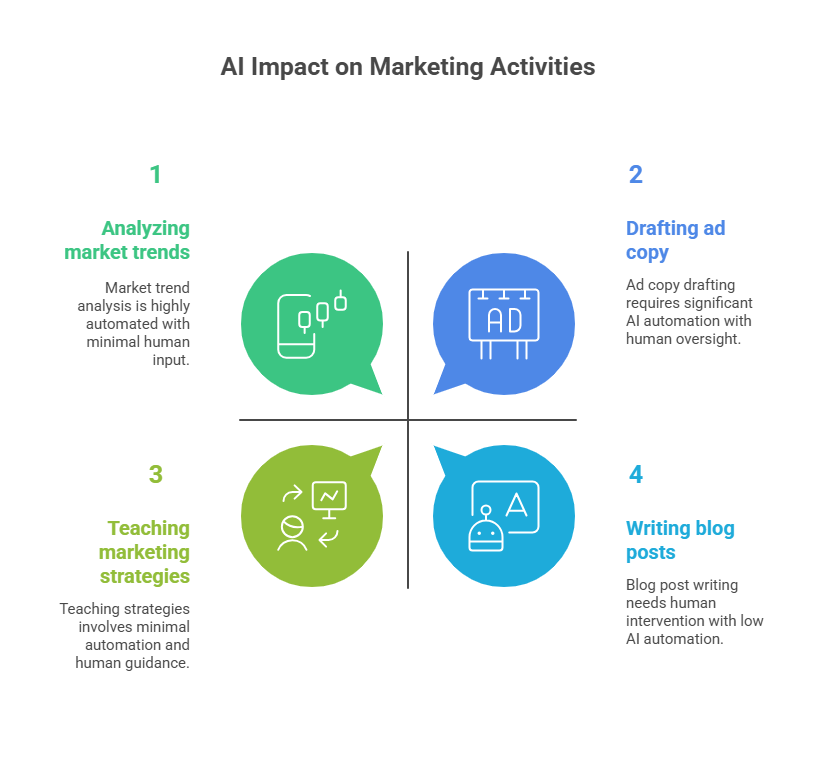
Writing (blogs, ad copy, emails)
Gathering and analyzing information (researching audience behavior, market trends)
Teaching and advising (explaining strategy or best practices)
Communicating information (drafting messages, reports, or presentations)
These are not just support activities. In many cases, AI handles them from start to finish with little human intervention.
This leads to a key insight: marketing jobs are not just being augmented—they’re being partially automated.
Read More: Why AI Can’t Replace Humans in These 5 Key Business Areas
Understanding AI’s Dual Role: Assistance vs. Automation
The study introduces two critical concepts:
User Goal: What the human is trying to achieve (e.g., “write a product description”).
AI Action: The specific task the AI performs to help (e.g., “drafting copy,” “summarizing product features”).
Surprisingly, in 40% of cases, these two don’t overlap—meaning AI often performs different work than the user initially intended.
Examples of User Goals vs. AI Actions
| User Goal | AI Action |
|---|---|
| Research a marketing trend | Summarizes the trend from multiple sources |
| Draft an email to customers | Writes the complete email with CTA |
| Analyze customer feedback | Extracts key themes and sentiment insights |
The Marketing Roles Most Impacted by AI
The researchers used a metric called the AI Applicability Score, which considers:
How often is AI used for tasks in a role
How successfully those tasks are completed
How broad the AI’s impact is across that role’s responsibilities
Detailed Table of Impacted Marketing Roles
| Marketing Role | Typical Tasks | AI’s Role | AI Applicability Score | Impact Level |
|---|---|---|---|---|
| Content Marketing Specialist | Writing blogs, social posts, guides | AI drafts and edits long-form and short-form content | High | 🔴 Very High |
| Copywriter | Creating ad copy, landing pages, and sales emails | AI generates compelling, high-conversion copy | High | 🔴 Very High |
| SEO/SEM Manager | Keyword research, metadata writing, audits | AI suggests keywords, optimizes content, and runs mock audits | High | 🟠 High |
| Social Media Manager | Post creation, engagement, replies | AI schedules, writes posts, and replies to comments | Medium-High | 🟠 High |
| Email Marketing Manager | Writing campaigns, segmenting lists | AI writes emails and predicts subject line performance | Medium | 🟡 Moderate |
| Market Research Analyst | Surveys, trend tracking, reporting | AI analyzes data, writes summaries, and forecasts shifts | Medium | 🟡 Moderate |
| Brand Strategist | Brand voice, positioning, storytelling | AI offers voice ideas and drafts messaging | Medium | 🟡 Moderate |
| Product Marketing Manager | Sales decks, competitor analysis | AI synthesizes product data and writes value propositions | Low-Medium | 🟡 Moderate |
How the AI Applicability Score Works
The score blends user interaction data with O*NET (a U.S. labor database) classification. It measures:
| Metric | What It Measures |
|---|---|
| Activity Share | % of conversations involving that task |
| Completion Rate | Whether AI completes the user’s goal successfully |
| Scope of Impact | How much of the task AI can cover (e.g., 25%, 75%, 100%) |
Read More: How to Start a Profitable Blog from Scratch in 2025 (Step-by-Step for Beginners)
Is AI Replacing or Supporting Marketing Work?
AI is excellent at routine, data-heavy tasks.
It is weaker in creativity, intuition, and strategy.
However, as businesses become more confident with AI, they may reduce reliance on entry-level marketers who traditionally handled repetitive work.
Instead, marketing jobs are shifting toward:
Overseeing AI output
Editing and fact-checking AI work
Driving creative direction and strategy
Microsoft’s Findings: Sales & Marketing Among Most Exposed
New research from Microsoft confirms that marketing and sales roles are among the most affected by generative AI.
Using its AI Applicability Score across all job categories, researchers found:
| Role | AI Applicability Score |
|---|---|
| Sales Representatives | 0.46 |
| Writers & Authors | 0.45 |
| Customer Service Representatives | 0.44 |
| Technical Writers | 0.38 |
| PR Specialists | 0.36 |
| Advertising Sales Agents | 0.36 |
| Market Research Analysts | 0.35 |
Read More: These are the 6 best companies hiring for remote AI jobs
Tasks Where AI Performs Best
AI consistently excels at:
Gathering information
Writing and editing content
Communicating information clearly
Teaching or coaching users
But in 40% of conversations, AI performed different tasks than users originally requested, reflecting its role as a coach or advisor.
Areas Where Human Strengths Still Dominate
Certain marketing tasks remain less affected by AI:
Visual and creative design
Strategic data analysis
Client-facing sales and event marketing
These require nuance, physical presence, or creativity that AI cannot yet replicate.
Education, Wages & Job Security
The study found:
Weak link between wages and AI exposure (correlation = 0.07).
Jobs requiring a bachelor’s degree had slightly higher AI applicability scores (0.27 vs. 0.19).
This suggests AI is impacting knowledge work more—but not necessarily eliminating jobs.
Researchers caution against assuming automation = job loss:
“This would be a mistake, as our data do not include the downstream business impacts of new technology, which are hard to predict and often counterintuitive.”
Read More: Freelance AI Jobs That Are in High Demand: Exciting Opportunities for Professionals
The Future of Marketing Careers
Not all marketing jobs will vanish—but most will change.
AI is blurring the line between idea and execution. The marketers who thrive in 2025 and beyond will be those who lead with AI rather than compete with it.
Don’t race AI on speed or grammar. Instead, focus on what it can’t do:
Emotional nuance
Customer empathy
Long-term strategy
Brand storytelling
Because while AI can write your next campaign, only you can make it matter.