Hassan Khan
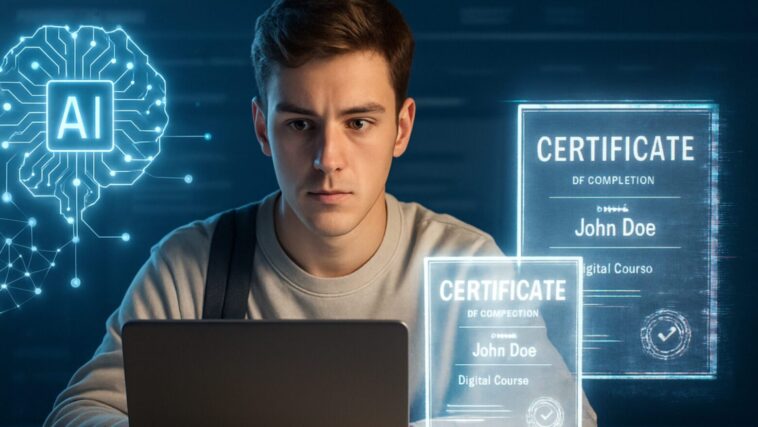
AI has made it trivial to complete quizzes and assignments without learning anything, so certificates alone now carry far less weight with employers. Credibility is shifting toward proof of work: portfolios, live projects and verified skill assessments. Learners who show what they can build will keep an advantage over those who only collect certificates.
Online learning has become a huge part of education. Platforms like Coursera, Udemy, Skillshare, and even university LMS systems have helped millions of people learn new skills from home. According to recent reports, the global e-learning industry is worth over $315 billion in 2024 and it’s still growing fast.

But here’s the twist. Artificial Intelligence is now changing the game and not always for the better.
While AI tools like ChatGPT, Gemini, and Claude make learning easier, they are also challenging the authenticity of many online courses. The question is no longer “Can you learn online?” but “How do we trust what someone has learned?”
The Rise of AI Generated Coursework
One of the biggest issues is that students can now:
- Write assignments
- Generate code
- Solve quizzes
- Complete full courses
Without actually learning anything.
A study from an online education survey showed:
54% of students have used AI tools to finish assignments
35% admitted they completed entire online tasks using AI
22% even used AI during proctored online exams
For Example: A person taking a coding course can ask AI to write all their programs. They’ll pass the course but don’t know how to actually code.
This means a certificate no longer guarantees real skills.
The Certification Problem
Online certificates used to be proof of your knowledge. Today, employers are becoming more skeptical.
Why? Because:
Many online exams are not monitored
AI can auto generate correct answers instantly
Plagiarism detection tools are not trained to catch AI content
A hiring manager recently shared that nearly 40% of applicants with “AI/ML certificates” fail basic skill tests raising questions about the real value of these credentials.
AI Courses Made By AI?
This is another concern: People are now creating entire courses using AI with little real expertise behind them.
Platforms are seeing:
Repeated, shallow content
Fake case studies
Low quality explanations
Copy pasted lessons from the internet
Many students enroll, only to realize the instructor themselves probably learned from Google + ChatGPT.
Good Side of AI (Because It’s Not All Negative)
Let’s be fair AI isn’t the villain here.
AI can help learners:
- Understand difficult concepts
- Translate lessons for global audiences
- Improve writing, coding, and accuracy
- Practice real world scenarios
- Learn faster and with less frustration
But the real challenge is balance using AI to learn, not to cheat your learning journey.
How E-Learning Platforms Are Responding
Some solutions already being tested:
AI-plagiarism checkers to detect generated content
Skill based exams instead of multiple choice tests
Live interview assessments for certification
Project-based learning that requires personal creativity
This new approach checks what students can actually do, not what AI can do for them.
The Future: Skills > Certificates
As AI continues to grow, the education world is shifting:
Employers care less about certificates
More companies use practical tests during hiring
Experience and personal projects matter more
In simple words,
Certificates may open the door, but your real skills decide how far you go.
So instead of letting AI finish your course. Use AI as a teacher, not a shortcut.
That’s how you will truly grow.
Conclusion Human Learning Still Matters
AI is powerful, but education is about understanding, creativity, and thinking things humans still do best. Online learning remains a great opportunity, but students and e-learning platforms must work together to:
- Keep learning authentic
- Maintain trust in online education
- Use AI responsibly
Because at the end of the day, the goal isn’t just to get a certificate. It’s to become capable and confident in real life.
AI FOR ALL BACKGROUNDS
In Pakistan, tech educator Zafar Iqbal is also teaching an “AI for All Backgrounds” course, helping beginners learn AI skills regardless of their field or education level.
AI FOR ALL BACKGROUNDS: LEARN AI/ML
FAQs: AI Challenges Online Learning Credibility
Q1: Is AI cheating ruining online learning?
Not exactly the problem isn’t AI itself but how students misuse it. When used correctly, AI can support learning, not replace it.
Q2: Do employers still trust online certificates?
Yes, but with caution. Many companies now test skills practically because certificates alone no longer guarantee real knowledge.
Q3: How can I prove my skills if I learn online?
Create real projects, build a portfolio, practice solving real problems, and share your work publicly. That proves learning much better than a certificate.
Are online certificates still worth anything?
They still help you get past filters, but they no longer close a deal on their own. Employers and clients increasingly ask for samples, and a strong portfolio does more work than a certificate list, which is why building a portfolio site that gets you hired is now the higher return move for most learners.
How can a learner prove real skill in the AI era?
Publish the work. Case studies with before and after numbers, public repositories, client testimonials and short walkthrough videos all give evidence AI cannot fake for you.
Will platforms fix this?
Some are adding proctoring, project reviews and identity checks, but verification will always lag behind the tools. Assume the market rewards demonstrated output, not completion badges.
Related reading
Last updated: August 2026.