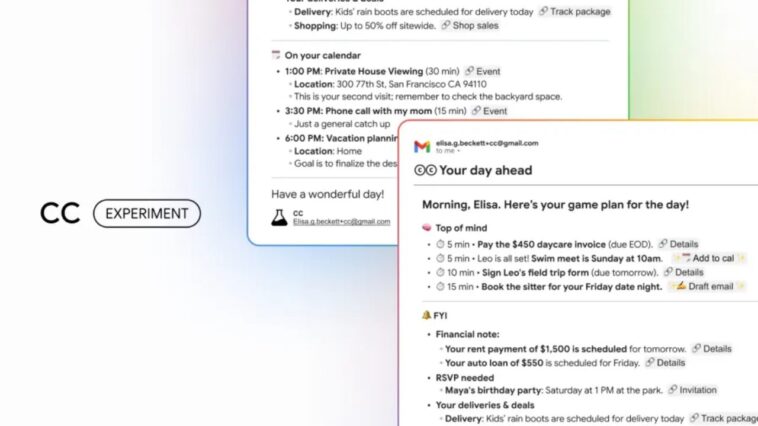
Companies keep returning to productivity as a proving ground for AI assistants, betting that saving users time is the fastest way to drive habit and loyalty. Google is the latest to test that theory with a new experimental, email-based assistant called CC, launched through a Google Labs experiment.
CC is powered by Gemini and connects directly to core Google services like Gmail, Google Drive, and Google Calendar. Its main output is a daily email briefing called “Your Day Ahead.” The message pulls together upcoming calendar events, pending tasks, and notable updates from your inbox and files, essentially turning email into a lightweight command center for the day.
What makes CC different from typical summary tools is that it’s designed to work both passively and interactively. Users can email CC at any time to add to-dos, save notes, search for information, or teach the assistant personal preferences. Over time, the goal is for CC to adapt to how you work, learning what matters most and filtering out the rest, without requiring users to open a separate app or dashboard.
For now, CC is available only to AI Pro and Ultra subscribers in the U.S. and Canada who are 18 or older. Google states that the assistant currently works only with consumer Google accounts, not Workspace accounts, indicating that this is still a controlled test rather than an enterprise-ready product. That limitation also suggests Google is watching closely to see whether people actually want AI productivity help delivered through email, rather than another standalone interface.
The experiment places Google in a growing field of AI tools that treat email as a daily briefing surface instead of just a communication channel. Sequoia-backed Mindy, which now focuses on creators and marketers, originally launched as an email-based assistant. Meeting-focused tools like Read AI and Fireflies also send daily summaries, though they typically lack deeper context from email and cloud storage. Meanwhile, Huxe—built by former NotebookLM creators—takes a different approach by turning inbox, calendar, and news data into a short daily podcast.
By testing CC inside the inbox itself, Google appears to be exploring a simpler question: can AI feel genuinely useful if it meets users where they already spend their time? If CC succeeds, it could point to a future where productivity assistants quietly operate through email, reducing the need for yet another app competing for attention.


 Hajra Naz