

 Madiha Yaqoob
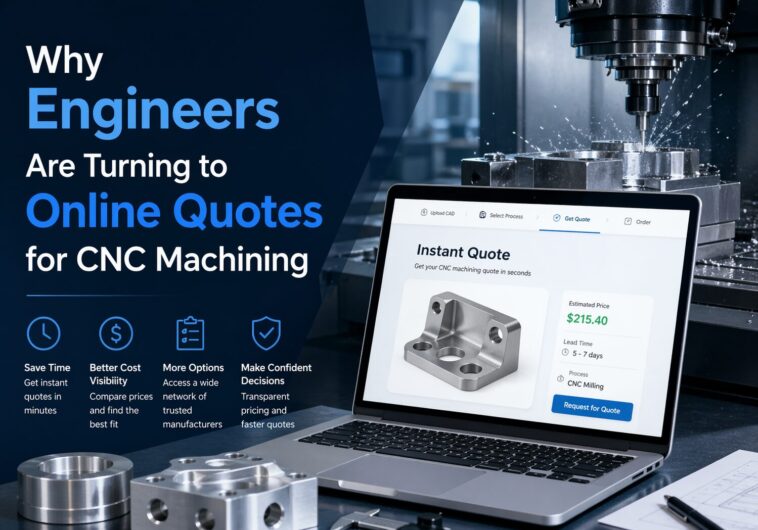
Engineering teams are moving away from slow manual RFQ processes toward online CNC quoting tools that return pricing in minutes instead of days. This shift is cutting sourcing delays and giving smaller shops a way to compete on speed.
For many engineering teams, sourcing machined parts begins with a familiar bottleneck: the traditional CNC RFQ process. Engineers typically send CAD files or technical drawings to multiple machine shops, then wait while suppliers manually review the design to estimate material costs, machining time, setups, and tooling requirements. Because pricing depends heavily on factors such as part geometry, tolerance requirements, surface finishes, and material selection, generating an accurate quote often requires a detailed engineering review.

The result is a cycle that can take several days (sometimes longer) before pricing and lead times arrive, slowing down prototyping and early production decisions. Online quoting platforms are emerging as a faster alternative by automating much of this cost analysis directly from CAD data. Read on to learn more about CNC machining quotes and why so many people are turning to them.
What an Online Quote for CNC Machining Actually Is
An online quote for CNC machining is a digital system that evaluates manufacturability and cost directly from a part’s CAD model.
Instead of sending drawings to multiple suppliers, engineers upload files such as STEP, STP, or IGES to a web-based platform. The software analyzes the geometry, identifies key features, and quickly estimates production requirements. Behind the scenes, algorithms model machining time, calculate material usage, and account for setup and finishing processes to generate pricing and lead times, often within minutes.
More than a pricing shortcut, these systems function as part of a broader digital manufacturing workflow that connects design decisions directly to production planning.
How Automated CNC Quoting Works
Automated CNC quoting platforms work by translating a CAD model into a manufacturability and cost assessment. Once a file is uploaded, the system begins with geometry analysis, where algorithms evaluate part volume, feature complexity, internal radii, pocket depth, and overall tool accessibility. These characteristics help determine how the part could realistically be machined.
Next, the software estimates a machining strategy. This includes identifying the likely machine type—such as 3-axis or 5-axis milling—along with the number of setups, expected cycle time, and potential tool changes required to produce the part.
Finally, the platform runs a cost model that incorporates raw material consumption, machining time, secondary finishing processes, and quality inspection requirements. By combining these factors, automated quoting systems can generate a near-real-time price and lead time based on practical manufacturing conditions.
Design for Manufacturability (DFM) Feedback During Quoting
One of the most valuable features of modern online quoting platforms is design for manufacturability (DFM) feedback. Instead of simply returning a price, many systems analyze uploaded CAD models and flag design elements that could increase machining difficulty or cost. For example, the software may detect tight internal corners that require very small end mills, deep pockets with limited tool access, thin walls that risk deflection during cutting, or tolerance specifications that are tighter than necessary for the part’s function.
Receiving this feedback during the quoting stage allows engineers to adjust the design before production begins. Small changes (such as increasing corner radii or relaxing noncritical tolerances) can significantly reduce machining time, tooling complexity, and overall part cost. As a result, online quoting tools increasingly function as engineering decision platforms rather than simple procurement utilities.
The Future of CNC Procurement: Digital Manufacturing Networks
Online quoting platforms are increasingly connected to digital manufacturing networks, allowing engineers to move from pricing to production without restarting the sourcing process. Instead of relying on a single supplier, these systems route parts to distributed manufacturing partners capable of handling both prototype quantities and larger production runs.
This model improves supplier capacity utilization, provides greater lead-time flexibility, and expands global sourcing options.
Custom manufacturing platforms such as Fictiv provide instant online quoting for CNC machining services, along with other capabilities in order to help engineering teams move from CAD design to production-ready parts with fewer procurement delays. This not only gets your component to you faster, but also allows for rapid iteration at speeds that weren’t previously possible unless a company had its own in-house machining capabilities. The future of CNC machining is here, and uses integrated AI technology to get quotes quickly and start production faster.
FAQ
What is a CNC RFQ and why is it slow?
An RFQ, or request for quote, is how engineers ask machine shops to price a part from a CAD file. The traditional process is slow because it depends on manual review of tolerances, materials, and tooling by each shop.
How do online quoting platforms help engineers?
They automate the design analysis so pricing and lead times come back almost instantly. The same instant-turnaround logic is reshaping other business tools too, similar to how a well-built business website now needs to respond to customers in real time.
Related reading
- The Best Marketing Material for Startups
- Don’t Ignore These 7 Hidden Costs That Are Hitting Your Small Business Profits
Last updated: August 2026.