Hisham Sarwar
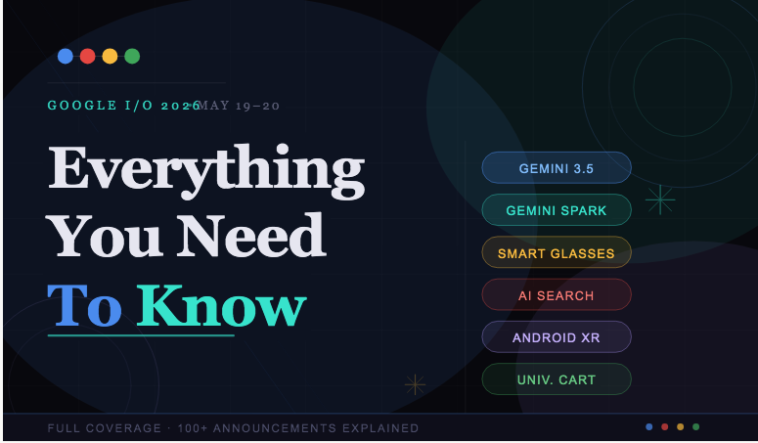
Google I/O 2026: Everything You Need To Know
From a 24/7 personal AI agent and brand-new Gemini models to smart glasses and the biggest Search upgrade in three decades — here is a full breakdown of every major announcement from Google’s annual developer conference.
01 — New Gemini Models
Gemini 3.5 Flash, Gemini 3.5 Pro, and Gemini Omni
Every Google I/O brings new model announcements, but 2026 introduced something qualitatively different. Instead of simply a smarter model, Google unveiled a model architecture designed specifically for agentic action — models built not just to generate responses but to plan and execute multi-step tasks on your behalf.
Gemini 3.5 Flash
Available now
The standout model of the event is Gemini 3.5 Flash. It is the first in Google’s newest model family and represents the company’s clearest push into agentic AI. On benchmark evaluations, it outperforms the previous Gemini 3.1 Pro across coding, multimodal understanding, and — most importantly — agentic task completion. Despite being the “Flash” variant optimised for speed and efficiency, it matches or exceeds the full Pro-tier model from the prior generation. Google says it delivers output tokens at four times the speed of comparable frontier models from other companies, making it well-suited for real-time, multi-step workflows that need fast responses. It is rolling out today across the Gemini app, Google Search, the Gemini API, and the new Antigravity developer platform.
- 4×Faster than rival frontier models
- Ships same day as announcement
Gemini 3.5 Pro
Coming next month
The heavier sibling to Flash, Gemini 3.5 Pro is in closed testing and will reach developers and users next month. It is designed for tasks demanding deep reasoning over long documents, complex multi-turn coding projects, and sustained agentic workflows that span hours rather than minutes. Google says it will set a new intelligence benchmark in the Gemini family.
Gemini Omni
Available now — AI Plus, Pro & Ultra
Gemini Omni is an entirely new model series that combines Gemini’s reasoning capabilities with content creation. The Omni Flash variant launching today accepts text, images, audio, and video as input and can output video that is grounded in real-world knowledge and editable in natural language. Google’s team internally called this their “Nano Banana moment” for video generation — a reference to a major leap in a core capability. It is available inside Google Flow, YouTube Shorts, and the Gemini app for paying subscribers. The Flow app is now on Android in beta, and Flow Music is live on iOS with Android coming soon.
02 — Gemini App
Gemini Spark: Your Always-On Personal Agent
The single biggest announcement of I/O 2026 was Gemini Spark — not a new model, not a new app, but a new relationship between users and AI. Spark is a 24/7 personal agent that works in the background even when your phone screen is off, monitoring your tasks, managing your schedule, and taking action on your behalf without you having to ask each time.
“Spark represents a big shift for Gemini — transforming it from an assistant that answers your questions into an active partner that does real work on your behalf, under your direction.” Google I/O 2026 Keynote
The live demo used an iPhone — deliberately, to signal this is for everyone — where a user fed Spark information about an upcoming wedding: invite lists, registry links, caterer contacts, a Pinterest inspiration board. Spark proceeded to autonomously organise timelines, draft vendor emails, flag a calendar conflict, and suggest alternatives without the user doing anything beyond the initial setup.
At launch, Spark integrates with Gmail, Google Docs, Calendar, and Google Tasks. Over the summer, it will expand to third-party apps via the open Model Context Protocol (MCP), which means it will eventually be able to control tools like Canva, Instacart, and OpenTable on your behalf. Google is starting with a beta for Google AI Ultra subscribers in the US next week, with broader rollout to follow.
03 — Google Search
Search’s Biggest Upgrade in Nearly 30 Years
One year after launching AI Mode at I/O 2025, Google reported that users who adopt it have fundamentally changed how they search — shifting from short keywords to full natural language questions. Building on that success, I/O 2026 introduced Information Agents directly inside Search results.
Information Agents are AI agents embedded in the search results page that go beyond surfacing answers. They can research multi-step questions, synthesise content from dozens of sources, and execute follow-up actions — booking appointments, adding items to a cart, drafting emails — all without you leaving Search. The goal is for Search to understand what you are trying to accomplish, not just what you typed.
- Information Agents launch inside AI Mode in the US, powered by Gemini 3.5 Flash.
- AI Mode is expanding globally with broader language support.
- Conversational search threads can now flow between Search, the Gemini app, and Gmail as a single continuous session — the agent remembers the full context as you move between products.
- Users can ask Google to verify whether an image is AI-generated directly from Search using Lens or Circle to Search.
04 — Shopping
Universal Cart: One Intelligent Cart Across the Entire Web
Universal Cart is built on a new open standard Google is calling the Universal Commerce Protocol. The premise: a single AI-powered shopping cart that works wherever you browse — in Google Search, the Gemini app, Gmail, or YouTube — so you are never stuck managing separate checkouts across five different retailer sites.
What makes it intelligent rather than just convenient is the layer of agentic reasoning behind it. Once you add products from multiple retailers to your cart, the cart proactively flags incompatibilities before you check out. Google’s demo showed a user building a custom PC: the cart detected that two selected components were not compatible and suggested alternatives. The cart also tracks price drop history, stock alerts, and restocking notifications. Because it is built on Google Wallet, it understands your payment method perks, loyalty programme points, and merchant offers, and surfaces the best way to pay automatically.
Universal Cart arrives in Google Search and the Gemini app in the US this summer, with YouTube and Gmail to follow.
05 — Google Workspace
Gmail, Docs, Keep, and a Surprising New App
Google Workspace received some of the most practically useful updates of the entire event. These are changes that affect how billions of people work every day.
AI Inbox — Now for More Users
Rolling out to Plus & Pro now
AI Inbox — previously exclusive to Google AI Ultra — is opening up to all AI Plus and Pro subscribers in the US. The feature surfaces emails that need action and de-prioritises noise. New additions: it generates personalised draft replies based on the full context of your thread and your writing style, surfaces relevant Docs, Sheets, or Slides files beside the relevant to-do, and lets you mark all emails about a topic as read with a single tap.
Gmail Live — Talk to Your Inbox
Gmail is getting a conversational voice search feature. Instead of typing search terms and guessing the right keywords, you can speak to Gmail naturally: “Find the thread where Sarah mentioned the Q3 budget last month” or “Show me all invoices from our design vendor.” This removes the frustration of trying to recall exact phrasing from emails sent months ago.
Google Docs and Keep — Conversational AI
Google Docs now supports ongoing back-and-forth conversations with Gemini while you are editing a document — not just single prompts, but a contextual dialogue that understands everything you have written. Google Keep is getting a brain-dump mode: speak freely for as long as you want, and Keep will automatically organise your stream of thoughts into structured notes and lists in the background as you talk. Both features roll out this summer for AI Pro and Ultra subscribers.
Google Pics — A New Design App
Launching now
Google quietly launched an entirely new product at I/O 2026: Google Pics, an AI-powered image editing and creation app. It supports object editing, background segmentation, text manipulation within images, and full AI image generation. It will integrate directly into Slides and Docs, meaning you can create and edit visuals inside your documents without switching apps. This is Google’s clearest move yet into Adobe’s consumer market.
Co-Scientist — AI for Researchers
Co-Scientist is a Gemini-powered research partner built for academics and scientists. It can reason over large datasets, summarise scientific literature, generate and test hypotheses, and identify connections across research papers that would take a human weeks to discover manually. Google is positioning it as a tool to meaningfully accelerate scientific progress.
06 — YouTube
Ask, Create, and Remix with AI on YouTube
YouTube’s I/O 2026 updates came in two categories: making the platform smarter for viewers, and giving creators powerful new generative tools.
Ask YouTube
Premium subscribers, US — youtube.com/new
Ask YouTube is a new conversational search interface that understands complex, multi-part questions and returns structured, interactive responses pointing to specific moments across multiple videos. Instead of scrolling through keyword results, you can ask “What are the main differences between mirrorless and DSLR cameras for beginners?” and Ask YouTube will synthesise answers from dozens of relevant reviews, organise them by category, and let you jump directly to the relevant timestamps. It is currently available at youtube.com/new for Premium subscribers in the US.
Gemini Omni in Shorts
Gemini Omni Flash is now integrated into YouTube Shorts’ creation tools, allowing creators to blend their own footage with AI-generated clips conversationally. Describe a visual you need, and Omni generates a grounded, editable clip that matches the look and feel of your existing material. This is built into the Shorts Remix feature and the standalone Create app.
07 — Hardware
Smart Glasses, Android XR, and the Android Halo UI
Google saved its most visually dramatic announcements for the closing section of the keynote — and the smart glasses reveal was genuinely striking.
Android XR Audio Glasses — Arriving Fall 2026
Launching Fall 2026
Google’s long-anticipated smart glasses are finally confirmed for launch this autumn. Rather than projecting information onto lenses, these audio glasses speak information into your ear privately — directions, question answers, real-time translations, notifications — without anyone around you knowing what you are hearing. They are hands-free, have a built-in camera for photos and video, and connect with both Android and iOS devices, which is a significant move positioning them as truly universal wearables. Samsung built the hardware in partnership with Qualcomm, while the external frame designs were created by Gentle Monster (fashion-forward) and Warby Parker (everyday), giving Google two very distinct audiences from day one. Separately, Google confirmed display-equipped XR glasses are also in development alongside the audio variant.
Android Halo — See What Your Agent Is Doing
Android 17 — later this year
One of the most clever interface ideas at the event was Android Halo, a new ambient UI layer coming to Android 17. The challenge with background AI agents is that you lose visibility into what they are doing. Halo solves this by showing a small, persistent indicator at the top of your screen — next to the clock — that displays the current agent task, its progress, and any messages it sends, from any screen without interrupting what you are doing. It launches with support for Gemini Spark and will expand to other agents over time.
XREAL Project Aura
At the event, XREAL also showed off Project Aura — AR glasses in the same category as Samsung Galaxy XR and Apple Vision Pro, but designed to look far closer to an ordinary pair of glasses. Journalists who got hands-on time described them as an impressive glimpse at where wearable AR is heading.
08 — Developer Tools
Antigravity 2.0 and Native MCP Support
For developers, I/O 2026 centred on Google Antigravity — the company’s agent-first development platform — which received its second major version.
Antigravity 2.0 runs on Gemini 3.5 Flash by default and adds a standalone desktop app, Google Cloud privacy protections for enterprise developers, and a significantly simplified workflow for building and deploying agents. New Managed Agents in the Gemini API let developers provision a full remote Linux environment with a single API call, where an agent can reason, execute code, manage files in an isolated sandbox, and browse the web to fetch live data — removing most of the infrastructure complexity that previously made agentic development hard to scale.
Perhaps most surprisingly, Google announced native support for the open Model Context Protocol (MCP) — the same standard championed by other AI companies and now widely adopted across the industry. Rather than building a proprietary integration system, Google backed the open standard, which means any tool or service already built on MCP can connect to Gemini Spark and other Google AI products without extra work. This will accelerate third-party integrations considerably.
Google Stitch, the AI prototyping tool, also gained a new live reflow feature: designers can now guide layouts conversationally as Stitch builds in real-time, adjusting spacing and components iteratively through natural language rather than describing the full design upfront.
09 — AI Trust & Safety
SynthID and C2PA: Knowing What Is Real
As AI-generated content becomes increasingly difficult to distinguish from real media, Google announced two significant expansions of its content verification tools.
SynthID — Google’s imperceptible AI watermarking technology — is expanding from the Gemini app into Google Search and Google Chrome. Users will be able to ask “Is this made with AI?” directly in Search using Lens, AI Mode, or Circle to Search, and Chrome will surface SynthID verification without any extension needed. Companies including OpenAI, Kakao, and ElevenLabs are also bringing SynthID to their own AI-generated content, which will significantly expand the reach of the standard across the web.
C2PA Content Credentials — an open industry standard backed by Adobe, Microsoft, and others — is also being added. While SynthID detects AI generation, C2PA tracks the provenance and edit history of any image, showing whether it is an unaltered original and which tools modified it. Together, these two systems give users a meaningful toolkit for verifying the authenticity of digital media.
Conclusion:
What Google I/O 2026 Actually Means
Stepping back from the individual announcements, I/O 2026 was about one thing above all else: Google is making its move to become the operating layer of your digital life. For decades, Google has been very good at helping you find things. That is a valuable but ultimately passive role — you come to Google, get a link, and then go do the work yourself.
The vision on display at I/O 2026 is far more ambitious. Gemini Spark, Daily Brief, AI Inbox, Universal Cart, Android Halo — every one of these announcements is designed to make Gemini the layer that sits between you and everything you do online. Instead of you going to apps, apps come to you through Gemini. Instead of you executing tasks, Gemini executes them on your behalf. That is a profound shift in how software works and how people relate to it.
The hardware story reinforces this: smart glasses that pair with iPhone and come in two design styles aimed at different consumer audiences signal that Google is serious about moving AI off the screen and into the physical world. The approach is pragmatic — ship audio glasses that are genuinely wearable today, build toward displays over time, rather than betting everything on a futuristic product that needs to wait for the technology to catch up.
The big open question is trust. Gemini Spark needs access to your emails, calendar, and personal routines to do its job. Whether people will find that useful or invasive will depend almost entirely on how gracefully the agent handles mistakes and the moments where its judgment falls short. But as statements of intent go, I/O 2026 was one of the most ambitious Google has ever made — and the products to back it up are, for once, actually shipping.