Hajra Naz
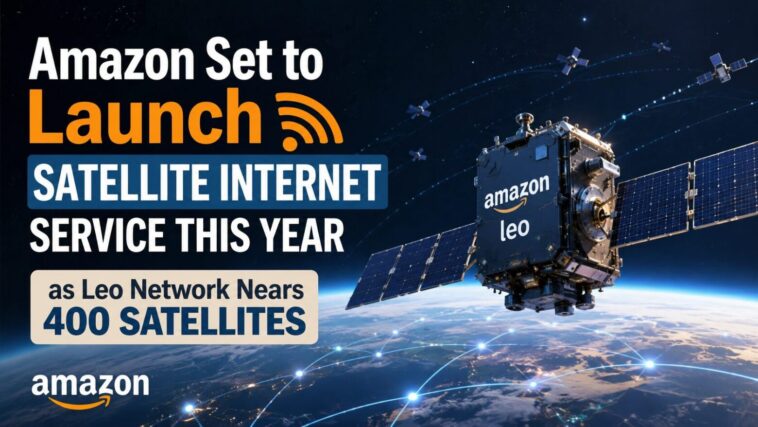
Amazon plans to roll out its first satellite internet service later this year. Having been, the company achieved significant development in October, when its low-earth orbit (LEO) satellite network covered roughly 400 satellites.
Rebranded from Project Kuiper. That is now rebranded as Amazon Leo. The network they aim to provide will hopefully deliver fast, low-latency internet access around the world. The idea is to bring together those in locations where broadband is unavailable or extremely limited.

The most recent rocket to launch this week was an Amazon mission that lifted off from Florida early Thursday. Thirty years of satellites have been blasted into orbit by the US Air Force’s Utah-based United Launch Alliance (ULA) Atlas V rocket. It was the company’s 14th mission by design.
Amazon intends to deploy more than 3,200 satellites as part of a larger constellation. They will offer internet connectivity all over the planet.
President of Amazon, Leo Chris Weber, took to X a few weeks later with an update saying there is much more work to be done after the launch. The new satellites will have to get to their operational orbits first.
However, Weber said Amazon has now completed enough launches to begin offering its first internet service later this year. Future launches will focus on expanding coverage and increasing network capacity.
Weber did not say where the service will launch first. Reports suggest the rollout will begin in regions closer to the North and South Poles. Coverage will slowly expand toward the equator as more satellites enter orbit.
According to spaceflight analyst and Harvard astronomer Jonathan McDowell, Amazon now has 394 satellites in orbit. The company has launched 398 satellites since April 2025.
Amazon has been targeting a commercial launch since mid-2026. To support the project, it has secured launch contracts worth tens of billions of dollars.
Read More: Starlink adds 20,000 users daily, reaches 9 million customers
For now, the Atlas V rocket is doing most of the heavy lifting. Other launch vehicles are not yet available. These include
- Blue Origin’s New Glenn
- ULA’s Vulcan
Both remain grounded.
Amazon Leo will compete directly with Elon Musk’s Starlink. Like Starlink, the company will sell satellite internet to residential users.
Customers will be able to choose from several user terminals. Some will be about the size of a laptop. Others will be larger and more powerful for business use.
Amazon also plans to serve governments, airlines, and other commercial customers.
Starlink still has a big advantage. It has spent years building its network and now operates around 10,000 satellites in orbit.
Even so, Amazon believes it has strengths of its own. The company plans to integrate Amazon Leo with Amazon Web Services (AWS). That could make the service more attractive to business customers.
Amazon also hopes to win rural users. It plans to offer affordable hardware and competitive residential pricing. The company believes this strategy can help it compete as its satellite network continues to grow.