Huma Siraj
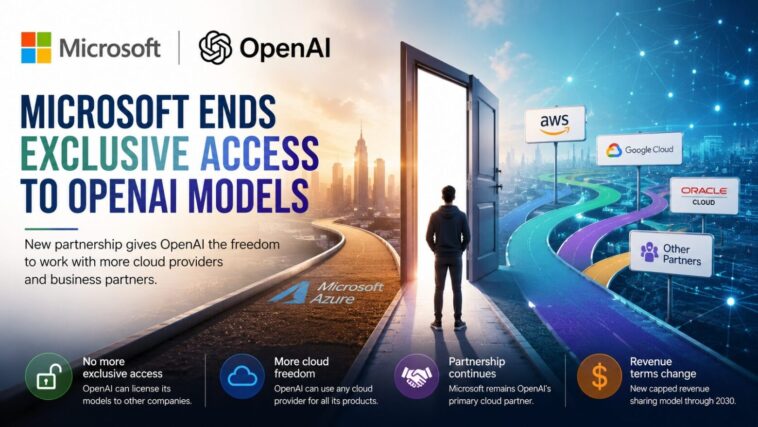
The partnership between Microsoft and OpenAI has been updated once more. This time, the major change is that Microsoft is no longer the only organization with access to OpenAI’s technology. Although the two companies will continue to work together, OpenAI now has greater freedom to do so.
The announcement shows how quickly the AI sector is evolving. Rather of adhering to the same contract they signed years ago, both businesses are modifying their partnership to facilitate future expansion.

Under the new deal, Microsoft will still have a license to use OpenAI’s technology until 2032. The difference is that the license is no longer exclusive. OpenAI can now license its models and products to other businesses if it chooses.
For Microsoft, this does not mean the partnership is ending. The company remains one of OpenAI’s biggest investors and will continue using OpenAI’s technology in many of its products. However, OpenAI now has more room to expand its business beyond Microsoft’s ecosystem.
Another important change involves cloud services.
Many of OpenAI’s products were previously powered mostly by Microsoft Azure. If it makes sense from a business point of view, OpenAI will be able to employ multiple cloud providers in the future.
Azure will, however, continue to be important. Future products are still expected to launch on Azure first, and Microsoft will continue to be OpenAI’s primary cloud partner. The sole exception is if Microsoft chooses not to host a certain product or is unable to maintain it.
The update also removes another restriction that had been in place for some time. Previously, certain OpenAI APIs were available only through Azure. That requirement has now been dropped, giving OpenAI the option to make its developer tools available through other cloud platforms as well.
The financial side of the partnership is changing too.
OpenAI will no longer receive a portion of Microsoft’s profits from OpenAI-related goods. Rather, OpenAI will keep paying Microsoft a portion of its earnings until 2030, but the amount will now be limited. This simplifies the financial arrangement while preserving the benefits of the partnership for both businesses.
The timing of these changes is not surprising.
Instead of relying solely on OpenAI, Microsoft has been collaborating with new AI firms within the past year. One example is Anthropic. Microsoft recently introduced Anthropic‘s Claude models into parts of its Copilot services, giving customers additional choices depending on the task they want to perform.
This approach gives Microsoft greater flexibility. Instead of depending just on one model, the firm can provide a number of possibilities and choose the one that best suits various business requirements.
However, since Microsoft first put billions of dollars into it, OpenAI has expanded significantly. ChatGPT is utilized by millions of people worldwide, and OpenAI continues to develop new solutions for companies and developers. As the business expands, it requires more autonomy to choose partners and create its own plan.