Hajra Naz
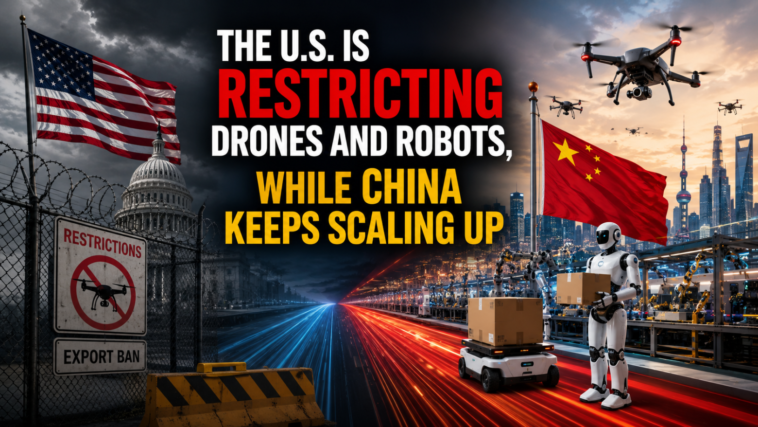
In July and August, Washington tightened restrictions significantly. This applies to foreign-made advanced robotic systems. The government also imposed steep tariffs. Those tariffs target imported drones and their components. Both moves cite national-security concerns as justification. The drone tariffs take effect in September. Additional component tariffs will follow in 2027.
These moves fit into a broader U.S. strategy. The goal is to restrict foreign technology in strategically important industries. The FCC’s Covered List was established back in 2021. It initially targeted telecommunications and surveillance equipment. That included companies like Huawei, ZTE, and Hikvision. Over time, the list expanded further. It grew to cover foreign-made drones. Most recently, it expanded again to include advanced robotic devices.

China’s Growing Dominance in Robotics and Drones
This latest move comes at a notable moment. Chinese manufacturers have built commanding positions in two key areas. That includes drones. It also includes humanoid robots. These companies often compete at prices that U.S. and European rivals struggle to match.
Taken together, these restrictions raise a bigger question. If Chinese drones and humanoids face growing barriers in the U.S., where does competition move next? These restrictions may protect parts of the American market. However, they don’t directly address China’s global manufacturing scale. They also don’t address China’s cost advantages.
Industry analysts and executives shared their views on this shift. Many believe the result won’t be a clean U.S.-China split. Instead, a more fragmented global market may emerge. Chinese companies could expand into other regions. Meanwhile, U.S. and allied manufacturers may focus on markets where security requirements matter more.
Read More: Robotics Startup Unveils First Industrial Humanoid In Uk
The Scale Gap Between the U.S. and China
The U.S. and Chinese robotics industries remain deeply interconnected. Still, both countries enter this competition with very different advantages. Unlike semiconductors, robotics doesn’t hinge on one single technology. No single country can easily control the entire field, said Ankur Saxena, an investment director at TDK Ventures.
China currently dominates global humanoid robot manufacturing. Global shipments hit 22,000 units in the first half of this year. The vast majority came from Chinese manufacturers, according to a report from Counterpoint. By contrast, U.S. companies are operating at a much smaller scale, said Soumen Mandal, a principal analyst at Counterpoint Research.
The world’s five largest humanoid robot makers were all Chinese companies. That includes AgiBot, Unitree, Galbot, UBTECH, and Leju Robotics. Together, these five companies accounted for 86% of global shipments in the first half of 2026, according to Counterpoint.
This advantage could compound over time. Lower prices let Chinese manufacturers deploy more robots in real-world settings. That generates valuable data, which can improve their technology further. Higher production volumes can then drive costs down even more, Saxena explained.
Mandal noted another factor driving down costs. Chinese humanoid makers are bringing more of their technology stack in-house. They’re also drawing on China’s existing manufacturing base. Unitree, for example, is developing more components internally. Automakers like XPeng are applying their existing expertise too. They’re leveraging experience in chips and vehicle manufacturing as they move into robotics.
“The United States leads in frontier AI, software and semiconductor innovation,” Saxena said. “China leads in manufacturing scale, supply-chain depth and cost.”
This manufacturing edge has let Chinese companies cut humanoid prices faster than most U.S. competitors can match.
“You cannot sanction your way around a cost curve. You can only out-build it, and America has yet to begin making the decade-long investment that will require,” Saxena said.
Read More: Major Updates in Machine Learning, Robotics, and Automation
Where Does China Go Next?
The answer may increasingly point outside the U.S. Even if Chinese robotics companies lose access to the American market, they still have options. They retain a large domestic market. They also have room to expand elsewhere. This is especially true in regions with growing demand for affordable automation, Saxena said.
Chinese robotics companies are already targeting specific markets. These include price-sensitive regions facing severe labor shortages. That covers parts of Europe, Southeast Asia, Latin America, and the Middle East, according to Mandal.
Mandal expects humanoid makers to follow a familiar pattern. It resembles the path taken by Chinese electric-vehicle companies. That pattern involves building scale domestically first. Companies then expand into overseas markets. Eventually, they establish local production abroad. Countries facing labor shortages and demographic decline could become early adopters. This applies particularly to manufacturing, where robots can handle repetitive work.
What the Drone Market Reveals
The drone market offers an early preview of this more fragmented landscape. The industry is increasingly splitting into two separate ecosystems. One is a U.S.-led market. It’s built around American-made, NDAA-compliant systems. The other is a China-led market. It focuses on low-cost, high-volume production, said Bentzion Levinson, founder and CEO of Virginia-based drone maker Heven AeroTech.
Levinson believes Western manufacturers are unlikely to beat Chinese companies in one specific area. That’s the low-end consumer drone market, where cost remains the dominant factor. Instead, U.S. and allied companies may increasingly compete elsewhere. That includes long-range autonomous systems for defense. It also includes critical infrastructure applications, where security requirements carry more weight.
Levinson sees the next competitive frontier shifting away from drones themselves. Instead, it’s shifting toward the technology that powers them. That includes the equipment drones carry too. “The next battleground is over who owns the next-gen energy and payload architecture,” he said. He specifically pointed to battery constraints as a key factor. As drones become more capable, he added, battery limitations could become an increasingly important competitive point.
Agility Robotics welcomed the FCC’s decision back in July. The company said it could address real security concerns. Specifically, it targets concerns around foreign-made advanced robots before they become deeply embedded in the U.S. market. That’s already happened within the drone industry. The company pointed to its own Digit humanoid robot. That robot is designed and assembled in the U.S. Agility Robotics also called for something important. It wants continued access to tools and technologies needed to advance robotics research.
Read More: Unitree Robotics Set to List in Shanghai After Record 8,000 Times Oversubscription
A More Regional Robotics Market
“The alternative to China isn’t a purely domestic U.S. supply chain; it’s a diversified allied one,” Saxena said.
This shift could create new opportunities elsewhere in Asia. Japan brings decades of experience in industrial robotics and precision manufacturing. South Korea offers strengths in electronics, batteries, and automobiles. Taiwan remains a major player in semiconductors. Still, none of these countries can simply replace China outright, Saxena noted. Chinese components remain deeply embedded across the global robotics industry.
Asian manufacturers could emerge as a middle ground option. They’d sit between lower-cost Chinese robots and more expensive U.S. offerings, Mandal said. South Korea’s Hyundai, which owns Boston Dynamics, is investing heavily in robotics. Japan’s Toyota is doing the same. Both companies are drawing on their existing expertise. That includes vehicles, manufacturing, and autonomous systems, as they expand into humanoid robots.
Yang Fang of Beagle Technology offered additional perspective on this trend. Beagle Technology is a California-based agtech startup. It uses AI and robotics software to convert conventional farm equipment into autonomous machines. Fang said robotics is likely to become more regional over time. Companies will design machines around specific labor needs.
Working conditions and customer bases in home markets will shape this too. Chinese robotics companies, for example, may focus on products suited to China and nearby markets. Meanwhile, U.S. companies are more likely to build for industries across North America, he explained.
The final result may not be two neatly separated industries. Instead, these restrictions could accelerate the emergence of regional markets. Chinese companies may compete on cost and scale across much of the world. U.S. and allied manufacturers could gain ground where security requirements matter most. Meanwhile, manufacturers in Japan, Taiwan, and South Korea may try to carve out space between these two poles.