Hajra Naz
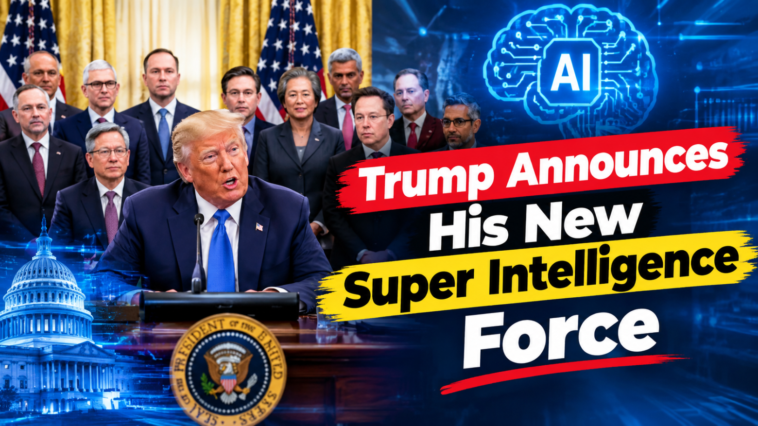
As promised, President Donald Trump has announced the formation of a new Super Intelligence Force. He said it will be led by national intelligence director Jay Clayton, along with other members of his administration.
“The Super Intelligence Force is tasked with coordinating the effort of the Federal Government to ensure that America continues to lead the world in super intelligence, which many say is bigger than the Industrial Revolution and the Internet, and will protect the interests and improve the lives of all Americans,” Trump said in a Sunday morning post on Truth Social, his social media platform.

Back in September, Trump responded to an ongoing AI safety debate. He had largely dismissed that debate as a hoax created by “Radical Left Democrats.” Still, Trump said he would form an AI Force and appoint an AI czar at the time. He added that “Only high-I.Q. individuals need to apply!”
Since then, Trump signed an executive order seeking to rebrand AI entirely. The new preferred term is “super intelligence.” This terminology appears to have been embraced, with some noticeable stumbles, by tech executives. Those executives gathered at the White House this week. They signed a non-binding safety pledge during that visit. Notably, the pledge included a significant typo.
Given this rebranding effort, it makes sense that Trump’s new task force follows the same naming convention. According to The Wall Street Journal, Clayton will chair the Super Intelligence Force. This effectively makes him the new AI, or SI, czar.
Read More: Can AI’s Image Problem Be Fixed With Super Intelligence and Safety?
Several officials will serve as vice chairs under him. That includes Federal Trade Commission Chair Andrew Ferguson. It includes Undersecretary of War for Research and Engineering Emil Michael. Office of Personnel Management Director Scott Kupor rounds out this group.
The task force will reportedly have 120 days to complete a specific assignment. It must create a report covering the risks and opportunities presented by AI. Clayton has previously commented on this topic publicly.
He said it would be irresponsible for the United States to “back away” from AI, especially as countries like China continue advancing. He made similar comments directly to the WSJ. According to Clayton, one of the biggest risks facing the U.S. is simply “not being first.”
The task force’s official charter reportedly outlines its mission clearly. It states that the group will “develop plans for responding to SI-enabled threats to our society while preventing overregulation and regulatory capture that would stifle innovation and competition.”