Hajra Naz
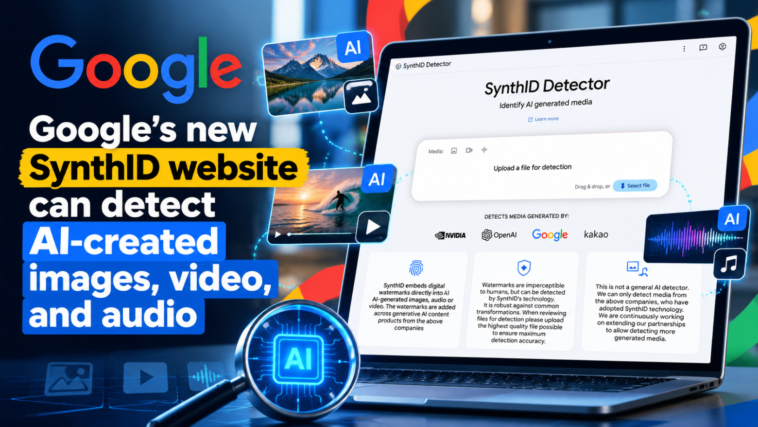
On Tuesday, Google launched a new site that lets anyone verify whether media was made with AI. It works on images, videos, and audio clips. The tool is open to everyone now.
From Limited Testing to Public Access
Google first offered this detector to a small group at Google I/O last year. That group included select journalists, media professionals, and researchers. They tested it and gave feedback. Now Google is opening the tool to the public.

Supported File Formats
The site accepts a wide range of file types.
- Images: JPG, JPEG, PNG, BMP, WEBP, AVIF, HEIC, HEIF, TIFF, TIF, and GIF
- Videos: MP4, MOV, and WEBM
- Audio: WAV, MP3, OGG, FLAC, AAC, and M4A
How SynthID Works
The tool relies on SynthID, which Google introduced in 2023. SynthID embeds a hidden watermark into AI-generated media. People can’t see or hear it. A detector can read it, though. That’s what the new site does.
Several Google products add this watermark to their output. That includes the Nano Banana, Veo, and Lyria models. It also includes tools with generation features, like Gemini, Flow, ProducerAI, and Vids.
Support Beyond Google
Other companies back SynthID too. OpenAI, Nvidia, and Kakao all support it. OpenAI also runs its own site for checking content. Apple is said to be adding support soon.
Built Into Everyday Tools
Google has built SynthID verification into the Gemini app and Google Chrome. People can check content without visiting a separate site. The company says people currently make 1 million verification requests every day.
Read More: Does AI-Generated Content Rank on Google?
Where Other Standards Stand
Microsoft and Meta have their own watermarking and verification standards. These tools aren’t foolproof, though. They have often failed to identify content made by their own makers’ models.
Why This Matters
AI-generated images, video, and audio are getting harder to tell apart from real ones. A free, public checker helps in several situations.
- Journalists can check a viral clip before they report on it.
- Researchers can study how synthetic media spreads.
- Everyday users can check a suspicious image before they share it.
A Limit Worth Knowing
SynthID only detects media that carries its watermark. A clean result doesn’t prove something is real. It may simply come from a tool that doesn’t use SynthID. A positive result is much more informative than a negative one. Anyone verifying content should treat the tool as one clue among several.