Hajra Naz
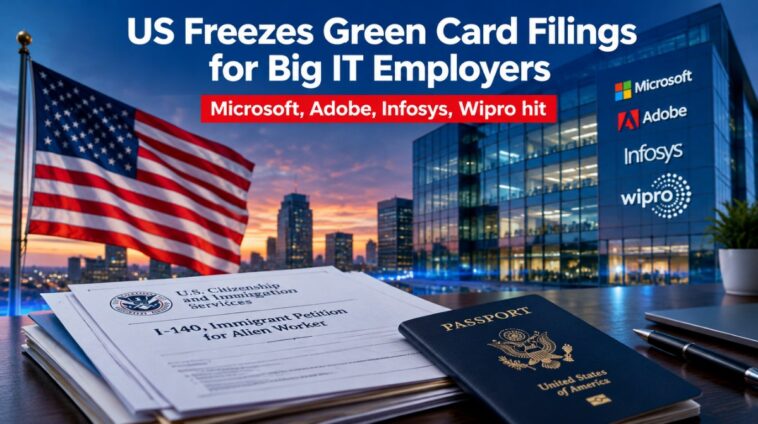
The United States government has stopped accepting new and pending permanent labor certification applications from Microsoft, Adobe, Capgemini, Cognizant, HCL, Infosys, Tata and Wipro, according to TechCrunch’s report of October 8, 2026. Labor Secretary Keith Sonderling announced the move, and the administration accuses the companies of fraud. Permanent labor certification, known as PERM, is the first step an employer must complete before sponsoring a foreign worker for an employment-based green card.
What was actually suspended
PERM is run by the US Department of Labor. Per the department’s own Permanent Labor Certification page, the employer files Form ETA 9089, and the certification tells USCIS that there are not enough able, willing, qualified and available US workers for the job and that hiring the foreign worker will not hurt the wages and working conditions of similar US workers. A certified application is valid for 180 days, and the employer generally needs it before filing the I-140 immigrant petition with USCIS.

This is separate from the H-1B, which is a temporary work visa. The suspension targets the permanent residency track, so a worker already on an H-1B at one of these companies can no longer count on that employer starting the green card process while the freeze lasts. TechCrunch’s report does not say how long the suspension will run or what it means for workers whose applications were already certified, and the Labor Department’s newsroom page did not show a notice when we checked.
A pattern that started in September
Cognizant was the first name to surface. In early September, the Labor Department’s Inspector General, Anthony D’Esposito, said in a post on X that Cognizant’s PERM filings had been suspended, as YourStory reported on September 9. That post gave no detail on the alleged violations, and the official hinted at wider action. Thursday’s announcement is that wider action. Vice President JD Vance, speaking at a news conference, said, “Our message to Microsoft is: You’re a great American company, but you’ve got to hire great American workers,” as Reuters reported. Vance also said the administration will investigate nine universities, including Harvard, Yale and Stanford, over alleged abuse of a program that lets international students come to the US.
Tech companies are among the biggest H-1B users, and nearly three-quarters of approved visas go to workers from India, according to the Associated Press figure cited by TechCrunch. Microsoft and Adobe had not responded to requests for comment at the time of publication.
Why South Asian and Gulf-based tech workers should pay attention
Most beingguru readers are not waiting on a US green card through Infosys or Microsoft. But the signal matters for anyone who has treated a US job as the default career endpoint. The named list mixes American software firms with the large Indian-origin IT services companies that send thousands of engineers abroad, which tells you the pressure is not aimed at one business model. A route that looked stable for a decade is now being narrowed by executive action, with little notice.
For freelancers and remote workers, that argues for building income that does not depend on a visa at all. Selling services to US and European clients from Karachi, Lahore or Dubai needs no sponsorship, no labor certification and no employer willing to wait years for a priority date. It also argues for keeping skills portable: the developers, designers and marketers who can win clients directly are the ones least exposed when an immigration door closes. Our earlier piece on Google’s plans to restart green card applications shows how quickly employer-side policies can swing in either direction.
What to watch next
Three things will tell us how serious this is. First, whether the Labor Department publishes a formal notice with the legal basis for the suspension, since no primary document has appeared yet. Second, whether the freeze extends to other large sponsors beyond the eight named companies. Third, whether the companies challenge it in court or negotiate a path back into the program. Until those answers arrive, anyone with a pending PERM case at one of these employers should ask their company’s immigration counsel directly rather than rely on headlines.
This article is general information, not legal advice.