Alveena Ahmad
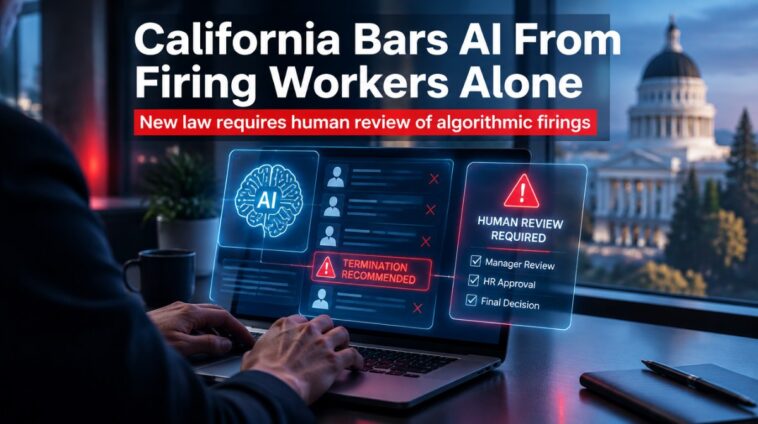
California has become the first US state to bar employers from letting an algorithm fire or discipline a worker on its own. Governor Gavin Newsom signed SB 947, the No Robo Bosses Act of 2026, on September 30, requiring a human reviewer to corroborate any termination or discipline decision that an automated system drives. The law takes effect July 1, 2027.
What the law actually requires
SB 947, authored by state senator Jerry McNerney, targets what labor groups call “bossware”: automated decision-making systems that employers use to monitor output, flag underperformance, and in some cases issue discipline directly. Under the new rules, an employer cannot rely solely on one of these systems to fire or discipline a worker. If a system is the primary basis for a termination or disciplinary action, a human reviewer must corroborate it using separate evidence, such as a manager’s evaluation, peer feedback, or personnel records. Employers must also tell the worker in writing that an automated system played a primary role in the decision, describe what employee data the system used, and name a human the worker can contact to discuss it. The California labor commissioner, the state attorney general, or local prosecutors can enforce the law.

McNerney’s office cited a British study finding that AI assistants misrepresent content nearly half the time as part of the case for mandatory human review, alongside a count of more than 550 commercial bossware products already in use across workplaces. The bill was sponsored by the California Federation of Labor Unions, AFL-CIO, whose president Lorena Gonzalez called the signing a template for “how, by letting workers lead, we can stop some of the worst abuses of AI at work.” Senator McNerney’s office published the full details of the signing.
The part that didn’t make the final bill
An earlier version of SB 947 would have extended its protections to gig workers. Newsom vetoed that draft in 2025 over its advance-notice requirements, and when McNerney reintroduced the bill this year, the gig-worker language was cut along with the broader notice provision, as employment law analysts have noted. The law as signed covers employees, not independent contractors managed through an app.
That distinction matters more than it might look. Ride-hailing and delivery platforms already route huge amounts of assignment, rating, and deactivation logic through algorithms with little human involvement, and freelance marketplaces are moving the same direction: job matching, visibility ranking, and account-level warnings on platforms like Upwork and Fiverr are increasingly automated too. SB 947 gives W-2 employees in California a right to a human check on an algorithmic firing. It gives none of that, yet, to the millions of people worldwide, including a large share of Pakistan’s freelance workforce, whose income depends on how a platform’s ranking or moderation algorithm treats their account. Anyone weighing which marketplace to build a freelance income on can compare the options in beingguru’s roundup of freelance marketplaces beyond Fiverr and Upwork.
Where this leaves platform workers
Nothing in SB 947 reaches outside California employment law, and nothing in it touches marketplaces that classify their workers as contractors rather than employees, which describes most freelance platforms. For now, a freelancer whose account gets flagged or suspended by an automated trust-and-safety system still has no statutory right to a human review of that decision, in California or anywhere else. Labor advocates who backed the bill have said they see it as a first step rather than a finished policy, and similar bills are already moving in other states. Whether that momentum eventually reaches platform and gig work, or stays confined to traditional employment, is the question worth watching from here.