Hajra Naz
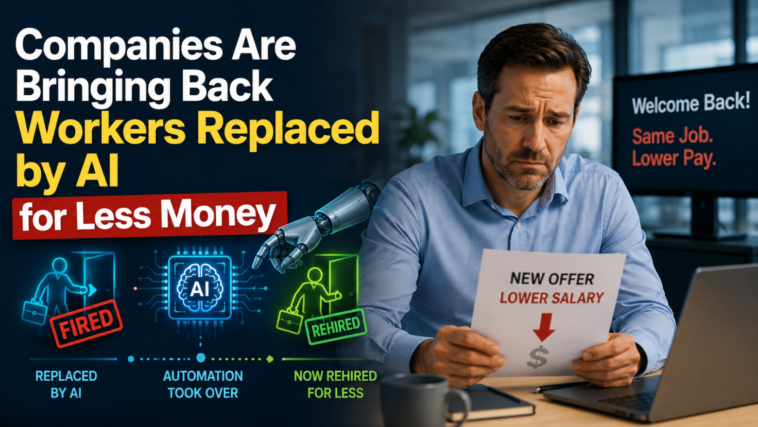
Many companies rushed to cut jobs because of artificial intelligence. Now, a growing number of them are reconsidering that decision. New research shows something striking. More than half of employers now regret their AI-driven layoffs.
Forrester conducted research on this exact trend. The firm reported that 55% of surveyed employers regretted laying off workers because of AI. Forrester also made a bold prediction. More than half of AI-attributed layoffs will eventually be quietly reversed.

Jobs Could Return With Lower Pay
This reversal may not actually benefit the original workers, though.
According to Forrester, roles may not return exactly as they were. Some jobs could return offshore instead. Others may return, but at significantly lower wages. This shift happens because companies are learning something important. Fully replacing human workers with AI is often more difficult and more expensive than expected.
Forrester also raised a related concern. Some companies may be engaging in what they call “AI washing.” This happens when layoffs are actually driven by financial pressures. Companies then frame those same layoffs as AI-related decisions. This framing can happen even when mature AI systems aren’t actually ready to replace those workers.
Forrester offered a broader forecast too. The firm expects AI to augment roughly 20% of U.S. jobs by 2030. It expects AI to fully automate only about 6% of jobs. This suggests something important. Widespread worker replacement seems less likely than a hybrid approach. That approach would combine human workers with AI tools.
Read More: Cloudflare cuts 1,100 jobs amid AI-driven restructuring
Workers Remain Worried
Despite this shifting corporate approach, worker anxiety hasn’t decreased much.
A Reuters poll found real concern among American workers. According to that poll, 53% of Americans worry AI could cost them, or someone in their household, a job. Another 37% said they weren’t concerned about this risk. The remaining respondents said they were unsure. This survey included 4,531 U.S. adults in total.
A separate study reinforced these concerns. A 2026 Software Finder survey found something similar. 53% of workers worried that AI tools could make their role feel less necessary over time.
Europe Tightens Worker Consultation Rules
European companies now face stricter requirements around major workforce decisions.
The EU recently revised its European Works Councils Directive, now labeled (EU) 2025/2450. This directive applies to covered multinational companies. Under the new rules, these companies must provide information to employees.
They must also consult employee representatives directly. This consultation must happen before major transnational decisions are finalized. Company management must also respond formally to workers’ opinions on these matters.
It’s worth noting some limits to this directive. These rules aren’t specifically an AI-layoff law. They also don’t apply to every employer operating in Europe. Instead, they apply specifically to qualifying multinational companies. They also apply to transnational matters specifically. That can include major layoffs. It can include outsourcing decisions. It can also include restructuring efforts that affect workers across multiple EU countries.
There’s a clear timeline attached to this directive too. Member states must adopt the required legislation by January 1, 2028. Most provisions will then apply starting January 2, 2029. The directive includes another important requirement. It calls for effective financial penalties in cases of violations. When setting those penalties, regulators must consider a company’s overall turnover.
Read More: MIT reports AI now capable of replacing millions of U.S. jobs
A More Nuanced Picture Emerges
Taken together, this data paints a more nuanced picture overall. This isn’t simply a story about AI eliminating jobs wholesale. Instead, it’s a story about companies learning something more complex. They’re figuring out where automation actually works well. They’re also identifying where human workers remain genuinely necessary. And perhaps most importantly, they’re discovering just how costly it can be to get that calculation wrong.