Huma Siraj
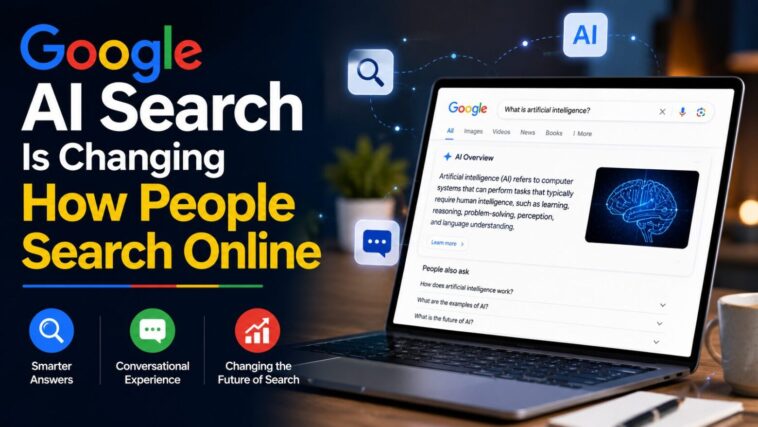
One of the most significant modifications to Google’s search engine in years is currently taking place. It is increasingly offering AI-generated responses that keep people on Google longer rather than just displaying a list of webpages. According to a recent study, this practice is rapidly expanding and altering how individuals look up information online.
According to market intelligence firm Similarweb, Google’s AI Overviews now appear in 43% of searches, compared with just 15% a year ago. The feature has moved from being a limited experiment to becoming a common part of the search experience.

AI Search Is Becoming More Common
Many consumers only sporadically viewed AI Overviews when Google originally launched them. These days, they show up in nearly half of all queries, providing visitors with concise summaries rather than requiring them to open many websites.
Also, Google’s conversational search function, also known as AI Mode, encourages users to go deeply into a subject.
According to Similarweb, publishers continue to experience a drop in referral traffic as AI-generated responses become more common.
Read More: You Can Now Log In to Your Google Account With a Selfie Video
People Are Asking Longer Questions
The report found that search habits are changing. In the past, users often searched using just a few keywords. Now they are writing complete questions, much like they would ask another person.
For instance, instead of putting “best budget phone,” people are more likely to inquire, “Which budget phone has the best camera and battery life?”
This change reflects the growing influence of conversational search powered by AI.
Google Is Becoming the Destination
Traditionally, Google acted as a gateway that directed users to other websites. That is beginning to change.
Instead of sending people elsewhere, Google is answering more questions directly on the search page. Users can then continue asking related questions without leaving Google’s platform.
As a result, people are spending more time inside Google’s own services.
Publishers Continue to Lose Visitors
While this may enhance the user experience, publishers now face new difficulties as a result.
Users may never land on the primary page if they discover the information they need in AI Overviews. As a result, news websites, blogs, and online publications that rely on internet traffic for advertising revenue will see fewer visitors.
Similarweb indicates that as AI-generated answers proliferate, publishers continue to witness a decline in referral traffic.
Cloudflare Introduces New Protection Tools
Publishers are now looking for ways to protect their content.
Cloudflare recently launched tools that allow website owners to block AI crawlers unless AI companies agree to pay for access to their content.
The new system gives publishers more control over how their articles and information are used.
AI Responses Now Include More Sources
There is also some encouraging news. Users may not spend time on the source page if they find the information they need in AI Overviews. As a result, news websites, blogs, and online publications that rely on internet traffic for advertising income will see fewer visitors.
ChatGPT Referrals Show Improvement
Similarweb also looked at referral traffic coming from ChatGPT. As of May 2026, just 6.8% of desktop searches in the United States included citations. However, travel, shopping, and sports searches were more likely to include links than many other categories.
Additionally, a search modification that was made public on May 7 contributed to an increase in referrals, according to the data. By the end of May, about 60% of ChatGPT requests linked users to websites, up from 25% in March.
It shows that when links are easy to locate, people keep clicking through to websites.
Search Is Entering a Different Era
Online search is changing quickly, according to the most recent statistics.
Google is evolving from a website-finding tool to a platform where users can ask questions, get thorough responses, and carry out further research without ever leaving the site.
Although this improves user experience, publishers whose material powers these AI-generated responses are also concerned.
Technology firms, publishers, and content producers will need to come up with new strategies to strike a balance between innovation and the importance of original journalism and online content as AI-powered search continues to grow.