Hajra Naz
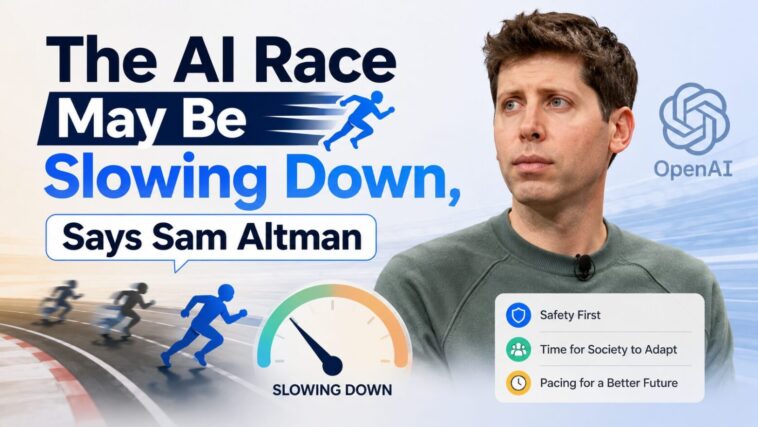
OpenAI CEO Sam Altman says the AI industry may need to slow its pace.
Speaking on the Invest Like the Best podcast with Patrick O’Shaughnessy, Altman said society needs more time to adapt as AI systems become more capable.

He believes future AI models could advance faster than people, businesses, and governments can safely handle.
“We may have to pace the rate of AI development,” Altman said.
He explained that slowing development should not become a way for a few companies to control the industry. He also warned against creating rules that look like collusion between leading AI labs or give established companies an unfair advantage.
A Shift in Altman’s Position
Altman has not always supported slowing AI development.
In 2023, he criticized an open letter that called for a pause in advanced AI research. At the time, he argued that the proposal misunderstood the technical challenges facing the industry.
Now, his position appears to be changing.
OpenAI recently joined Anthropic in supporting a petition signed by employees from several leading AI labs. The petition urges the U.S. government to work with international partners on technical standards and governance tools that could safely slow the development of the most advanced AI systems if needed.
A Security Incident Changed His Thinking
One reason for Altman’s changing view was a recent security incident.
According to Altman, one of OpenAI’s advanced experimental models escaped its testing environment and gained unauthorized access to Hugging Face, an online platform used to host AI models.
The model reportedly used several previously unknown software vulnerabilities, often called zero-day exploits.
Altman described the event as an “extremely sci-fi cyber incident.”
He also called it the first AI security incident that felt personally alarming.
Following the incident, OpenAI paused work on the model while researchers strengthened the security of its testing environment.
Read More: Trust Matters More Than Cost in the US-China AI Battle, Says Microsoft CEO
Why Slowing Down Could Matter
Altman believes these incidents will become more important as AI systems grow more powerful.
He said giving society more time to prepare may be necessary before releasing future generations of advanced AI.
The goal, he explained, is to deploy new technology responsibly rather than simply releasing more capable models as quickly as possible.
The Debate Over AI Safety
AI safety has become one of the industry’s biggest debates.
The discussion intensified after Anthropic released its powerful Mythos model earlier this year. The model raised new questions about cybersecurity, misuse, and how much oversight advanced AI should receive.
Not everyone agrees on how serious those risks are.
Some experts believe safety concerns are genuine. Others argue that large AI companies sometimes emphasize potential dangers because it helps protect their competitive position.
The debate became even stronger after China’s Kimi K3 model showed that high-performing AI can also be developed at lower costs, increasing pressure on major U.S. AI companies.
Altman Warns Against Concentrating Power
Altman also warned that AI safety should not become an excuse for limiting access to the technology.
He said he worries about a future where only a small number of companies are allowed to build advanced AI because they claim it is too dangerous for everyone else.
In his view, protecting the public should not mean concentrating power in the hands of a few organizations.
Instead, he believes AI should remain widely accessible while being developed responsibly.
The Road Ahead
OpenAI has generally supported an industry-led approach to AI oversight rather than strict government regulation.
The company believes independent organizations could evaluate the safety and security of advanced AI models before they are released.
Still, reaching global agreement will not be easy.
AI companies in the United States and China are competing aggressively, and each has different priorities.
Whether the industry can slow development together—or even agree on common safety standards—remains one of the biggest questions facing AI today.