Hajra Naz
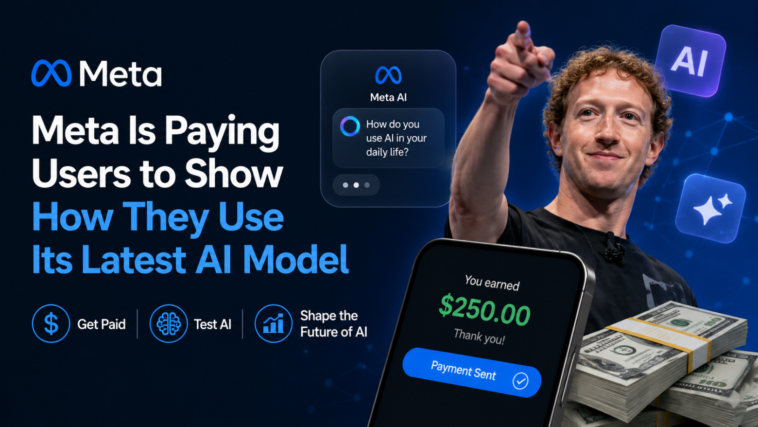
Most AI tools let users opt out of sharing their usage data. That data typically helps model providers improve future versions. Meta has taken this idea a step further. The company has now put a price tag on it.
For its new Muse Spark model, Meta is offering something specific. This model is intended for operating coding and other agents. Meta offers an explicit discount for certain users. That discount averages out to about 95%. It applies to users who “contribute” to future model development. Specifically, they do this by sharing their prompts and model outputs.

The pricing difference is significant. Under a standard agreement, 1 million input tokens cost $1.25. Under the contributor pricing model, those same tokens cost just 10 cents. Output tokens follow a similar pattern. The standard price sits at $4.25 per million tokens. Under the contributor model, that same million costs just 20 cents.
Meta has struggled to obtain training data recently. Earlier this year, the company launched an initiative. It aimed to track employees’ computer usage. That initiative drew wide internal criticism. It was paused in June. Meta did not respond to a question about its new pricing model.
This kind of user data plays a critical role. It’s vital for making agentic tools work better over time. “The reason we saw a big jump in [coding agent] capabilities between April 2025 and October 2025 was that Claude Code, by default, would store all your coding agent sessions and use them for reinforcement learning training,” said Mario Zechner, developer behind the open-source harness Pi.
Model builders increasingly need to deploy agentic tools beyond software engineering. Still, a real obstacle exists. Their ability to evaluate and improve these tools faces limits. That’s due to complexity. It’s also due to a lack of digital traces across many professional workflows.
Arvind Narayanan, a Princeton computer science professor, offered his own perspective. He noted strong evidence that large companies resist having their data used for training.
“They stick with token-billed Enterprise plans even though the subscription-based consumer plans like Claude Max and ChatGPT Pro are discounted by 10x-20x or even more! (The main difference between the plans is data retention + enterprise IT governance),” he wrote on social media.
Meta’s new pricing may reflect awareness of this dynamic. The company is now offering explicit compensation for that data. Its pricing guide describes the contributor tier specifically. It says this tier “lowers the barrier to entry for prototyping, testing integrations, and scaling experiments where training on your data is acceptable.”
Narayanan suggested a possible ripple effect from this approach. It could push large companies to think more carefully. Specifically, they may reconsider which data is truly proprietary. They may also reconsider which data could reasonably be shared with model providers.
This pricing framework also fits into a bigger industry trend. Price competition between frontier AI labs continues to intensify. Anthropic’s newest Fable and Mythos models were released yesterday. They came with lowered costs for processing cached tokens. Meanwhile, OpenAI’s latest models received major price cuts. Those cuts arrived at the end of July.