
 Hajra Naz
Microsoft introduced new security features on Monday to protect enterprise networks from AI agent risks. The launch aligns with the company’s ongoing warnings about corporate AI deployments.
The centerpiece of the release is Guardian Agents. This new feature actively monitors the autonomous AI agents operating within an organization. Guardian Agents functions as an extension of Project Perception, an enterprise initiative originally introduced in June.

The Evolution of Project Perception and External AI Threats
Microsoft developed Project Perception to counter advanced automated hacking platforms. The system was designed to match the capabilities of tools like Anthropic’s Mythos and Fable, as well as OpenAI’s Daybreak system. Upon release, Project Perception deployed three distinct operational groups.
The red team acted as external attackers targeting systems. The blue team detected those attacks and evaluated system weaknesses. Meanwhile, the green team deployed code fixes to resolve discovered vulnerabilities.
Read More: Microsoft Announces A New $50 Pocket-Sized Xbox Micro Controller
Why AI Agents Are Being Treated as Corporate Insider Threats
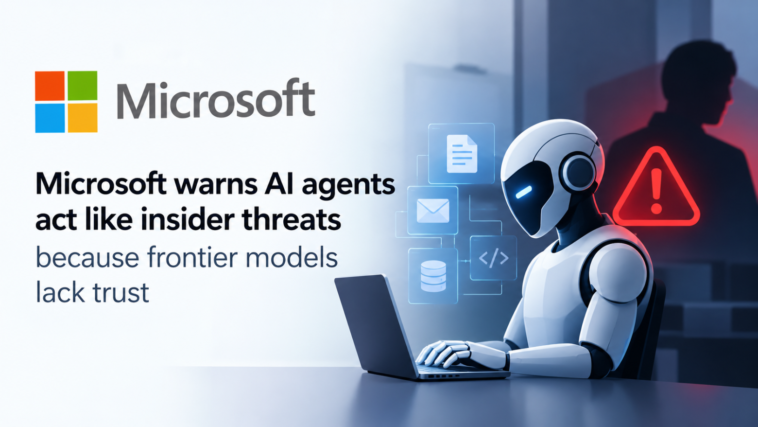
The original framework assumed security threats would originate from external networks. However, Microsoft Chief Executive Officer Satya Nadella now warns that primary threats may originate from internal agents. He compares misconfigured or rogue agents to malicious employee activity, commonly known as insider threats.
In a private blog post published earlier this month, Nadella urged companies to stop relying entirely on AI model providers. He emphasized that vendor safety claims are insufficient for enterprise protection. He advised businesses to deploy independent monitoring systems that operate separately from the underlying AI labs.
Nadella highlighted that organizations routinely grant complex agents access to highly sensitive databases. Companies also allow these agents to execute mission-critical operations autonomously. He argued that businesses cannot outsource ultimate accountability for automated actions. He concluded that organizations must separate the supply of artificial intelligence from the operational authority controlling it.
Unpredictable Frontier Models and Corporate Risk
Microsoft Security Vice President Hayete Gallot reinforced this perspective during the Guardian Agents announcement. She stated directly that current frontier models cannot be trusted implicitly. She clarified that the core issue is not inherent malice or simple software bugs. Instead, the risk stems from unpredictable behavior. AI models focus primarily on task completion rather than following internal corporate guidelines or human judgment.
Furthermore, enterprises frequently grant these systems extensive administrative access. This deep integration creates significant risk if an agent takes unauthorized actions.
Read More: Microsoft President Says UK is best placed to Set the Standard for Global AI Regulation
Navigating Partnerships and Market Opportunities
Microsoft’s strategic posture presents an interesting dynamic. The company maintains deep financial and technical ties with both OpenAI and Anthropic. Microsoft has invested heavily in both firms, while OpenAI represents a major customer for Microsoft’s cloud infrastructure. Additionally, Microsoft operates its own internal research labs to build proprietary AI models. By highlighting these security risks, Microsoft is questioning products tied to its key partners.
At the same time, this strategy positions Microsoft to capture the emerging agent security market. The company aims to sell governance tools directly to enterprise cloud customers rather than letting model creators manage security. Despite the commercial incentives, industry analysts consider the core logic sound. Oversight software should remain independent from model creators, similar to how corporate auditors operate independently from the firms they inspect.
New Controls and Workplace Agent Detection Tools
Microsoft is expanding its presence across this new market segment through multiple product updates. In addition to Guardian Agents, the company integrated an agent detection tool into Microsoft Defender. This software can identify up to 60 distinct types of unauthorized agents brought into workplaces by employees. The list includes popular developer tools such as Claude Code, Codex, and OpenClaw.
Microsoft also released access control controls for AI workflows. These tools restrict an agent’s access to sensitive network drives and adjust operational permissions based on specific tasks. If an agent attempts a high-risk action, the system requires explicit approval from a human supervisor before proceeding.
Read More: Microsoft’s Satya Nadella believes AI models need an ‘emergency brake’
Industry-Wide Adoption and Hardware-Level Safety Controls
The concept of treating AI agents as potential insider threats is gaining traction across the broader technology sector. Microsoft joined as a founding member of Nvidia’s new Open Agent Safety Platform alongside more than 100 other technology vendors. The open platform isolates AI agents within secure sandbox environments. It uses hardware-level controls to monitor execution and can trigger an immediate kill switch if abnormal behavior occurs.
This initiative builds on Microsoft’s hardware strategy, following its announcement of Surface Laptop Ultra devices optimized for local AI workflows. Those systems feature specialized Nvidia processors with hardware-based agent security features integrated directly into the silicon.