Hajra Naz
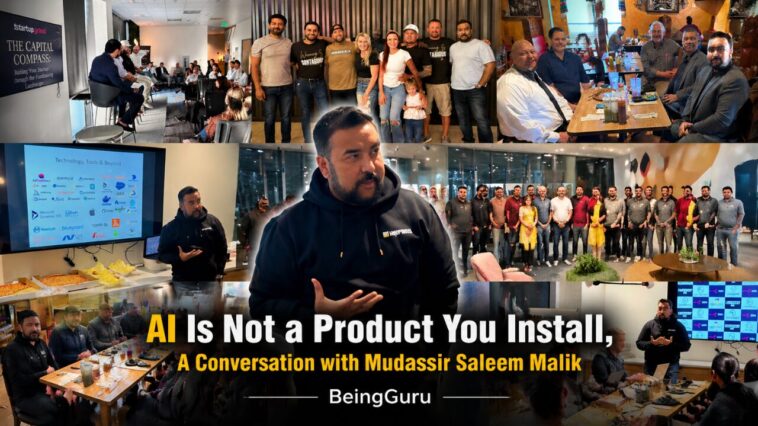
AI adoption succeeds when it’s treated as an ongoing organizational change, not a one-time software install — that’s the core message from this conversation with AI strategist Mudassir Saleem Malik.
Artificial intelligence has gone from boardroom buzzword to boardroom pressure. Every executive in America is being asked what their AI strategy for US enterprises is. Fewer have a genuine answer, and fewer still have someone they trust to help them build one.

Mudassir Saleem Malik is one of those rare practitioners who operate at the intersection of business strategy and AI implementation. Based in Richardson, with active engagement across California and New York, he works with US enterprises, growth-stage companies, and startups to define where AI creates real business value and then designs and delivers the systems to get there.
His work spans HealthTech and FinTech AI implementations across the United States and internationally, with a particularly strong footprint across MENA markets, including Saudi Arabia and the United Arab Emirates.
We sat down with him to ask the questions most organizations are not asking themselves and to understand what it actually takes to build AI that survives contact with the real world.
BeingGuru: Before we get into the how, tell us about your work in the United States. Where are you focused, who are you working with, and what problem are you actually solving for US companies right now?
Mudassir Malik answered:
My primary work is in the United States, that is where the majority of my client engagements are, where I spend most of my time, and where I think the most consequential AI adoption strategies are being made right now.
Geographically, Texas is my base and my strongest market. The Dallas-Fort Worth corridor in particular has become a serious enterprise technology hub, with financial services firms, healthcare organizations, insurance companies, and energy sector enterprises all actively investing in AI and digital transformation Texas.
I work with leadership teams in those sectors to define their AI strategy, build the business case for AI investment, and design the implementation roadmap. Not at the proof-of-concept level, at the level of committed, production-bound transformation.
California is where I engage most actively with the venture and startup ecosystem, the AI infrastructure conversations, and the early-stage companies building in FinTech and HealthTech AI that will become the platforms larger organizations adopt in three to five years. Being present in that conversation matters because it keeps my thinking current and my network relevant.
New York brings a different dimension, financial services at the enterprise scale, where AI in lending, compliance, risk decisioning, and customer intelligence is moving from pilot to production across major institutions. The conversations there are sophisticated, the stakes are high, and the tolerance for vague strategy is very low. I find that environment clarifying.
The problem I am solving across all three markets is essentially the same: US organizations have genuine AI ambition and, increasingly, real budget behind it, but they are making strategy and architecture decisions without the kind of structured business analysis that separates successful implementations from expensive failures. I help close that gap.
BeingGuru: Everyone says they are doing AI now. What are most US companies actually doing, and where are they going wrong?
Mudassir:
“The dashboard problem kills more AI implementations than bad technology. The system works. The model is accurate. But nobody acts on the output, and that is a change management failure, not an AI failure.”
BeingGuru: You work with enterprises, SMBs, and startups across the US. Is the AI challenge fundamentally different across those three?
Mudassir:
Same problem, very different constraints, and the constraints matter more than people think.
For US enterprises at the Fortune 500 level, the major financial institutions, and the large healthcare systems, the challenge is inertia and integration. They have the budget, they have the data, and they have existing systems that AI has to work alongside.
The blockers are organizational: competing priorities, legacy infrastructure, and the change management work of getting a large organization to actually use what you build. At the CXO level, my job is as much about sequencing the roadmap to build early confidence as it is about the technical architecture. Win something visible in ninety days, and you earn the space to do the harder transformation.
For US growth-stage companies, Series A through C, typically, the challenge is prioritization. They cannot afford to experiment widely. Which one or two AI interventions will have a disproportionate impact relative to cost and operational complexity? That question has to be answered before anything else moves.
For startups, especially in FinTech and HealthTech, the work is architectural. Build AI-readiness into the product from day one. The companies that retrofit AI two years later spend three times as much and disrupt their own momentum in the process. I advise founders on where to make the design decisions early that give them strategic flexibility later and where the AI investment should wait until the business model is sufficiently validated.
BeingGuru: Agentic AI is getting a lot of attention right now. For a CFO or COO who is not deep in the technical space, what does it actually mean, and why should US enterprises care?
Mudassir:
Most enterprise AI right now is still sophisticated search and summarization; it responds to a prompt, retrieves information, and generates a document. Genuinely useful, but not transformational.
Agentic AI implementation in the USA is a system that can reason through a multi-step problem, make a sequence of decisions, and take action without a human triggering each step. In a US financial services context, one agent monitors regulatory changes from the SEC, CFPB, or state-level bodies; a second cross-references those changes against your existing product documentation and compliance frameworks; a third identifies the gaps; a fourth drafts the remediation brief for your legal team. The human makes the decision that matters. The system eliminates the ten hours of work that used to precede that decision.
In HealthTech, the same architecture applies to clinical triage, prior authorization workflows, diagnostic support, and care coordination—high-volume, structured-judgment tasks where the cost of delays is measurable in patient outcomes and operational efficiency.
Why should a CFO care? Because that is where AI changes the unit economics of a business, not just the speed of a department. When you remove entire categories of low-judgment work from the human workflow, you are not trimming cost at the margins. You are restructuring how the organization operates. That is a fundamentally different conversation from buying a software subscription.
“When you remove entire categories of low-judgment work from the human workflow, you are not trimming cost at the margins. You are restructuring how the organization operates.”
BeingGuru: Your primary focus is the US market, but you also have significant work in Saudi Arabia and the UAE. How does the MENA dimension fit into what you do, and what are you building there?
Mudassir:
MENA represents roughly twenty percent of our business, but it punches above its weight in terms of what it does for our credibility and capability.
In Saudi Arabia and the UAE, we are focused on two sectors: FinTech and HealthTech, the same sectors that dominate our US work. That is not a coincidence. It reflects where AI is creating the most consequential change in regulated, high-stakes environments, and where the implementation complexity is high enough that organizations need a partner who understands both the technology and the business context deeply.
In FinTech across MENA, we have worked on payments infrastructure, digital lending platforms, insurtech workflow automation, and neo-banking systems, all of which require AI that is designed for auditability and regulatory compliance from the architecture layer up. The Saudi Central Bank (SAMA) and the UAE Central Bank (CBUAE) have frameworks that are, in some respects, more rigorous than what US companies face domestically. Building to those standards makes our work stronger everywhere.
In HealthTech, the challenge is access and scale. MENA has significant population growth, rapid urbanization, and healthcare systems expanding faster than specialist capacity can keep up. AI in clinical decision support, diagnostic assistance, and care coordination is infrastructure in that context, not experimentation. The same design principles we apply in US HealthTech implementations translate directly.
What the MENA work does for our US practice is give us a proof point that serious, compliance-aware, regulated-industry AI implementation is not theoretical for us. We have done it in some of the most demanding regulatory environments in the world. That matters when a US financial institution or healthcare system is evaluating whether we understand the governance requirements they operate under.
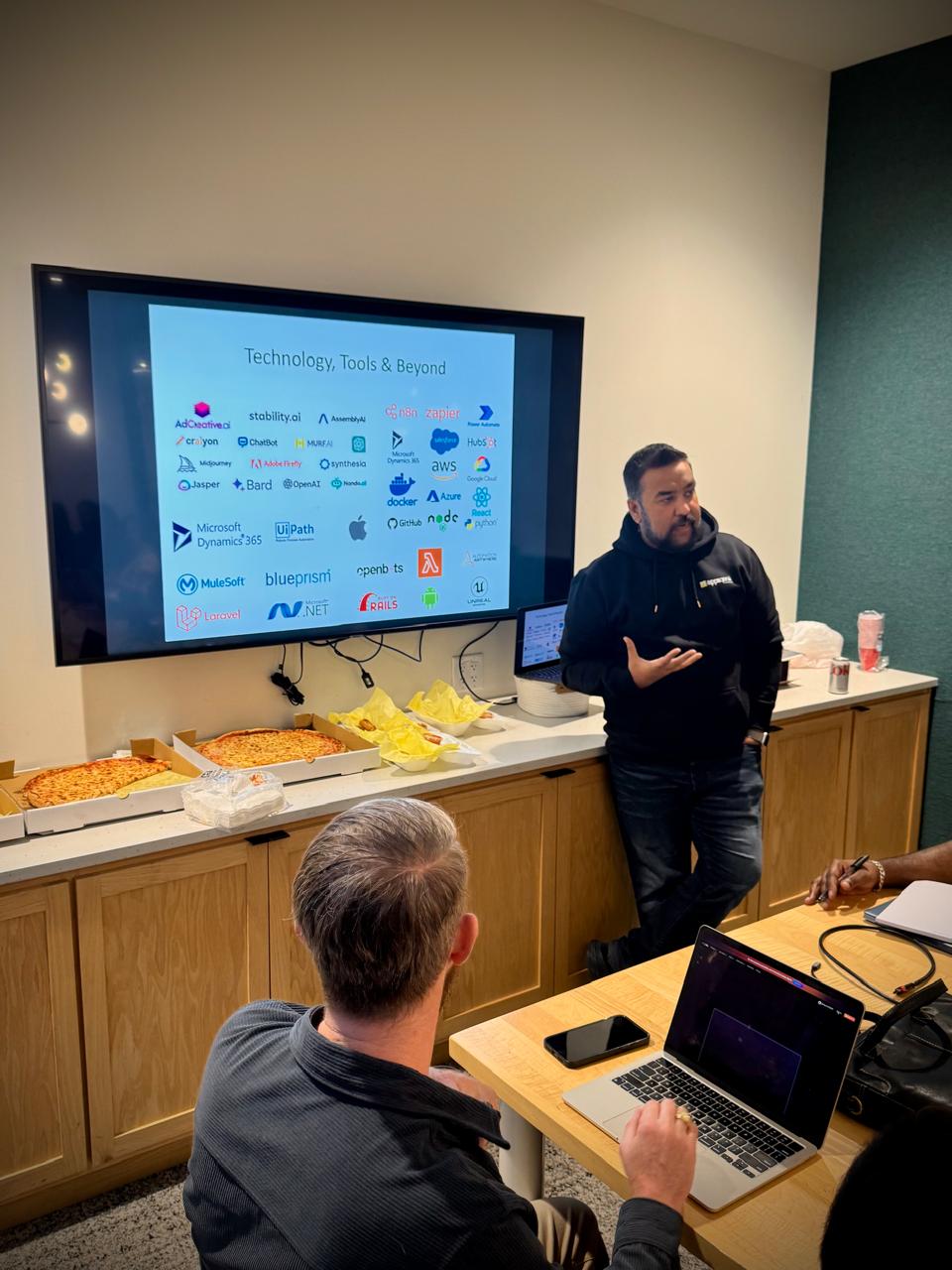
BeingGuru: You are active in Texas and California, but you are also deeply connected to Pakistan’s technology ecosystem. How does that positioning work in the US market?
Mudassir:
It works because I use it deliberately rather than just mentioning it.
Pakistan has one of the strongest technology talent pools in the world, engineering capability that is genuinely world-class at a cost structure that makes it strategically attractive for US companies building AI and automation systems. The challenge has always been trust and structure. US enterprise buyers need confidence that a distributed team will operate to their standards, communicate at their level, and deliver with the kind of accountability they would expect from a domestic partner.
My role in that equation is to be the bridge that makes that confidence possible. I understand what a Dallas-based CXO needs from an engagement: the business case framing, the governance structure, the communication cadence, and the accountability model.
And I understand how to build and lead the technical team that delivers against it. That combination is not common, and it is genuinely valuable to US companies that want to access high-quality AI engineering capability without the risk that normally comes with cross-border technology partnerships.
In Texas and California, I engage actively with global startup communities and technology networks, connecting founders with investors, linking Pakistani technology capability with US enterprise buyers, and building the kind of cross-border relationships that result in real commercial partnerships rather than just LinkedIn connections. Those conversations take time. The ones worth having always do.
BeingGuru: Tell us about the AI work you are most proud of, where the strategy actually delivered outcomes.
Mudassir:
The work I point to most often is at GharPar Technologies, where I serve as CTO. It is a good example because the AI implementation was never the goal; the business outcome was the goal, and AI was the right tool to get there.
GharPar is a marketplace platform for at-home beauty and wellness services. The question we started with was not “where can we add AI?” It was “where are the economic inefficiencies in this marketplace, and can we address them systematically?” The answer was demand forecasting to reduce professional idle time, intelligent matching to improve service consistency and customer retention, and dynamic pricing signals to improve booking economics.
Each of those has a direct line to a measurable business metric. The platform today provides flexible employment to over 1,500 professionals, most of whom are women who previously lacked access to formal, flexible work. That outcome was not incidental. It was the design.
BoxesGen, the eCommerce startup I co-founded, tells a different kind of story, one about applying the same strategic discipline to a direct-to-consumer business. BoxesGen serves the US, UK, and Canada markets with custom packaging solutions, built on a digital-first model that simplifies a traditionally fragmented, friction-heavy procurement process for businesses of all sizes.
The challenge there was not AI in the conventional sense, it was building a scalable operational model around customer experience, fulfillment efficiency, and digital acquisition. Understanding the problem at a business level before making any technology decisions was the same discipline. The market reach across three countries also reflects something I care about: building ventures that are genuinely cross-border in their commercial footprint, not just in their delivery teams.
And in the US market specifically, working with enterprise clients across Texas, California, and New York, the work that stays with me is the implementations where the AI changed something structural about how the organization operates. Not a faster dashboard. Not a smarter search. A genuine shift in where human judgment is required versus where a well-designed system can carry the load reliably. Those projects take longer to scope, longer to build trust for, and longer to deliver. They are also the ones that compound.
BeingGuru: Last question. One piece of advice for a US CXO who is about to launch an AI initiative: what is it?
Mudassir
Start with three questions, and do not move forward until you have honest answers to all three.
First: what specific business outcome do you need AI to improve, and exactly how will you measure whether it has improved?
Not “efficiency” or “productivity” as a general direction, a specific metric, a specific baseline, or a specific target. If the answer is vague, the initiative will be vague.
Second: Does the data infrastructure exist to support this application, or does it need to be built first?
Most AI failures in US enterprises have nothing to do with the AI model itself. They fail because the underlying data was not clean, not structured, and not accessible in the way the system needed. In FinTech and HealthTech, the data governance question is also a compliance question, and it has to be answered before architecture begins.
Third: Is the organization genuinely prepared to act on what the AI produces? Will the output reach a decision-maker who will use it, trust it, and be accountable for decisions made with it? Or will it go into a system that people stop checking because they do not understand how it works and do not trust what it tells them?
“If you cannot answer all three clearly,” he says, “you are not ready to implement. You are ready to plan. And that planning conversation is the most important investment you will make in the entire initiative.”
“The organizations that get AI right are not the ones who moved fastest. They are the ones who were most honest about where they stood, what they needed, and what success would actually look like.”
Mudassir Saleem Malik is the CEO & Co-Founder of AppsGenii Technologies, headquartered in Richardson, Texas. He specializes in AI Strategy, Agentic AI Architecture, and Digital Transformation, working with enterprises, growth-stage companies, and startups across the United States, with a focused international practice in FinTech and HealthTech across Saudi Arabia and the UAE. He is a keynote speaker, a recognized technology ecosystem builder across Texas and California, and a former elected board member of P@SHA (Pakistan Software Houses Association). He was recognized among Pakistan’s Top 100 Entrepreneurs by CxO Global Forum in 2025.
Connect with Mudassir: [email protected]
LinkedIn: https://www.linkedin.com/in/malikmudassir/
Website: appsgenii.com
FAQ
What’s the most common mistake enterprises make with AI?
Treating AI as a tool you buy and deploy once, rather than a capability that requires ongoing process, data, and team changes.
Who is Mudassir Saleem Malik?
An AI strategist who works with US enterprises on adopting artificial intelligence in a structured, sustainable way.
Related reading: The Real Winner in AI Race Will Be Infrastructure, Not Algorithms · Jensen Huang argues society needs to establish new norms for an AI-powered future