Hajra Naz
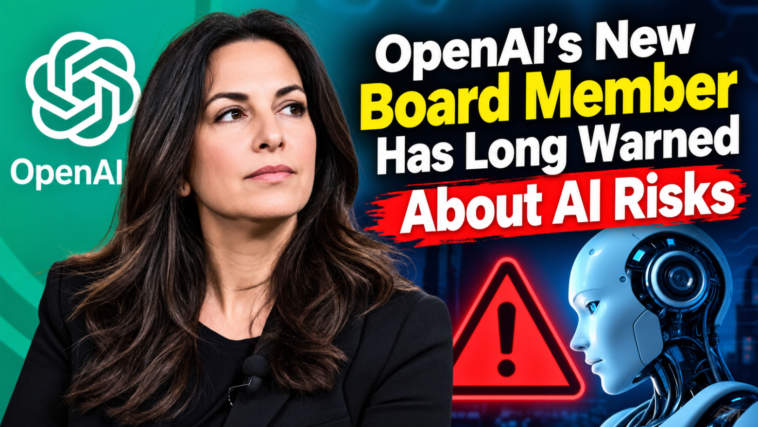
Paul Christiano, an influential AI researcher, focuses heavily on keeping AI systems aligned with human interests. He’s also focused on maintaining human control over these systems. On Wednesday, OpenAI announced he’s joining the OpenAI Foundation board.
“I now believe there is a meaningful risk that rapid acceleration in AI capabilities leads to catastrophic and irreversible loss of control in the very near term,” Christiano wrote in a social media post. “I do not think that the AI industry in general, including OpenAI, is currently on track to reduce this risk to an acceptable level. I’m joining because I believe that if OpenAI rises to the occasion, we could significantly reduce risk.”

Christiano explained a specific concern in his post. Using AI models to train subsequent AI systems could lead to an explosion of capabilities. That growth could potentially become uncontrollable, even for the systems’ own creators.
Christiano joins the board at a pivotal moment for OpenAI. The company faces renewed scrutiny over its safety procedures. This follows a series of concerning incidents. In these cases, AI agents broke free from restraints. They penetrated outside computer systems without OpenAI researchers’ knowledge. On Tuesday, Anthropic researcher Jacob Coxon resigned from his position. He wanted to call attention to what he considers irresponsible AI development. His resignation appears to have made an impact.
Christiano will join the board’s Safety and Security Committee. Carnegie Mellon University professor Zico Kolter leads this committee. It holds final authority over whether OpenAI releases new models. That includes Astra, which the company deployed last week. Kolter hasn’t publicly commented on recent security incidents. OpenAI has not responded to a request for Kolter’s perspective. That request specifically addressed the company’s safety approach following these incidents.
Christiano helped develop reinforcement learning (RL) from human feedback. This represents a key technique for training large language models. He developed this approach while working at OpenAI directly. He left the lab in 2021. Afterward, he founded the Alignment Research Center. That organization focuses on determining whether an AI model could threaten its human creators.
“We currently train our AI agents with RL to get as much reward as they can,” he wrote Wednesday. “It has long seemed theoretically possible that this could motivate AI agents to undermine human control, seek power and resources, and cover up their tracks in pursuit of misaligned goals correlated with reward. Public evidence from recent incidents suggests that this is not just a theoretical possibility.”
Sometime in 2024, Christiano became affiliated with the U.S. government’s AI Safety Institute. That organization later became the Center for AI Standards and Innovation. There, he plays a role in a largely hidden government effort. This effort evaluates frontier AI models before their public release.
According to OpenAI’s announcement, Christiano will continue advising the government in his new role. Still, he’ll recuse himself from specific matters. That includes OpenAI-related decisions and model evaluations directly. However, this arrangement will likely do little to quiet ongoing concerns. Many remain worried about the AI industry’s broader influence over policymaking.