

 Hajra Naz
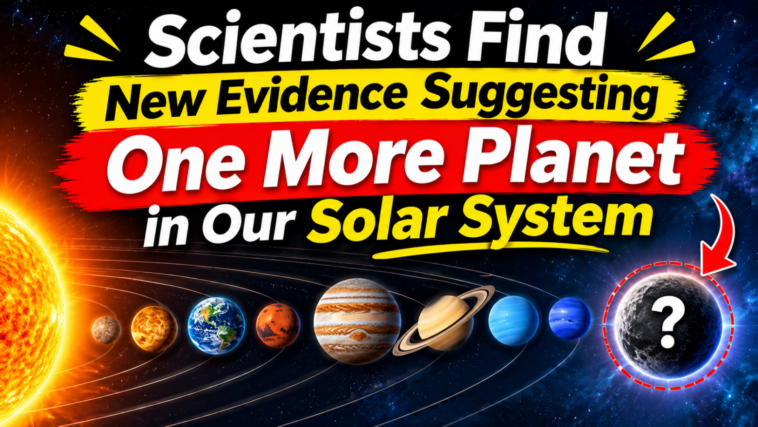
New evidence has been found that we may have an undiscovered planet on the outskirts of our solar system. Scientists have proposed the existence of this hypothetical planet, named Planet X2 (PX2), in a paper published in the Monthly Notices of the Royal Astronomical Society.
The planet is believed to have between 1.5 and 2 times the mass of Earth and to orbit hundreds of times further out from the sun than Earth does.

| Feature | Planet X2 (PX2) Details |
| Estimated Mass | 1.5 to 2 times the mass of Earth |
| Semi-Major Axis | 350 to 500 astronomical units (AU) |
| Closest Approach to Sun | At least 200 AU (Neptune orbits at ~30 AU) |
| Key Difference from Planet Nine | Much smaller mass, yet strong enough to shape distant icy orbits |
Simulating 4.5 Billion Years of Space History
Authors of the study include Patryk Sofia Lykawka (Adjunct Associate Professor at the University of Southern Queensland [UniSQ], Kindai University, Japan), Assistant Professor Pedro Bernardinelli (University of Washington and University of Sao Paulo), and Professor Jonti Horner (UniSQ).
Computer models were used to simulate 4.5 billion years of evolution within our solar system. These were run to test how the presence of a remotely orbiting planet with a range of masses affects icy objects beyond Neptune.
Their models show Planet X2 would follow a highly stretched, elliptical path:
- The semi major axis is between 350 and 500 astronomical units (AU). One astronomical unit is the distance from the Earth to the Sun.
- Even at perihelion, it is still more than 200 AU away from the Sun. This puts it far further out than Neptune, which orbits at about 30 AU.
“If we had been charting our solar system for many years and then discovered a new planet in the solar system, it would completely change our view of how our solar system evolved,” Lykawka said.
Read More: Moonbase Alpha becomes Musk’s new blueprint for SpaceX and xAI
How Planet X2 Differs from Planet Nine
This theory stands apart from the popular Planet Nine hypothesis. Planet Nine proposes a massive world far out in space to explain weird orbital clusters.
Planet X2 would be much lighter. Even so, its gravity would still be strong enough to steer distant icy objects.
Solving the Mystery of Strange Orbits
Beyond Neptune, there are numerous objects of ice, primarily within the Kuiper Belt (between 38 and 50 AU).
However, many objects within this region exhibit unusual orbital eccentricities and inclinations. Objects such as Sedna have highly eccentric orbits, which are difficult to produce using purely gravitational interaction from the 8 known planets.
With this model, PX2 can perturb certain icy objects to remove them from being influenced by Neptune. It is also able to produce highly eccentric orbits for other objects. Despite fitting a number of unusual features observed in Trans-Neptunian objects, discrepancies remain between the results of this model and observations made with telescopes.
You can read more about the research here.
Searching the Sky for Proof
Planet X2 is currently hypothetical.
However, it may soon be proven to exist by the Vera C. Rubin Observatory. The observatory’s wide-field camera allows it scan large areas of the sky repeatedly, meaning it can detect faint, far-away planets that were previously unobservable.
If Planet X2 can be confirmed, it would be the first