Hajra Naz
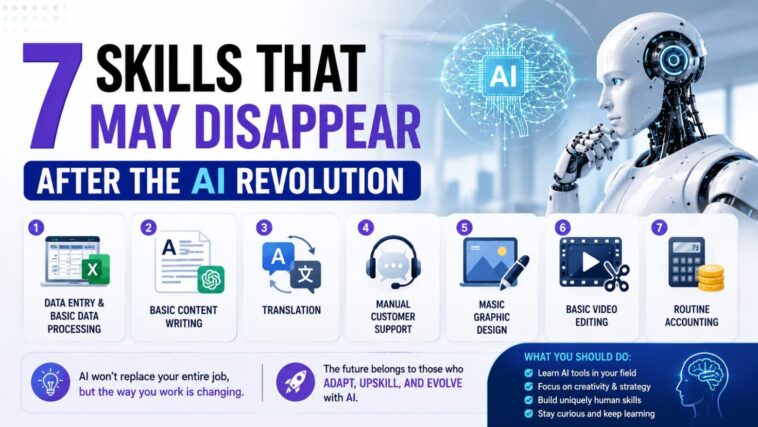
Some skills are losing value as AI takes over repetitive tasks like basic writing, editing, and data entry — the skills gaining value instead are the ones AI can’t easily replace: judgment, strategy, original creative direction, and complex client relationships.
Artificial intelligence is not a distant concept anymore. And it is already changing the way we work. Whether it is drafting emails, editing videos, or responding to customer queries, AI is performing a lot of mundane tasks that previously required some human effort.

This shift has created excitement. It has also created fear.
A lot of professionals are concerned that AI will take their jobs. The reality is more complicated. Not every profession is being replaced by an AI. Rather, it is replacing repetitive work in multiple industries. Jobs are changing, and those who would adapt will find opportunities.
So keep reading to find out why this is happening and what it means for you and your career.
Why Some Skills May Disappear
The biggest reason is simple. AI can do repetitive tasks more quickly than humans.
Modern artificial intelligence systems are able to process massive volumes of information in a matter of seconds. They rarely get tired. It can work for them 24/7. They are also getting better every month.
That poses a clear benefit to businesses.
This enables faster onboarding, reduced costs, and higher productivity for companies. You can automate a lot of routine work with AI, rather than bringing in such large teams to do boring stuff.
This does not mean people become useless.
Rather, it changes the nature of work. This is why humans are moving towards areas with creativity, critical thinking, decision making, workplace usage, and emotional intelligence.
The future is for people who learn to work with AI instead of against it.
Read More: AI Skills That Clients Are Actually Paying For in 2026 (Complete Guide)
1. Data Entry and Basic Data Processing
Data entry is another common online job that has been in existence for a long time.
Companies began employing individuals to enter customer information, sort spreadsheets, duplicate data across systems, and sanitize databases.
Artificial Intelligence (AI) is doing most of this work automatically today.
With the help of modern AI tools, you can read invoices, scan documents, categorize Excel sheets, find duplicate records, and read PDFs in seconds.
Optical Character Recognition (OCR) is also extremely accurate nowadays. Powered by AI, it can turn printed or handwritten documents into searchable digital text in virtually no time at all.
Tasks like these are becoming highly automated:
- Copy-paste work
- Spreadsheet organization
- Form filling
- Database updates
- Basic data cleaning
- Information extraction
Manual data entry folks will not see many jobs in the upcoming times at all.
Nonetheless, data-related jobs like data analyst, business intelligence analyst, SQL, and Power BI jobs excel in automation. Python expert professionals will always be in demand, as they are not just going to input the data but also read it.
2. Basic Content Writing
AI has dramatically changed content creation. Today, someone can generate blog drafts, social media captions, product descriptions, emails, and marketing copy within minutes. This has reduced demand for very basic writing tasks.
Businesses no longer need someone to write hundreds of short product descriptions from scratch when AI can generate them almost instantly. That does not mean writers are becoming obsolete.
Quality still matters.
AI often produces generic content. It struggles with original reporting, storytelling, personal experiences, humor, emotional depth, and a strong brand voice.
Professional writers who specialize in these areas continue to be in demand. Instead of competing with AI, successful writers now use it as an assistant.
They spend less time creating first drafts and more time researching, editing, fact-checking, interviewing experts, and adding unique insights.
Writing is evolving—not disappearing.
Read More: The Rise of AI in Content Writing: Identifying Usage and Evaluating Worth
3. Translation
Translation has improved enormously because of AI. Modern language models understand grammar, sentence structure, context, and even cultural expressions much better than earlier translation software.
Many businesses now rely on AI for:
- Website translation
- Email translation
- Document translation
- Subtitle generation
- Customer support
- International communication
But for straightforward translations, AI is often sufficient. However, the important thing is that human translators still play a significant role
Fields such as law, medicine, writing, marketing, and government communications need cultural knowledge and careful wording that machines cannot always provide.
Some professional translators have become language consultants and editors rather than mere translators.
4. Manual Customer Support
How customer service has evolved in recent years. Most of the companies are using AI chatbots as a primary contact point. Customers get prompt answers instead of waiting for an agent.
AI assistants have become capable of handling thousands of conversations concurrently. They respond to FAQs, order status tracking, refunds, appointment booking, and resolving simple issues without any human intervention.
This balances cost savings with superior customer experience. Complex issues still require people.
It is common for customers with a billing dispute, an emotional situation, a technical emergency, or a rare request to want someone else on the other end of the phone.
Much like a combination of AI efficiency with human compassion, customer support will combine the two going forward.
5. Basic Graphic Design
Design is a whole lot more accessible. Imagine creating a logo, poster, banner, thumbnail photo, social media graphic, or presentation using an AI image generator in a matter of minutes.
Companies, which previously needed a designer for each mundane task, can now, if dwarfingly, create basic visuals on their own. It is not to say that professional designers are going away.
Design is all about communication, branding, psychology, and user experience; it goes far beyond just how a button looks. AI can generate attractive images. Those images humans use to solve a business problem.
Designers who focus on branding, UI/UX design, creative direction, motion graphics, and visual storytelling will rise further to the fore.
They become less technical and more strategic in their role.
6. Basic Video Editing
Editing videos is also getting more and more automated.
Now there are AI tools that trim the clips, cut out silence, generate captions, and add transitions or just make complete videos from text prompts.
Easy editing tasks have sped up. Creators can create social videos in minutes. It saves time and money for the business. But professional editing is still more than simply clipping clips.
Writings on creative judgment in docs, features, commercials, brand storytelling, and cinema. Human expertise still plays an enormous role in timing, pacing, emotion, music selection, and storytelling.
AI speeds up production. It does not replace creative vision.
Read More: Work Smarter, Not Harder: Master Video Editing as a Freelancer with AI Assistance
7. Routine Accounting
Accounting is yet another niche that is going through fast automation.
In this way, the AI software is capable of recognizing various kinds of expenses, invoicing, reconciliation, and bookkeeping processes, as well as preparing financial reports without anyone at all.
Fewer errors, faster processing — businesses stand to gain from it all. It is, accordingly, getting less and less valuable routine accounting work. But professional accountants are hardly going anywhere.
They are becoming focused on financial planning, tax strategy, auditing and compliance, but also forecasting, business consulting, etc.
They can be experience-driven, judgment-laden, and out of touch with ever-evolving regulations. Technology handles calculations. Humans make financial decisions.
AI Replaces Tasks, Not Entire Careers
The biggest myth regarding AI is that it replaces entire jobs. In fact, nearly every job contains dozens of separate tasks. Some tasks are repetitive. Others require human judgment.
Most of the time, AI only automates manually repetitive parts. Take marketing as an example. AI can write headlines, analyze customer data, produce ads, and compose images.
However, planning a marketing campaign, human psychology helping to convert to sales for clients, and effective business decision-making will always need people.
This pattern exists in healthcare, education, finance, law, and many other industries.
AI won’t replace professions, but it will change how professionals spend their time.
The Skills That Will Become More Valuable
As automation grows, employers are placing greater value on skills that machines struggle to replicate.
These include:
- Critical thinking
- Creativity
- Communication
- Leadership
- Emotional intelligence
- Strategic planning
- Problem-solving
- Negotiation
- Collaboration
- Adaptability
Technical skills also remain important.
Developing a competency in how to use AI tools effectively is proving to be an edge over nearly any profession.
Those who truly understand their industry and AI will be heads above those relying on one or the other.
How to Future-Proof Your Career
Your best bet is to never stop receiving an education. Technology changes quickly. But as the market evolves, waiting too long to pick up new skills is getting dangerous.
Instead, develop a habit of getting better each week. Get familiarized with AI tools corresponding to your profession. Experiment with automation.
Take online courses. Build projects. Improve your communication skills. Stay curious.
Most importantly, develop skills that require original thinking.
AI is becoming excellent at following instructions. Humans remain best at asking the right questions.
Final Thoughts
AI will not necessarily replace your job; however, someone sat next to you who knows how to use AI might.
That statement captures today’s reality.
The future does not just belong to programmers or AI engineers. It is for the people who desire to learn, adapt, and grow.
Most of the mundane tasks will be undertaken. Opportunities will come around just as quickly.
As history shows us, every major technological revolution disrupts the job market. The internet gave us jobs that did not exist before. Smartphones did the same. Artificial intelligence is going the same way.
What I would say is do not fear AI, figure out how to work with it.
Those professionals who adapt themselves to change, learn to blend human creativity with AI efficiency, and continuously upskill will come ahead in the years to come.
Frequently Asked Questions
Which skills are most at risk from AI?
Repetitive, rules-based tasks — basic content writing, simple data entry, routine editing — are the most exposed as AI tools get faster and cheaper at doing them.
What skills should I build instead?
Focus on judgment-heavy, strategic, and relationship-driven skills — the parts of a job that require taste, context, and trust, which AI still can’t reliably replace.
Last updated: August 2026.