Hajra Naz
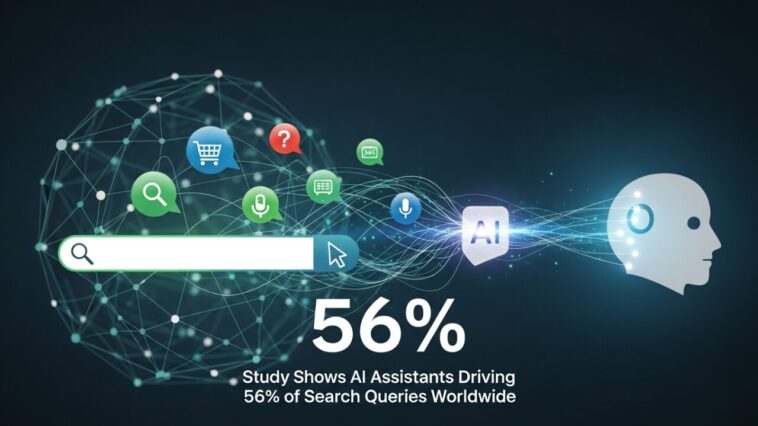
A new analysis suggests AI assistants now account for roughly 56 percent of global search sessions, a dramatic shift in how people find information online. This changes what it means to be visible in search, since answers are increasingly generated rather than clicked through.
Artificial intelligence tools are rapidly changing how people search for information online. A new analysis suggests that AI assistants now generate around 45 billion monthly sessions worldwide, representing about 56% of global search engine volume.

The study was conducted by Ethan Smith, the CEO of Graphite. His analysis combined both web traffic and mobile app usage across the largest AI platforms.
The findings show that AI-driven discovery is growing quickly rather than replacing traditional search engines.
Mobile Apps Are Driving AI Usage
A major reason for the rapid rise of AI tools is mobile adoption. Most AI interactions now take place inside mobile apps instead of websites.
Popular AI platforms such as ChatGPT, Gemini, Perplexity AI, Grok, and Claude are driving most of this growth.
According to the report:
83% of global AI usage happens in mobile apps
In the United States, about 75% of AI activity occurs on mobile
This shows that mobile devices are becoming the primary gateway for AI-powered information discovery.
Read More: Most Popular AI Tools for Coding Every Developer Should Know
AI Usage Is Expanding Search, Not Replacing It
Despite the rapid rise of AI tools, traditional search engines are still widely used.
In fact, the report suggests that the overall demand for information discovery has increased globally by 26% since 2023.
Rather than replacing search engines, AI assistants appear to be expanding the total volume of information queries.
For marketers and businesses, this means that visibility in both search engines and AI systems is becoming increasingly important.
Key Findings From the Report
The analysis examined activity across the five largest AI platforms and compared them with the six biggest search engines worldwide.
Several important insights emerged:
AI platforms generate 45 billion monthly sessions globally
In the United States, AI usage accounts for about 5.4 billion sessions per month
ChatGPT dominates AI usage, representing about 89% of global AI sessions
When focusing only on information-seeking prompts, AI activity equals 28% of global search usage
In the United States, AI information queries represent around 17% of search activity
The study excluded prompts categorized as tasks like writing content or generating images. Instead, it focused on information-seeking queries, which are closest to traditional search behavior.
Read More: Best AI Assistants (Chatbots)
Why Previous Comparisons Missed the Real Picture
Many earlier studies compared website visits to platforms like Google with traffic to AI chatbot websites.
However, this approach misses a large portion of AI activity.
Most AI usage happens inside mobile apps rather than on websites. Because of this, earlier comparisons likely underestimated AI activity by four to five times.
The report also compared multiple AI models and multiple search engines instead of focusing only on Google and ChatGPT.
Google Still Leads, But Competition Is Growing
Even with the rapid rise of AI assistants, Google remains the dominant platform for information discovery.
However, the company’s share of search-related activity has started to decline slightly.
The report estimates that Google’s share dropped from 89% in 2023 to around 71% by the fourth quarter of 2025.
Meanwhile, AI usage trends show mixed signals globally.
Worldwide AI activity appears to have stabilized since mid-2025, but growth in the United States continues at a rapid pace. By December 2025, U.S. AI usage had grown around 300% year over year.
This suggests that AI assistants will likely remain a major part of the future search landscape.
Read More: The Rise of AI Assistants: A New Era of Smart Tech
FAQs
1. How much global search activity do AI assistants handle?
According to the study, AI assistants generate about 45 billion monthly sessions, which equals roughly 56% of global search engine volume.
2. Which AI platform has the most usage?
ChatGPT currently dominates AI usage, accounting for around 89% of global AI sessions among the major platforms analyzed.
3. Where does most AI usage occur?
Most AI activity happens inside mobile apps, representing 83% of global usage.
4. Are AI assistants replacing traditional search engines?
No. The report suggests AI tools are expanding overall search activity, not replacing traditional search engines.
5. How is Google affected by the rise of AI search?
Google still leads the market, but its share of search-related activity has declined slightly as AI assistants gain popularity.
FAQ
What does the 56 percent figure actually measure?
It combines AI assistant sessions with traditional search engine volume to estimate how much of all information-seeking behavior now runs through AI tools rather than classic search results pages.
How should businesses adapt to this shift?
By rethinking outdated SEO tactics, since simple SEO tactics no longer carry the same weight when AI systems are doing the summarizing instead of a ranked list of links.
Related reading
- Google reveals 75% of crawl problems come from two URL mistakes
- Google Stops Showing AI-Generated Overviews for Specific Medical Topics
Last updated: August 2026.