

 Hassan Khan
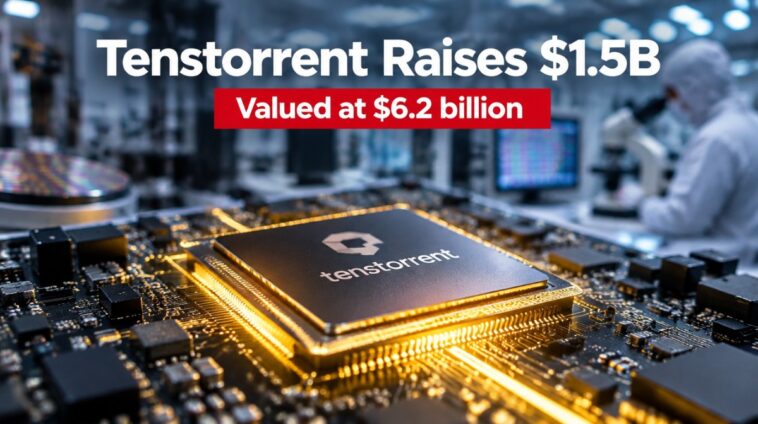
Tenstorrent, the Santa Clara AI computing company, announced a $1.5 billion Series E at a $6.2 billion post-money valuation on October 19, 2026. The round was led by Trace Capital and Innovation X, with money going toward deploying its Galaxy servers at scale, serving open-weight models and advancing the processor IP it licenses.
The details come from the company’s Series E press release, and the deal was also tracked by AI Weekly.

Who is in the round
Participants named in the release include Fidelity Management and Research Company, ARK Invest, Morgan Stanley, T. Rowe Price, Tether Investments, XTX Markets, Virtu Financial, Cadence Ventures, Eclipse, Sandisk, Protagonist and others. Existing backers include Bezos Expeditions, Samsung, LG Electronics and Hyundai Motor Group. Note that some summaries credit Fidelity, ARK and Morgan Stanley as the headline names, but the release names Trace Capital and Innovation X as leads.
What Tenstorrent actually sells
Tenstorrent builds RISC-V-based AI processors and systems, ranging from single cards and workstations to racks and superclusters. It pairs them with an open-source software stack. It also licenses its TT-Ascalon RISC-V CPU and Tensix AI cores to chip designers, and the release names Samsung and LG among licensees. CEO Jim Keller sums up the approach: “We built one architecture and sell it at every size.”
Customers listed include developers, enterprises and sovereign infrastructure buyers. The company has offices in Santa Clara, Austin, Toronto, Belgrade, Tokyo and Bangalore. The release does not say how many Galaxy servers are deployed or how much revenue the company earns, so the valuation rests on promise more than disclosed sales.
A crowded field with one dominant incumbent
Nvidia still sets the pace in AI accelerators, and Google, Amazon and others are building their own chips and software layers to reduce dependence on it. Tenstorrent’s bet is different: open hardware designs and an open software stack, sold both as finished systems and as licensable blueprints. If that works, buyers who want to avoid lock-in get another route, and countries building their own AI infrastructure get a vendor willing to license the design itself.
The risks are easy to name. Software compatibility is the hardest part of dislodging an incumbent, since developers go where the tools already work. Raising $1.5 billion buys time to build that ecosystem, but it does not guarantee developers will adopt it.
What developers and small teams can take from it
You are unlikely to buy a Galaxy server any time soon. The practical takeaway is that more hardware choices, and more open software, tend to widen where models can run and how they are priced. If you build AI tools for clients, writing code that does not assume one vendor’s chips or one cloud keeps your options open as these alternatives mature.