

 Hajra Naz
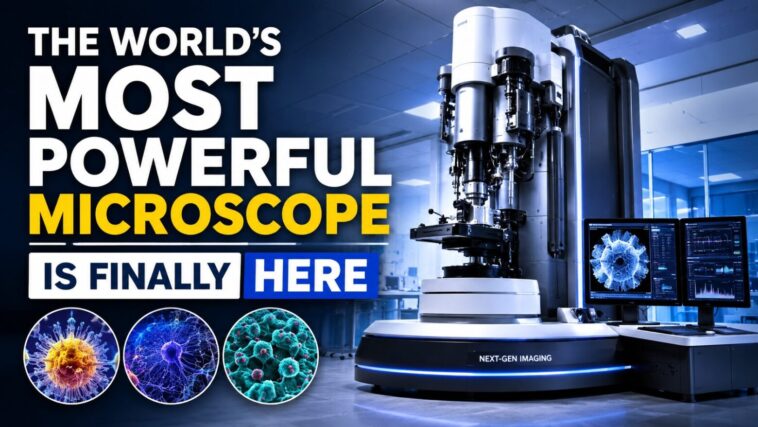
Brookhaven National Laboratory, run by the US Department of Energy, has just brought online a custom electron microscope that researchers are calling a genuine turning point for materials science.
Housed at the lab’s Center for Functional Nanomaterials, the new scanning transmission electron microscope offers energy resolution roughly 200 times sharper than what’s currently available elsewhere. That kind of precision lets scientists examine a material’s atomic structure, chemical makeup, and electronic behavior all at once—rather than one at a time.

That distinction matters more than it might sound. Figuring out how materials behave at the atomic level feeds directly into real-world progress: longer-lasting batteries, faster semiconductors, and advances in quantum computing. Older microscopes forced scientists into a compromise — someone studying, say, a battery cathode could look at its structure or its chemistry, but never both together, in the moment. This new instrument does away with that compromise entirely.
Four key innovations make it possible.
Read More: Skills That May Disappear After the AI Revolution: What You Need to Learn to Stay Ahead
First, a pair of secondary electron detectors can image both the top and bottom surfaces of a sample at the same time, down to atomic-level detail. That dual-view capability turns out to be especially useful for catalyst research, since catalysts are what drive the chemical reactions happening inside batteries and fuel cells. Being able to watch both surfaces before and after a reaction gives researchers a much clearer picture of how a catalyst’s structure shifts while it’s actually working.
“Even the most advanced X-ray imaging techniques are generally limited to spatial resolutions on the scale of tens of nanometers, whereas modern electron microscopes can provide atomic-scale information,” said Sooyeon Hwang, who played a key role in bringing the microscope to Brookhaven while working in CFN’s Electron Microscopy group. She’s now an associate professor at Dongguk University.
The second major advance is in the microscope’s energy filtering system, which is what delivers that 200-fold jump in resolution. It relies on a technique called momentum-resolved electron energy-loss spectroscopy, which lets researchers study quasiparticles—phonons, magnons, and plasmons—that shape how a material conducts heat, reacts to magnetic fields, and interacts with light and electricity. Behavior that was essentially invisible before is now something scientists can actually see.
Third, the microscope can run at voltages as low as 20 kiloelectron-volts, well below the usual 100–300 keV range most instruments use. That lower voltage helps protect fragile materials from damage during imaging, which is especially important when studying two-dimensional quantum materials that may only be a few atoms thick. Counterintuitively, lower-energy electrons actually scatter more effectively while doing less harm to the sample.
Finally, the whole system runs on Python-based software that supports remote operation — a feature that opens the door to autonomous, machine-learning-guided microscopy. Researchers anywhere in the world could potentially run experiments without ever setting foot in Brookhaven, which could speed up the pace of discovery considerably.
Read More: Use Python for Data Science to Earn 6-Figure Income
Yimei Zhu, the senior physicist heading Brookhaven’s advanced electron microscopy group, says the instrument represents the outer edge of what’s currently possible.
“We have really pushed the current microscope instrumentation limit,” Zhu said. “This voltage is particularly designed for two-dimensional quantum materials, which are often one or a few atomic layers thick. Lower voltage electrons not only have higher scattering power but also can minimize damage to sensitive materials.”
“With [this] new instrument, we are now able to feel more of the elephant,” Yang added. “We can finally get at the truth, what’s really there, and I think that’s pretty exciting. It’s what we all want to do as scientists.”