Hajra Naz
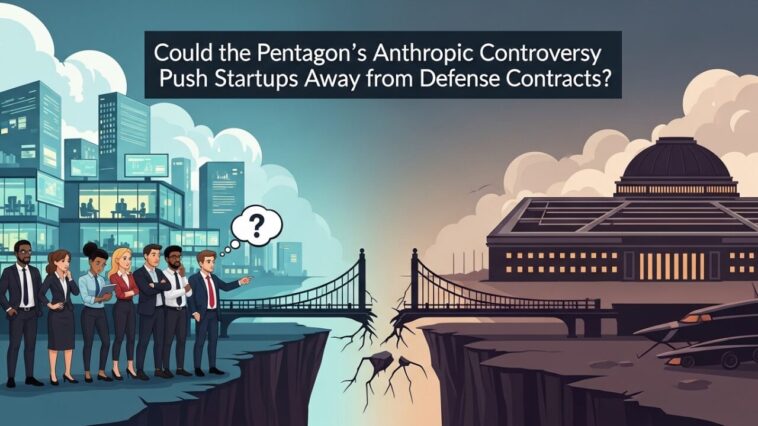
A dramatic series of events transpired over the course of only a week around the Pentagon’s proposed use of Anthropic’s Claude AI technology. Discussions between the U.S. Department of Defense and Anthropic fell apart, and not long after, the Trump administration tagged the AI company as a supply-chain risk. Promptly, Anthropic responded, saying it would contest that designation in court.
Meanwhile, OpenAI quickly raced to announce its own agreement with the Pentagon. The announcement sparked a wave of pushback online. Some users, it was reported, started deleting ChatGPT from their devices, and Anthropic’s Claude rocketed to the top of the App Store rankings.

The controversy also sparked internal discord at OpenAI, with at least one executive resigning amid concerns that the deal had been pushed through too quickly and without enough safeguards.
All of this drama raised a bigger question that rippled through the tech industry: Will this conflict dissuade startups from entertaining contracts with the federal government, and especially with the Pentagon?
Will the Dispute Alter How Start-Ups Approach Federal Contracts?
One issue that was carefully addressed during the discussion was raised by Kirsten Korosec, who pointed out that the conflict between the Pentagon and Anthropic is hardly going to be a one-off concern for other startups.
She wondered whether companies throughout Silicon Valley might begin reconsidering their quest for federal funding, particularly when it involves sensitive government agencies such as the Department of Defense.
“No, but it’s definitely something to be watched,” Kirsten said when asked if this high-profile dispute could be indicative of a growing change in how startups see defense partnerships.
The situation, she argues, poses a simple but important question: Will startups start to “change the tune” when it comes to pursuing government dollars?
Read More: OpenAI Discloses More Details About Its Pentagon Agreement
The government’s defense work is often done discreetly.
Sean O’Kane pointed out that although the current controversy is getting a lot of attention, it’s in fact unusual compared to most government contracting relationships.
Many companies — startups and big corporations alike — routinely do work with the federal government and the Department of Defense without drawing public scrutiny.
The U.S. Army has been buying defense vehicles from General Motors for decades, for instance. The company has even been developing electric and autonomous military vehicles, but projects like this seldom receive much press.
According to Sean, much of this activity remains under the radar. The reason this dispute is so public has less to do with the underlying nature of defense contracts than it does with the companies involved.
A Very Bright Spotlight on AI Companies
The actual difference, Sean said, is that companies like OpenAI and Anthropic run products everyone uses every day.
Recently, people in the public dialogue, media coverage, and online communities have been discussing these AI tools. Because of that, any significant decision related to them immediately draws interest.
Many defense contractors, by contrast, work quietly behind the scenes, without consumer-facing products. Their work seldom enters the larger cultural dialogue.
Since OpenAI and Anthropic have achieved household name status in the AI industry, their ties to the Pentagon naturally receive far more scrutiny than those of traditional defense contractors.
The Ethical Considerations of AI in Warfare
However, another major contributor to this controversy is the technology itself.
Sean said the contention around these AI companies boils down to a touchy question: how their technologies may be deployed in military operations.
This is not just about government contracts or technology collaborations. It is also about whether the tools of artificial intelligence could help in missions that include lethal force.
That renders this discussion completely different compared to traditional defense manufacturing.
When people consider whether companies like General Motors should make military vehicles, the ethical implications tend to feel more abstract. But when A.I. tools are potentially employed in decision-making systems tied to combat or surveillance, the debate is more direct and charged with emotion.
As a result, such AI companies working with the military are under far greater scrutiny.
Read More: Nobody Has Figured Out How AI Companies Should work with the government
Dual-Use Startups Might Be Able to Forge Ahead
But Sean does not see the controversy causing most startups to walk away from defense partnerships.
Numerous emerging tech companies have constructed their businesses around dual-use technology — tools intended to serve both civilian and military markets.
Startups that publicly brand themselves as dual-use technology are companies like Applied Intuition, one of the many companies that develop software for autonomous systems.
Sean thinks these companies will not shy away from defense opportunities because the scrutiny on them is orders of magnitude smaller than the scrutiny on OpenAI and Anthropic.
They are less exposed in the public eye, so they may not face the same pressure or backlash.
The Real Personalities Behind the Conflict
Anthony Ha argued that this particular story is unusually shaped by the personalities involved.
While there is an important policy discussion happening about the role of artificial intelligence in government, he believes the conflict between Anthropic and the Pentagon cannot be understood without recognizing how specific individuals may have influenced the situation.
Interestingly, Anthropic and OpenAI do not appear to hold drastically different public positions on the issue of government collaboration.
Both companies have stated that they want clear restrictions on how their AI technologies are used, particularly when it comes to military applications.
Neither company has publicly taken the stance that it refuses to work with the government altogether.
The difference appears to lie in how strongly Anthropic resisted potential changes to the terms of its contract.
Read More: Attorneys General Want Major AI Companies to Do More to Rein In Harmful Chatbot Behavior
Reports of Personal Tensions
Anthony also said there might be a lot of personal tension among some key players involved in the story.
There are reports that Dario Amodei, Anthropic’s CEO, and Emil Michael, now the chief technology officer for the Department of Defense and formerly known as Uber’s approach to Jonathan Shieber, are not on good terms with each other.
This part of the story has not officially been fleshed out, but it adds another layer to the conflict.
There was a “girls are fighting” aspect to the situation, Sean said jokingly — noting that sometimes personal dynamics factor into high-stakes industry disagreements.
OpenAI Faces Public Backlash
Meanwhile, the public reaction to OpenAI’s deal with the Pentagon has been striking.
Kirsten pointed out that following the announcement, reports suggested a sharp rise in ChatGPT uninstalls. Some estimates indicated uninstall activity surged by nearly 295% shortly after the deal became public.
At the same time, Anthropic’s Claude gained momentum in app store rankings, reflecting how quickly public sentiment can shift when companies become involved in controversial government projects.
However, Kirsten emphasized that these reactions might ultimately be short-term noise compared to the deeper issue at play.
The Real Concern: Changing Contract Terms
For Kirsten, the most important and potentially troubling aspect of the situation lies in the government’s attempt to modify an existing contract.
According to her analysis, the Pentagon was reportedly trying to change the terms of an already-established agreement with Anthropic.
In government contracting, this is highly unusual.
Federal contracts often take months or even years to finalize. They go through extensive legal review, negotiation, and regulatory oversight before being approved.
Because of this lengthy process, companies typically expect those agreements to remain stable once they are finalized.
If the government begins altering contract terms after the fact, it could create uncertainty for startups that depend on predictable agreements when working with federal agencies.
Why This Situation Could Give Startups Pause
Kirsten believes this aspect of the dispute should concern startups far more than the public drama surrounding OpenAI or Anthropic.
The bigger issue is whether the political environment around defense contracts may be shifting.
If government agencies begin revisiting or changing previously agreed-upon terms, startups could face greater risks when entering into federal partnerships.
For young companies with limited resources, unexpected contract changes could significantly impact finances, product development, and long-term strategy.
Because of that, the Pentagon-Anthropocene conflict might serve as an important warning sign for startups considering defense work.
Read More: Anthropic’s Claude Hits No. 1 on the App Store After Pentagon Fallout
A Debate That Is Far From Over
Despite the controversy, Anthropic’s technology is still reportedly being used by the military in various capacities.
At the same time, OpenAI’s involvement with the Department of Defense continues to evolve, and the broader discussion about AI’s role in national security is far from settled.
As governments around the world explore how artificial intelligence can support defense operations, the debate over ethics, oversight, and corporate responsibility is likely to intensify.
For startups, the situation highlights both the opportunities and the risks of working with powerful government institutions.
And as this story continues to unfold, the technology industry will be watching closely to see whether it changes how the next generation of startups approaches defense partnerships.
FAQs
1. Why did the Pentagon’s negotiations with Anthropic collapse?
The negotiations reportedly fell apart due to disagreements over contract terms and how Anthropic’s Claude AI technology would be used by the military.
2. Why was Anthropic labeled a supply-chain risk?
The U.S. administration designated Anthropic as a supply-chain risk during the dispute, though the company has said it plans to challenge that designation in court.
3. How did OpenAI become involved in the situation?
After the Pentagon’s negotiations with Anthropic failed, OpenAI quickly announced its own deal with the Department of Defense, sparking industry debate and public backlash.
4. Are startups likely to avoid working with the Pentagon after this controversy?
Experts believe most startups will continue pursuing defense contracts, especially those focused on dual-use technologies, although the situation may cause some companies to proceed more cautiously.
5. What is the biggest concern for startups in this situation?
The main concern is the possibility that the government might change contract terms after agreements have already been finalized, creating uncertainty for companies working with federal agencies.