Hajra Naz
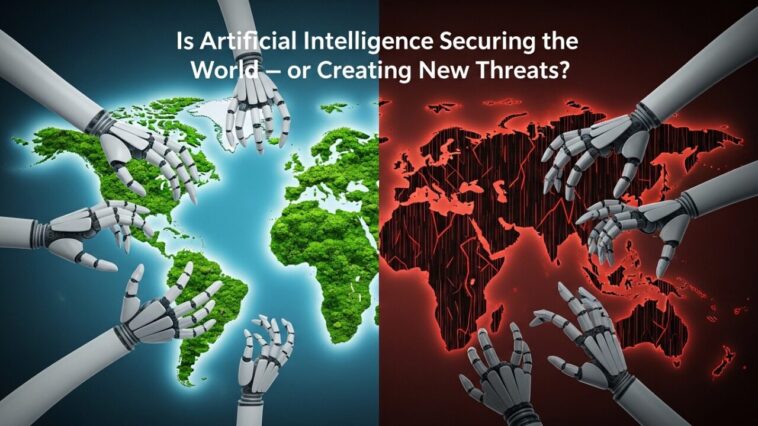
AI is doing both at once. It strengthens cyber defence, speeds up intelligence analysis and improves disaster forecasting, while also giving attackers cheaper tools, flooding public debate with deepfakes and pushing weapons toward less human oversight. Governments are responding on the second front: the EU now requires deepfakes and AI generated media to be labelled. The sections below look at each side of the ledger, including how these tools are being used in the current Iran and US confrontation.
Artificial intelligence is rapidly transforming how countries protect themselves. From cybersecurity systems to intelligence analysis and disaster prediction, AI is becoming a central part of modern national security strategies.

But with every powerful technology comes an important question: Is AI making nations safer, or is it introducing new vulnerabilities?
Governments around the world are investing heavily in AI-powered systems. These tools promise faster decision-making, better threat detection, and improved disaster response. At the same time, experts warn that the same technology can also be used for cyber attacks, misinformation campaigns, and even autonomous weapons.
The reality is that AI is reshaping national security in complex ways—bringing both significant benefits and serious risks.
Why AI Matters for National Security
In recent years, governments have begun integrating AI into several critical areas of national security. These include cybersecurity, defense systems, surveillance, and intelligence operations.
Modern threats are increasingly digital, fast-moving, and global. Human analysts alone often struggle to process the enormous amounts of data generated every second. AI systems can analyze this data far more quickly, helping governments detect threats earlier and respond faster.
Because of these capabilities, AI is becoming a core pillar of modern security infrastructure. However, the technology’s rapid adoption also raises concerns about misuse, oversight, and unintended consequences.
You may also like to read: Nobody Has Figured Out How AI Companies Should Work with the Government
How AI Is Making Countries Safer
Stronger Cybersecurity
Cyber attacks have become one of the biggest threats to national security. Governments, hospitals, financial systems, and power grids are frequent targets of hackers.
AI is playing a crucial role in defending against these attacks. Advanced AI systems can monitor millions of network activities in real time and detect suspicious behavior far faster than human analysts.
For example, AI-powered cybersecurity systems can:
Identify hacking attempts instantly
Monitor massive volumes of digital traffic
Detect unusual patterns in network behavior
Predict potential cyber threats before they occur
By recognizing patterns that humans might miss, AI helps governments protect critical infrastructure and respond to cyber threats more effectively.
Faster Intelligence Analysis
Modern intelligence agencies deal with enormous amounts of information—from satellite imagery and surveillance data to online communications and global news reports.
Analyzing all this data manually would take an enormous amount of time. AI helps by processing and organizing information at incredible speed.
With AI assistance, intelligence agencies can:
Identify suspicious patterns in global data
Analyze potential threats more efficiently
Detect early warning signs of conflict or terrorism
Improve the speed and accuracy of decision-making
This capability allows governments to respond to threats more quickly and make more informed strategic decisions.
Disaster Prediction and Emergency Response
Beyond military and cybersecurity uses, AI is also helping governments prepare for natural disasters and public health emergencies.
AI systems can analyze historical data, weather patterns, satellite imagery, and environmental signals to predict potential disasters before they happen.
These predictions can help governments prepare for:
Floods
Earthquakes
Climate-related disasters
Disease outbreaks
Early warnings allow authorities to evacuate communities, deploy resources, and coordinate emergency responses more effectively. In many cases, these predictions can save thousands of lives.
Read More: Top IT Companies and AI Leaders to Watch in 2026: Insights from TIME100 Talk
How AI Could Make Countries More Vulnerable
While AI offers powerful advantages, it also introduces new risks that governments must carefully manage.
AI-Powered Cyber Attacks
The same AI technologies used to defend against cyber threats can also be used by attackers.
Cybercriminals and hostile governments can use AI to automate hacking, identify system vulnerabilities, and launch more sophisticated cyber attacks.
AI-powered attacks may include:
Automated hacking systems
Rapid vulnerability scanning
Highly targeted phishing campaigns
Large-scale coordinated cyberattacks
As a result, cyber warfare is becoming more advanced and potentially more dangerous.
Deepfakes and Information Warfare
Another growing concern is the rise of deepfakes—AI-generated videos, images, and audio that appear extremely realistic but are completely fabricated.
These technologies can be used to manipulate public opinion, spread misinformation, and destabilize societies.
Deepfakes can contribute to:
Political manipulation
Fake news campaigns
Public confusion and mistrust
Social and political instability
In an era where information spreads rapidly online, AI-driven misinformation can quickly become a serious national security threat.
The Risk of Autonomous Weapons
AI is also being integrated into military technology, including autonomous drones and advanced weapons systems.
Some of these systems can identify targets and make combat decisions with limited human involvement.
While proponents argue that such systems could reduce human casualties and increase military efficiency, critics warn about the risks of machines making life-and-death decisions.
Concerns include:
Lack of human oversight
Potential technical errors
Ethical and legal challenges
Escalation of autonomous warfare
The development of AI-powered weapons has sparked global debate about whether strict regulations or bans are needed.
Read More: Is xAI Moving Fast and Breaking Safety?
AI’s Role in the Current Iran–U.S. Conflict
1. Real-Time Targeting and Intelligence
The ongoing tensions between Iran and the United States show how AI is changing modern warfare.
AI is now used in military targeting and intelligence operations. The U.S. and Israeli forces use AI tools to analyze large amounts of data. This includes satellite images, surveillance information, and communication signals.
AI systems process this data much faster than humans. They help military planners identify possible threats quickly. They can also suggest which targets should be prioritized.
This process is often called an AI-powered kill chain. It speeds up military decision-making. It also improves targeting accuracy.
AI systems can recommend precise coordinates for strikes. They also help forces respond faster to potential threats.
2. AI-Powered Cyber Attacks
AI is also involved in cyber warfare.
AI can be used by both sides to harden cybersecurity systems. It can also be a tool that attackers use to launch more advanced cyber attacks.
AI can perform rapid scans of networks and identify weaknesses. Hackers can exploit these vulnerabilities to gain access to systems.
AI also makes it possible to automate cyber attacks. This speeds things up and makes them less detectable.
So cyber warfare is getting more complicated. Experts also caution that artificial intelligence could heighten the scale and pace of cyber skirmishes.
3. Ethical Concerns in Autonomous Weapons
AI is also being used in self-flying drones and weapons.
Iran and the United States are developing military systems powered by AI. These systems can recognize targets and execute operations with little human oversight.
But this type of technology provokes serious ethical dilemmas.
Many experts wonder whether machines should make life-and-death choices. Others fear errors or breakdowns in systems during military operations.
AI-powered drones have already been used in recent skirmishes for surgical strikes. Some of these systems run with little human intervention.
This raises issues of international law, military accountability, and the future of warfare.
Read More: OpenAI Discloses More Details About Its Pentagon Agreement
The Real Challenge: Responsible AI Use
Artificial intelligence is one of the most potent technologies humans have ever developed. But it can also make countries safer, smarter, and more ready for subsequent threats.
Yet, without governance, transparency, and international cooperation in place, the very same technology can also introduce new vulnerabilities and risks.
The main concern of governments is not using AI but rather using it responsibly.
Striking an effective balance between innovation and regulation will be key to ensuring that AI bolsters, rather than undermines, global security.
The question is no longer whether AI will drive the future of national security—it already is.
Further reading on AI policy
- US Commits Over $5 Billion to Embed AI Across Federal Scientific Research
- EU Delays Toughest AI Act Rules to December 2027, Giving Companies More Time to Comply