Hajra Naz
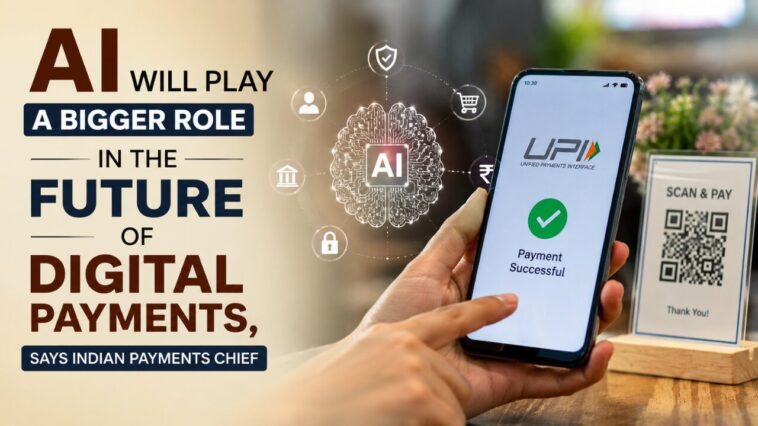
India’s digital payments industry is growing at an incredible pace.
The country’s Unified Payments Interface (UPI) now processes more than 750 million transactions every day. That number continues to rise as more people and businesses adopt digital payments.

The next goal is even bigger.
India wants UPI to handle more than one billion daily transactions.
According to Dilip Asbe, managing director and CEO of the National Payments Corporation of India (NPCI), artificial intelligence will play a major role in reaching that milestone.
He believes AI can help bring hundreds of millions of new users onto the platform while making digital payments safer and more accessible.
AI Could Help Bring the Next 500 Million Users
Speaking during an interview at Mumbai Tech Week 2026, Asbe said AI will become a key part of UPI’s next phase of growth. He said NPCI, the Reserve Bank of India, and the Indian government are working together to expand digital payments across the country.
According to Asbe, AI can help onboard the next 500 million users. It can also strengthen fraud detection.
“We will use AI across every part of the next phase of UPI,” he said.
That includes finding fraud faster. It also means identifying mule accounts used for illegal transactions. AI could also improve access to credit. People and merchants with strong digital payment histories may find it easier to receive loans and financial services.
Read More: Why Flexible Payment Options Have Become Critical for Business Success
Voice AI Could Make Payments Easier
Another area NPCI is exploring is voice technology. India has hundreds of millions of users who speak different regional languages. Asbe believes AI-powered voice assistants could make digital payments easier for many first-time users.
Voice-based systems could simplify onboarding. They could also help people complete transactions without typing. However, Asbe said the technology still needs improvement.
Current voice AI models must become more accurate before they can be widely adopted. NPCI introduced a voice assistant platform in 2023. So far, adoption has remained limited.
Asbe believes the right use cases could eventually make voice an important part of India’s payment ecosystem.
AI Could Transform Financial Services
Around the world, financial companies are adding AI to their products. Some platforms already allow AI agents to assist users with investing and financial planning. India is also exploring similar possibilities.
NPCI has previously demonstrated AI-powered payment experiences with fintech partners. However, large-scale deployment has not yet happened.
Asbe believes AI can become a trusted part of financial services if strong regulations are in place. He said user protection must remain the highest priority.
There should also be clear records showing what instructions users gave AI systems. That would make it easier to resolve disputes if something goes wrong.
India Wants to Build Its Own AI Models
Asbe also sees an opportunity for India to develop its own AI models for financial services. Instead of relying only on large global models, he believes Indian banks and fintech companies can build smaller, specialized language models.
These models could be trained using India’s financial data.
“We believe AI models will be differentiated by the quality of their data,” Asbe said.
India already has one of the world’s richest digital payment ecosystems. That creates a strong foundation for building AI tools designed specifically for Indian users.
According to Asbe, smaller language models could deliver faster, more reliable, and more accurate financial services.
NPCI Is Already Using AI
NPCI has already introduced AI into some of its services. Last year, the organization launched an AI-powered model called FIMI. The system helps users resolve payment disputes. It can also cancel payment mandates and answer customer requests.
According to Asbe, the platform is already serving more than one million users. He added that adoption is growing quickly.
Competition in the UPI Market
While UPI continues to expand, the market remains heavily concentrated. PhonePe and Google Pay currently control more than 80% of all UPI transactions. Indian regulators want to encourage more competition. A proposed rule would limit any single UPI app to 30% market share.
The regulation is expected to take effect on December 31, 2026, unless the deadline is extended again. Asbe said switching between UPI apps is easy because most offer similar features. He believes the biggest challenge for new competitors is finding a sustainable business model.
PhonePe and Google Pay invested heavily to reach their current positions. New companies will likely invest more once stronger revenue opportunities become available.
Read More: Google and PayPal are teaming up to bring smarter AI shopping and payment experiences
BHIM Remains a Strategic Alternative
NPCI also operates its own UPI app called BHIM. The app was separated into its own business in 2024 to help it compete more effectively.
Although BHIM’s transaction volume has increased, its market share remains close to 1%. Asbe said, NPCI is not focused on chasing a specific market share.
Instead, the goal is to provide India with a secure, reliable, and sovereign digital payment platform.
India’s Digital Payments Future
India has become one of the world’s largest digital payment markets. The country’s rapid adoption of UPI continues to attract global attention.
As AI becomes more advanced, NPCI believes the technology can improve security, expand financial access, simplify onboarding, and support the next stage of digital payment growth.
If those efforts succeed, AI could become one of the biggest drivers of India’s digital economy over the next several years.