Hajra Naz
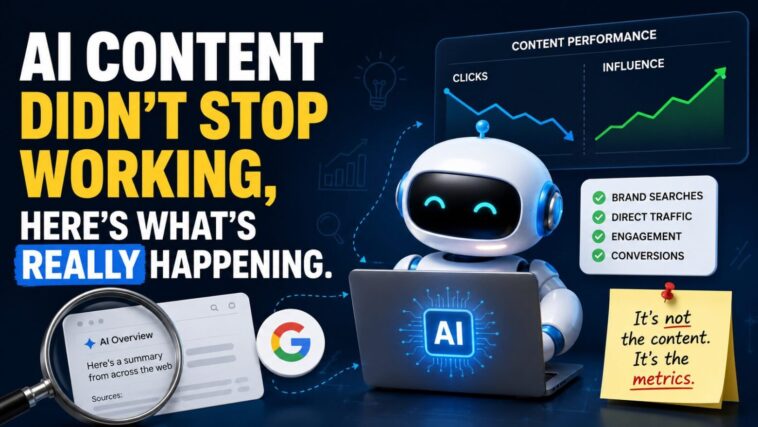
AI content didn’t stop working — the old rule of “more traffic equals better content” broke because AI Overviews and chat assistants now answer questions directly, so success needs to be measured by AI citations and mentions, not just click-through traffic.
For years, content marketers relied on one simple rule. More traffic meant better content.

If a page ranked well on Google, people clicked it. Those clicks appeared in Google Analytics. Teams used that data to measure success. That approach worked for a long time.
Today, it doesn’t.
Many businesses are publishing quality content. Their articles rank well. Their pages appear in search results. Yet traffic stays flat or even declines.
The first reaction is often the same.
“AI content doesn’t work anymore.”
That conclusion is understandable. But it is not always correct.
- The problem may not be your content.
- The problem may be the way you measure its performance.
Search has changed faster than analytics tools have. Google is no longer just a search engine that sends visitors to websites. It has become an answer engine. People often get the information they need without leaving the search page.
That changes everything.
Why Everyone Thinks Their Content Is Failing
Content teams are working harder than ever. They publish detailed guides. They update old articles. They invest in research. They create videos, charts, and original images.
Despite all that effort, monthly traffic reports often look disappointing. Many companies immediately blame AI-generated content. Some stop investing in SEO altogether.
Others believe Google is simply favoring big brands. Neither explanation tells the whole story. The internet itself has changed. People search differently today. Google answers more questions directly.
AI summarizes information before users visit a website. That means fewer clicks. But fewer clicks do not always mean less influence. Your content may still educate readers. It may still build trust. It may still influence buying decisions.
The difference is that those actions are becoming harder to measure.
Read More: How to Create and Publish Quality Content: A Step-by-Step Guide
Zero-Click Searches Are Becoming the New Normal
One of the biggest reasons behind declining traffic is the rise of zero-click searches. A zero-click search happens when someone finds the answer on Google’s results page.
- They never visit another website.
- They never generate a page view.
- They never appear in your analytics.
Research from SparkToro shows that nearly seven out of every ten Google searches in the United States now end without a click. That number has continued to grow.
AI Overviews are one of the biggest reasons. Instead of showing ten blue links, Google now generates summaries. Those summaries answer many questions immediately. For simple searches, users often stop there.
Imagine someone searches,
“What is SEO?”
Google displays a detailed AI summary.
The user reads it. They leave. No website receives a visit. Yet dozens of websites may have contributed information to that answer. Traditional analytics cannot measure that influence.
AI Overviews Changed the Rules
Google’s AI Overviews have completely changed how people interact with search results. Users spend more time reading summaries. They compare information. They scroll through different sources.
Only then do they decide whether clicking is necessary. This is very different from traditional search. Previously, users quickly selected one of the top results. Now the search page itself does much of the work.
Several studies have found that AI-generated summaries reduce organic click-through rates. Some pages lose a significant share of their traffic. That sounds alarming. However, there is another side to the story.
Being cited inside an AI overview can still increase your visibility. Millions of people may see your brand. They simply do not click immediately. That exposure still has value.
- It builds awareness.
- It increases credibility.
- It introduces your brand to new audiences.
Those benefits rarely appear inside Google Analytics.
Read More: Why Your Content Isn’t Showing in AI Overviews (Even If It Ranks in Google’s Top 10)
Traffic No Longer Equals Value
For decades, marketers treated traffic as the ultimate performance metric. More visitors meant better results. Today, that relationship is much weaker.
Imagine two different articles.
The first receives 20,000 visitors. Almost everyone leaves within a few seconds.
- Nobody remembers the brand.
- Nobody subscribes.
- Nobody buys anything.
The second article receives only 5,000 visitors.
- Readers stay longer.
- Many subscribe to the newsletter.
- Several become paying customers.
Which article performed better?
The second one clearly delivered more business value. Yet traditional dashboards often celebrate the first page because it generates more sessions. This is why marketers need new ways to evaluate content.
Traffic still matters. It simply cannot be the only metric.
AI Is Changing User Behavior
Search behavior looks different today. People ask longer questions. They use conversational language. Many search exactly as they would speak to ChatGPT.
Instead of typing,
“best CRM”
they now ask,
“Which CRM is best for a small business with five employees?”
Google’s AI can answer that immediately. Users read the summary first. Then they decide whether additional research is necessary. This creates fewer but more qualified visitors.
Someone who clicks after reading an AI overview usually has a stronger reason to visit.
- They want deeper information.
- They need examples.
- They want pricing.
- They are closer to making a decision.
That means each visitor may actually become more valuable.
Your Analytics Can’t See Everything
This is one of the biggest challenges facing marketers. Analytics platforms measure visits. They do not measure influence. Imagine someone reads your article through Google’s AI Overview. A week later, they remember your company. They search your brand directly. Then they buy your product.
What deserves credit?
The original article influenced the purchase. But analytics often assigns credit to the branded search. The first interaction disappears. This happens thousands of times every day.
Content creates awareness long before someone becomes a customer. AI-powered search is making that effect even stronger. Influence is spreading beyond clicks.
Unfortunately, most dashboards were never designed to measure it.
What Is Really Happening to Your Content?
Many marketers look at declining traffic and assume their content has lost value. That is not always true. In many cases, people are still finding the content.
- They are still reading it.
- They are still learning from it.
The difference is where that interaction happens. Today, much of it happens inside Google’s search results. That makes your influence harder to measure.
Your Content May Be Reaching More People Than Before
Imagine publishing a detailed guide. A few years ago, someone searched for that topic. They clicked on your article. They read it on your website.
Google Analytics recorded the visit. Now imagine the same search today.
Google generates an AI Overview. Your article helps train or support that answer. The user reads the summary. They never visit your website. Your analytics show zero visits.
But your content still helped answer the question. That influence is real. Your dashboard simply cannot measure it. This is one of the biggest changes in modern SEO.
Visibility and traffic are no longer the same thing.
Read More: Why hiring professional writers is still essential for Quality Content Creation
Fewer Clicks Do Not Always Mean Lower Impact
Many websites report lower click-through rates. At first, that sounds like bad news. However, click-through rate only measures one part of the customer journey.
- It does not measure awareness.
- It does not measure trust.
- It does not measure influence.
Suppose your article appears in thousands of AI-generated answers. Millions of users see your brand name. Only a small percentage clicks.
Traditional reports will highlight the low click rate. They will ignore the brand exposure. Yet people remember useful brands. They often come back later.
Some search directly for the company. Others recommend it to friends. These actions happen outside the original search session. That makes them difficult to attribute.
Brand Awareness Is Becoming More Valuable
Modern SEO is no longer only about ranking. It is also about being remembered. Every helpful article increases familiarity with your brand. Someone may discover your company today. They may return next month. Perhaps they subscribe to your newsletter. Maybe they visit your website directly.
Or they search your brand name later. Those visits often convert better than cold search traffic.
Why?
Because people already know who you are. Trust has already started to develop. This is why many SEO experts now pay close attention to branded searches.
If more people search your company name over time, your content is probably creating demand. Even if traffic reports stay flat.
AI Citations Are Becoming the New Ranking Signal
In the past, marketers wanted one thing. The number one ranking. Today, another goal is emerging.
Being cited by AI.
When Google’s AI Overview references your content, your brand gains credibility. Users see your name associated with useful information.
Some studies even suggest that pages mentioned in AI summaries receive better engagement than pages that are not cited.
The click numbers may still be lower than before. But the visitors who do click often arrive with stronger intent. They have already evaluated several sources.
Now they want additional details. Those visitors spend more time reading. They ask better questions. They are often closer to making a purchase.
Quality is replacing quantity.
Why Some Pages Look Like They Failed
Many companies review old content every few months. If traffic drops, they assume the page is no longer useful. Some delete it. Others stop updating it. That can be a costly mistake.
A page can lose traffic for many reasons. Google may answer the basic question directly. AI Overviews may satisfy casual readers. But the page can still influence thousands of potential customers.
- It may continue attracting qualified visitors.
- It may earn backlinks.
- It may strengthen topical authority.
- It may build trust in your brand.
Looking only at page views hides these benefits.
Instead of asking, “How many people clicked?”
Ask another question. “Did this content help my business?”
That answer often tells a different story.
Focus on Engagement Instead of Clicks
Not every visitor behaves the same way. Some leave after ten seconds. Others spend fifteen minutes reading your guide.
Which visitor is more valuable? The answer is obvious. This is why engagement metrics deserve more attention.
Look at:
- Average engagement time
- Scroll depth
- Pages viewed per session
- Newsletter subscriptions
- Repeat visitors
- Demo requests
- Downloads
- Product inquiries
- Purchases
These actions show genuine interest. They also show buying intent. A smaller audience with stronger engagement often produces better business results.
Influence cannot Be Measured With One Number
Marketing has never been completely measurable. People rarely make decisions after seeing something once.
- They research.
- They compare.
- They ask friends.
- They watch videos.
- They read reviews.
- They return later.
Content influences every step of that journey. AI search has made those journeys even more complex. Someone may first discover your article through an AI overview. Later, they watch one of your YouTube videos.
A week afterward, they visit your website directly. Finally, they become a customer.
Which interaction deserves the credit?
There is no simple answer. That is why relying on one KPI no longer works. Successful marketers now combine multiple signals.
- They look at traffic.
- They watch branded searches.
- They monitor direct visits.
- They analyze conversions.
Together, these metrics tell a much clearer story.
Content Still Works. The Rules Have Changed.
AI has not killed content marketing. It has changed how people consume information. The websites that succeed in the coming years will not be the ones chasing page views.
- They will be the ones creating memorable content.
- They will answer questions better than anyone else.
- They will build trust before asking for a sale.
Most importantly, they will understand that influence often happens before the click. That is the biggest shift in SEO today. And it is only beginning.
Read More: The New Era of Quality Content: 6 SEO Tips
Measure Business Impact, Not Just Traffic
Many marketers open Google Analytics first. They look at sessions. They compare monthly visitors. They celebrate traffic increases. Those numbers still have value.
But they no longer tell the complete story. Ask yourself a different question.
Did the content help the business?
That answer matters more.
If an article generates qualified leads, newsletter subscribers, product demos, or sales, then it is successful. It does not matter if traffic is lower than last year.
Business results always matter more than page views. Every content strategy should connect with business goals. Otherwise, you are optimizing numbers instead of outcomes.
Watch Direct Traffic Carefully
Direct traffic is becoming more valuable. People who type your website into their browser already know your business. They are not discovering you for the first time. They are returning.
Returning visitors usually convert better. They spend more time reading. They explore more pages. They are also more likely to become customers.
If direct traffic keeps growing while organic traffic slows, your content may still be performing very well. It simply influences users before they arrive.
Read More: How to Increase Organic Traffic on Your Website (5 SEO Techniques)
Build Content People Can’t Forget
Many websites still publish articles that simply answer simple questions. That strategy worked years ago. Today, Google often answers those questions itself. Instead of repeating information, go deeper.
- Write articles based on real knowledge.
- Share original research.
- Publish case studies.
- Include expert opinions.
- Add personal insights.
- Create useful charts.
- Design calculators.
- Offer downloadable templates.
- Record short videos.
- Build interactive tools.
These resources give people a reason to visit your website. AI summaries cannot fully replace them. The more unique your content becomes, the more valuable it is.
Don’t Delete Pages Just Because Traffic Dropped
Many businesses remove articles after traffic declines. That can hurt long-term SEO. A page with fewer visitors may still perform an important role.
- It may attract backlinks.
- It may appear inside AI overviews.
- It may increase branded searches.
- It may support another page.
- It may introduce your company to future customers.
Before deleting content, review the bigger picture.
Ask questions like:
- Is this page still ranking?
- Does it support other pages?
- Has it earned quality backlinks?
- Does it generate leads?
- Does it improve topical authority?
Sometimes updating the page is a much better option than removing it.
Different Industries Need Different Strategies
Not every website is affected in the same way. Understanding your industry helps you respond correctly.
Publishers
News websites face the biggest challenge. Many readers now get quick answers directly from Google. That reduces ad impressions.
Publishers should focus on exclusive reporting. Opinion pieces. Interviews. Original investigations. Content that AI cannot easily reproduce.
E-commerce Businesses
Product pages remain important. Category pages still convert. The biggest changes affect buying guides. Comparison articles. Review pages.
Businesses should improve these pages with videos. Real customer experiences. Interactive comparison tables. Buying tools.
The goal is to give shoppers something AI summaries cannot provide.
SaaS Companies
Software companies should focus on expertise. Publish tutorials. Detailed walkthroughs. Customer success stories. Industry reports. Original research. These resources build authority. They also encourage high-quality backlinks.
Local Businesses
Local SEO continues to perform well. People are searching for
- Restaurants.
- Doctors.
- Lawyers.
- Home services.
Or nearby stores usually still click. Maintain an updated Google Business Profile. Collect reviews. Answer customer questions. Publish helpful local content.
These activities continue driving valuable traffic.
Final Thoughts
Many marketers believe AI content has stopped working. The evidence tells a different story. Content still influences buying decisions. It still builds trust. It still introduces people to brands.
What has changed is measurement. Traffic alone no longer reflects success. Modern SEO requires a wider perspective.
- Track branded searches.
- Watch direct traffic.
- Measure engagement.
- Monitor conversions.
- Study returning visitors.
- Look for long-term business growth instead of short-term page views.
- Create content that people remember.
- Answer questions better than anyone else.
- Offer insights AI cannot copy.
- Help readers solve real problems.
Those principles worked before AI. They still work today. The companies that understand this shift will continue growing. The ones chasing traffic alone may never see the full value of their content.
In the AI era, success is no longer measured by clicks alone. It is measured by influence, trust, and the actions your content inspires long after the search is over.
Frequently Asked Questions
Why is my content traffic dropping even though it still ranks well?
Google’s AI Overviews and AI assistants increasingly answer questions directly in the results page, so users don’t always click through anymore — even for well-ranking content.
How should content success be measured now?
Alongside traffic, track how often your content gets cited or mentioned inside AI Overviews and chat assistant answers — that’s becoming a real, separate visibility metric.
Last updated: August 2026.